



France's debt bomb
Can the ECB save the Euro?
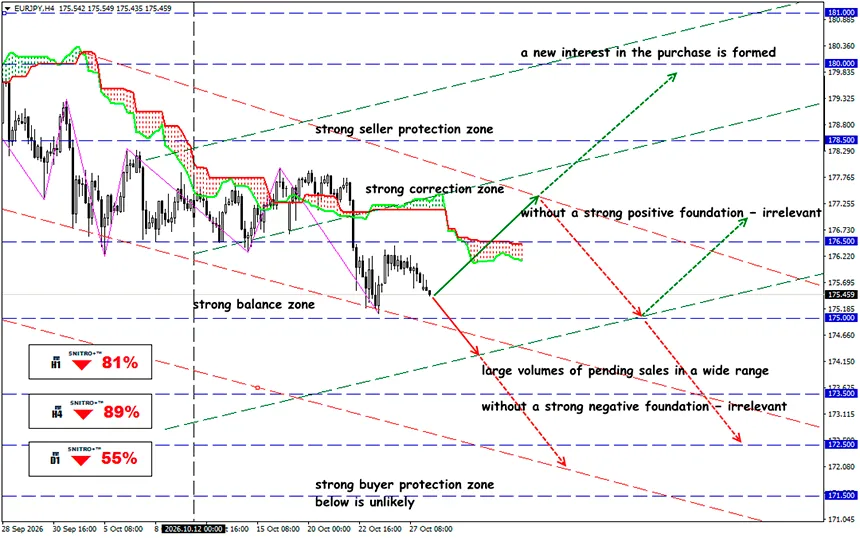
EUR/JPY
Key zone: 175.00 - 176.00
Buy: 176.50 (on strong positive fundamentals); target 178.50; StopLoss 175.80
Sell: 174.50 (on a decisive break above 175.00) ; target 172.50; StopLoss 175.20
French bond yields have approached 5%, while the yield spread over Germany has exceeded 150 basis points. Sovereign debt risk is triggering another wave of selling. Traders must assess the probability of a Eurozone collapse and the outlook for all euro-related assets.
Europe recognizes that rising interest rates no longer guarantee a stronger single currency. French government bond yields are climbing, investors are demanding an additional premium for fiscal and political risks, and the ECB is trying to contain inflation while preventing disruptions in the sovereign debt market.
Unfortunately, on October 28, the yield on 10-year French OATs reached approximately 4.965%, while comparable German Bunds traded around 3.382%. The difference was approximately 158.3 basis points.
A quick recap:
When OAT yields rise faster than Bund yields, the market is signaling an increase in the France-specific risk premium rather than merely a general tightening of financial conditions across Europe. However, a full-blown crisis would require additional warning signs: selling spreading to other countries, deteriorating liquidity, problems placing new bond issues, and stress in the banking system. For now, the contagion remains predominantly French rather than a full-scale repeat of the 2010–2012 sovereign debt crisis. Nevertheless, the market considers such contagion a very real possibility.
France's deficit significantly exceeds the 3% of GDP benchmark established by European fiscal rules. Budgetary pressure increases as old bonds mature and new ones are issued.
This process could create a self-reinforcing cycle of rising debt-servicing costs.
There are currently no signs of a complete loss of market access. According to LSEG, France issued €13.25 billion in bonds at its October 15 auction, with an aggregate bid-to-cover ratio of 2.28. This indicates that demand remains intact, although investors are still dissatisfied and demand higher yields.
Social protests in France are becoming an additional factor complicating the implementation of fiscal policy.
Following widespread unrest on October 17–18, French stocks and bonds came under pressure. On the morning of October 19, the CAC 40 was down approximately 1.18%, while the yield on 10-year OATs stood around 4.84%. Domestically focused companies, including retailers, hospitality businesses, and banks, were particularly sensitive.
A major development was Moody's rating decision on October 23. The agency maintained France's sovereign rating at Aa3 with a negative outlook. This temporarily eased concerns about an immediate downgrade but did not resolve the structural problems.
Tomorrow, October 29, the ECB will hold its next policy meeting, with three fundamentally different potential reactions.
- The ECB keeps rates unchanged and reaffirms its hawkish stance on inflation. Short-term European bond yields could receive support, while EUR/USD and EUR/JPY could stage a temporary recovery.
- The ECB keeps rates unchanged and emphasizes financial stability risks. Markets may begin scaling back expectations of future tightening. This would potentially be negative for the euro but positive for government bonds.
- The ECB explicitly discusses tools to counter market fragmentation. Such rhetoric could narrow the OAT/Bund spread and reduce the European risk premium.
So What Is the Outcome?
For the euro, what matters is not the political protests themselves, but their impact on the likelihood of passing a budget, the cost of government financing, and the stability of the banking sector.
If parliamentary disagreements in France delay budget decisions, investors may demand an additional risk premium even without another sovereign rating downgrade.
The French debt factor could have a stronger impact on EUR/JPY than on EUR/USD if European risks simultaneously trigger a reduction in carry trades and increased demand for safe-haven assets.
At the same time, traders must account for the Bank of Japan's decision and potential changes in expectations for Japanese monetary policy.
So we act wisely and avoid unnecessary risks.
Profits to y’all!


