














Digital stocks or trading capital on the blockchain
Tokenized stocks as the new market standard
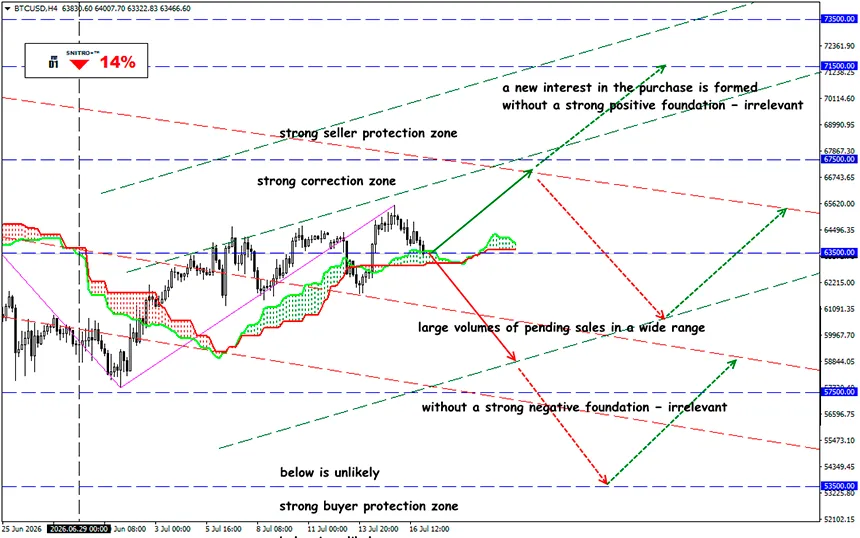
BTC/USD
Key zone: 61,500 - 65,500
Buy: 66,000 (on strong positive fundamentals); target 69,500-71,500; StopLoss 65,000
Sell: 61,000 (on a decisive break above 61,500) ; target 57,500-55,500; StopLoss 65,000
Financial markets operate like any traditional business—with regulations, weekends, and holidays—but capital never stops moving. Economic events, geopolitical developments, mergers, and acquisitions continue to influence stock prices even when exchanges are closed. For the most active investors, tokenized assets offer an alternative.
The market for tokenized stocks is expanding rapidly. According to RWA.xyz, as of July 2026, the value of tokenized public equities on the blockchain had reached approximately $1.8 billion, while monthly transfer volume was close to $8.8 billion.
Reminder:
A tokenized stock is a digital token issued on a blockchain that represents rights linked to shares of a publicly traded company. Depending on the issuer, each token is typically backed 1:1 by the corresponding share held by a regulated custodian.
One of the most significant developments has been the launch of xStocks, a tokenized equities platform backed by Kraken that is rapidly expanding its distribution network. Investors gained access to more than 130 tokenized U.S. stocks and ETFs alongside cryptocurrencies and other tokenized real-world assets. The platform states that its tokenized stocks are backed by the underlying securities on a 1:1 basis and can be traded 24 hours a day.
Tokenization has the potential to make capital markets more efficient by enabling near-instant settlement, fractional ownership, and broader global access to financial assets. Critics argue that the technology still depends on trusted intermediaries and operates within a regulatory framework that is still evolving.
How do tokenized stocks work?
- The price of a token is intended to track the market value of the underlying security as closely as possible. Instead of purchasing shares through a stock exchange, investors buy blockchain-based tokens. Transactions are recorded on the blockchain, allowing users to store and transfer tokenized assets in much the same way as cryptocurrencies.
- The exact structure varies depending on the issuer, making it important to understand precisely what a specific token represents. Some products can be redeemed for the underlying asset or its cash equivalent, while others simply provide economic exposure to changes in the stock's price.
The key difference between tokenized stocks and traditional listed shares lies in ownership rights. Investor rights depend on the product's legal structure rather than on blockchain technology itself.
When investors buy shares through a brokerage account, they become shareholders of the company. Tokenized stocks, by contrast, provide access to those shares through a blockchain-based token issued by a third party.
Traditional shareholders may receive dividends, vote on corporate matters, and participate in other shareholder activities. With tokenized stocks, these rights depend on the issuer and the legal structure of the product.
Therefore, investors considering tokenized stocks should evaluate not only the company itself but also the issuer, custody arrangements, and the rights associated with each token.
Regulation remains another key consideration. The availability of tokenized stocks, as well as the rights they provide, can vary significantly depending on the platform and jurisdiction.
What does this mean?
Tokenized stocks may be available outside regular market hours, support fractional ownership, and allow users to manage stocks alongside cryptocurrencies within a single wallet.
Tokenized stocks broaden access to capital markets, but they should not be viewed as digital copies of conventional shares. They provide an alternative way to gain exposure to publicly traded companies, yet their legal structure, investor rights, and regulatory protections often differ from those associated with direct share ownership. As this market matures, understanding these differences may prove even more important than the technology itself.
So we act wisely and avoid unnecessary risks.
Profits to y’all!


