



Bitcoin's freedom under threat
A Political shift is changing the rules
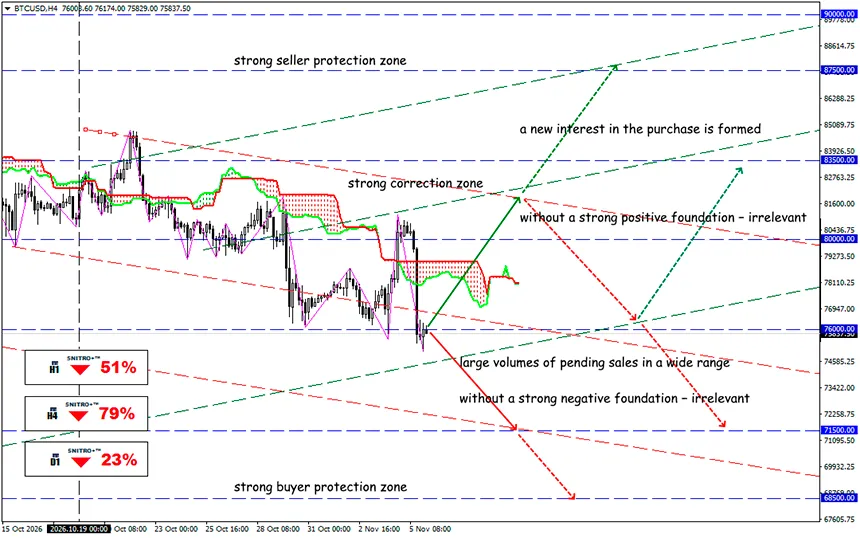
BTC/USD
Key zone: 76,000 - 78,500
Buy: 80,000 (on strong positive fundamentals); target 83,500-85,500; StopLoss 79,000
Sell: 75,500 (on a pullback following a retest of 76,500) ; target 71,500; StopLoss 76,500
Democrats gain control of the US Congress, and the outlook for cryptocurrency regulation is becoming clearer. BTC is attempting to recover alongside the Nasdaq, but dollar liquidity and the fate of the CLARITY Act remain risk factors. It is still unclear whether speculative momentum can turn into sustained growth.
The midterm elections on November 3, 2026, changed the political balance in Washington. Markets have already begun reassessing the likelihood of key cryptocurrency legislation being passed.
A reminder:
The initial reaction was negative. Poor Bitcoin briefly fell to $75,600–75,700, while Nasdaq-100 futures lost about 2.3%. Investors feared that the new political leadership would complicate the passage of legislation favorable to the crypto industry.
The market effectively demonstrated two opposite reactions to the same political event. Initially, regulatory risk dominated, followed by reduced political uncertainty and a recovery in global risk appetite.
The main question is whether the cryptocurrency market can continue rising alongside technology stocks if the industry's legislative prospects are deteriorating at the same time.
- The relative resilience of Ethereum and Solana during the recovery shows that market participants are willing to return to riskier crypto assets. However, their greater sensitivity to speculative demand simultaneously increases potential losses if sentiment deteriorates again.
- An additional signal came from US spot ETFs. After three days of capital outflows estimated at approximately $1.16 billion, Bitcoin funds recorded net inflows of around $74.6 million on November 4. Ethereum ETFs attracted approximately $53 million.
- This is a positive change, but one day is insufficient to confirm sustained institutional demand. Inflows into BTC ETFs offset only about 6.4% of the preceding three-day outflows.
Consequently, the recovery should currently be viewed as an attempt to stabilize after the sell-off rather than proof that the correction has ended.
The main political factor remains the fate of the Digital Asset Market Clarity Act, known as the CLARITY Act. The bill is intended to establish a federal regulatory framework for digital assets, delineate the powers of the SEC and CFTC, and define the legal conditions under which cryptocurrency intermediaries operate.
According to Polymarket data published on November 5, the probability of legislation establishing a cryptocurrency market structure being passed before the end of 2026 declined from 8.45% before polling stations closed to 6.6%. This change of 1.85 percentage points reflects the assessment of prediction market participants, not the official probability of a legislative decision.
For BTC, institutional demand, liquidity, and access to regulated investment products remain key factors. Legislative changes may affect trading infrastructure, but the direct regulatory risk for BTC differs from the risk faced by platforms and tokens with more complex legal classifications.
For BTC, institutional demand, liquidity, and access to regulated investment products remain key factors. Legislative changes may affect trading infrastructure, but the direct regulatory risk for BTC differs from the risk faced by platforms and tokens with more complex legal classifications.
BTC's short-term performance largely depends on funding conditions and global risk appetite. An important source of uncertainty is the movement of funds between the banking system and the US Treasury's account, the Treasury General Account (TGA). And keep in mind that for BTC, it is not only the absolute level of dollar liquidity that matters, but also the direction of its change.
So What Is the Outcome?
Democratic control of Congress increases uncertainty surrounding the CLARITY Act, but does not automatically mean a shift toward any prohibitions. At the current stage, cryptocurrencies remain sensitive to the overall condition of the US stock market. Regulatory uncertainty is an additional risk factor, not the sole reason for the decline.
We do not recommend buying BTC solely on the recovery of the stock market. Following the November 5 decline, priority should be given to a confirmed return of the price above $80,000 and stabilization of ETF flows. Until then, rebounds may remain corrective. If the positive scenario is confirmed, the $82,000 area serves as a target.
Sustained underperformance of BTC during a Nasdaq recovery could signal cryptocurrency-specific risk, but does not in itself guarantee further declines.
So we act wisely and avoid unnecessary risks.
Profits to y’all!/p>


