


















Bitcoin vs. global capital
Who controls the future of money?
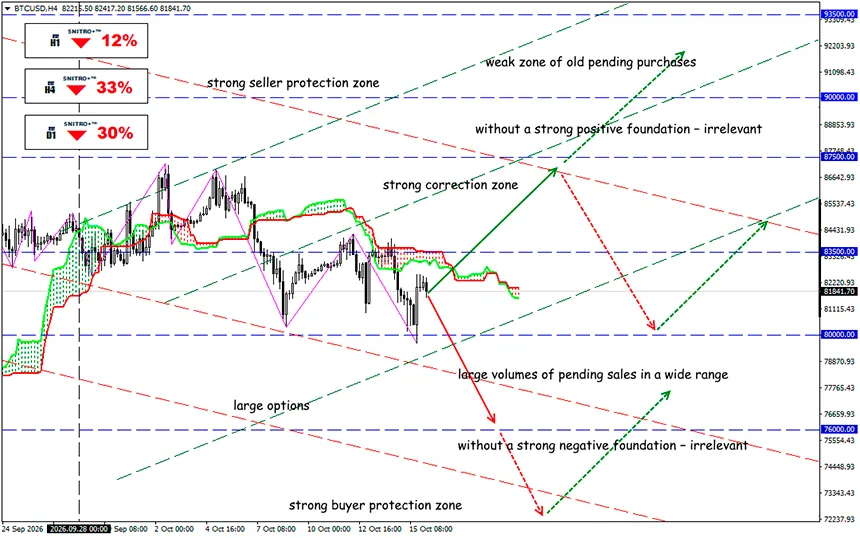
BTC/USD
Key zone: 81,000 - 83,000
Buy: 83,500 (on a confident break above 83,000); target 86,500-87,500; StopLoss 82,500
Sell: 80,000 (on strong negative fundamentals) ; target 76,500-75,000; StopLoss 81,000
Bitcoin is transforming from an alternative payment instrument into a strategic financial asset. But institutionalization creates new risks: dependence on fund capital, Federal Reserve policy, and corporate debt. U.S. policy, institutional capital, and limited supply are changing the rules of the game.
The central contradiction of today's BTC market lies in the changing structure of demand. Bitcoin has become part of the system it was created to oppose.
A quick recap:
Cryptocurrency was created as a decentralized system for transferring value without banking intermediaries. Today, a significant share of investment demand is generated through exchange-traded funds, publicly traded companies, and regulated financial infrastructure.
For participants in today's market, this means a change in the pricing mechanism. Limited issuance remains Bitcoin's fundamental advantage, but short-term price movements are increasingly determined by global liquidity, borrowing costs, ETF flows, and institutional investors' appetite for risk.
In other words, the technical decentralization of the network does not guarantee that BTC's market price is independent of the traditional financial system.
And the most relevant failure of Bitcoin's independence policy has been U.S. policy: Washington created a reserve but did not ensure sustained demand.
- Donald Trump's policies have indeed changed the institutional status of cryptocurrencies. However, it is essential to distinguish between political support for the industry, the creation of a legal framework, and actual government investment.
- The executive order establishing the U.S. Strategic Bitcoin Reserve primarily provides for the use of BTC acquired by the government through confiscations. Establishing the reserve does not automatically mean purchasing cryptocurrency on the open market.
This distinction is fundamental to assessing demand. Retaining coins already owned by the government reduces potential supply but does not create the same buying pressure as regular BTC purchases using budget funds.
An additional effect of U.S. policy is related to stablecoin regulation. The GENIUS Act, adopted in 2025, establishes a federal regulatory framework for payment stablecoins. This facilitates the integration of digital assets into dollar-based infrastructure but does not guarantee BTC appreciation.
In effect, Washington supports the development of a regulated cryptocurrency market while simultaneously strengthening the dollar's role in digital payments.
So What Is the Result?
How can anyone speak of cryptocurrency independence when strong U.S. macroeconomic indicators have become a direct source of pressure on BTC by raising expectations of tighter Federal Reserve policy? Under restrictive monetary conditions (and not just in the United States!), BTC remains sensitive to changes in Treasury yields and the repricing of risky assets.
Moreover, the cryptocurrency market as a whole is under pressure from technology stock sell-offs driven by concerns about debt financing for AI infrastructure.
Thus, no amount of government recognition of cryptocurrency has yet ensured widespread demand for its use in payments. BTC's investment value is determined primarily by capital holders' willingness to keep it in their portfolios, rather than by the number of merchants accepting cryptocurrency.
Of course, Bitcoin is gradually acquiring the characteristics of an international reserve investment asset, but it has not yet demonstrated the ability to consistently function as a settlement currency or a safe-haven instrument during liquidity crises.
U.S. cryptocurrency policy has created important legal prerequisites for the industry's further development. The main threat lies not in the limitations of the technology but in the financial architecture taking shape around it: leverage, corporate debt, concentration of custody, and potential forced selling.
So we act wisely and avoid unnecessary risks.
Profits to y’all!


