

















Bitcoin seeks protection
Major capital invests in BTC security
BTC/USD
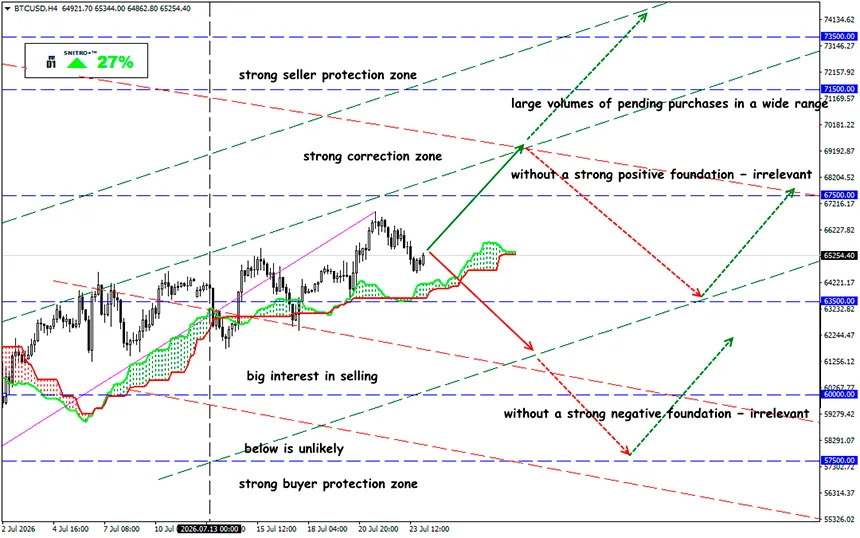
Key zone: 63,500 - 66,000
Buy: 66,500 (on a pullback after a retest of 65,000); target 69,500-71,500; StopLoss 65,500
Sell: 63,000 (on strong negative fundamentals); target 59,500-58,500; StopLoss 64,000
Nine major companies have joined forces to establish the Bitcoin Security Consortium, which will allocate $15 million over the next three years to Bitcoin security research and the development of open-source software.
To recap:
The rapid progress in quantum computing has prompted cryptocurrency companies and blockchain developers to assess how vulnerable digital wallets and transactions could become. Most blockchains rely on legacy cryptography, using elliptic curve cryptography to generate public and private keys, as well as digital signatures that verify ownership and authorize transfers.
If a sufficiently powerful quantum computer is able to derive a private key from a public key, attackers could forge digital signatures and execute fraudulent transactions. This represents a particularly serious risk for public cryptocurrency networks, where transactions are irreversible.
- According to Google research, quantum computers could be capable of breaking blockchain cryptography by 2029, increasing the urgency of implementing quantum-resistant upgrades.
- Estimates, including an unpublished paper from June 2026, suggest that 35–50% of the tokens currently in circulation could become vulnerable to quantum attacks, creating the risk of severe price shocks and broader market contagion.
- None of the top 20 blockchain networks has implemented post-quantum signature algorithms. Ethereum plans to achieve full quantum resistance by 2029, while Algorand intends to introduce post-quantum accounts later this year.
The founding members of the Bitcoin Security Consortium include BlackRock, Coinbase, Strategy, Anchorage Digital, ARK Invest, Block, Blockstream, Fidelity Digital Assets, and Galaxy. The consortium's primary objective is to prepare the Bitcoin network for potential threats posed by quantum computers.
- The consortium plans to regularly publish reports for investors and the broader public on the state of Bitcoin security and the progress of related research.
- The group will not pool or centrally manage the announced $15 million. Instead, each participant will independently decide which developers, researchers, or projects will receive funding. The initiative is expected to increase financial support for projects focused on the long-term security of the Bitcoin network.
- One of the proposed solutions under discussion is BIP 360. It introduces a new transaction output type designed to reduce the period during which public keys remain exposed to potential attacks.
- Developers are also exploring post-quantum digital signature schemes and methods to protect coins held in legacy addresses whose public keys have already been revealed.
The consortium's operations will be coordinated on a voluntary basis by Brink Executive Director Mike Schmidt.
So, what does this mean?
The decision by major industry players to unite signals that the market is moving beyond merely discussing quantum risks and is beginning to prepare for them in practice. For investors, this is generally a positive development, as the industry is proactively building the infrastructure needed to protect the network.
In the short term, the initiative is unlikely to have a meaningful impact on Bitcoin's price. However, over the long run, it strengthens the investment case for BTC. Systematic efforts to improve post-quantum security reduce one of the network's most significant technological risks.
So stay disciplined and avoid taking unnecessary risks.
Wishing everyone profitable trades!


