



Binance hack or a controlled catastrophe?
The largest crypto theft threatens another wave of sell-offs
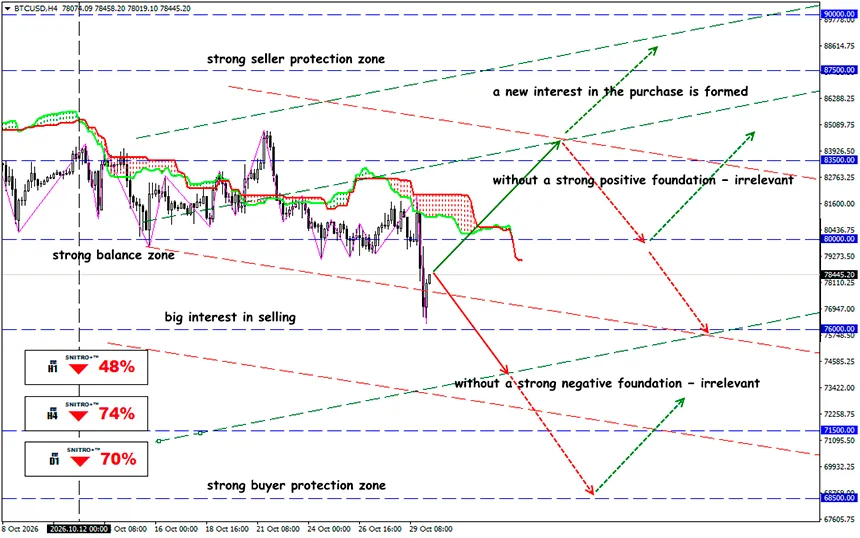
BTC/USD
Key zone: 78,500 - 80,000
Buy: 81,500 (on strong positive fundamentals); target 85,500-87,500; StopLoss 80,500
Sell: 76,500 (on a pullback following a retest of 80,000); target 71,500; StopLoss 77,500
Freezing billions of dollars in crypto assets prevented the immediate liquidation of some stolen funds, but it did not eliminate the risk of a crisis of confidence. North Korean hackers, vulnerabilities in Binance's infrastructure, and threats to liquidity are changing the rules of the game.
Efforts to completely stop the sale of stolen Bitcoin and Ethereum have so far been unsuccessful. The primary risks now are a crisis of confidence in Binance and a potential liquidity breakdown.
A quick recap:
On October 29, 2026, Binance suffered an unprecedented cyberattack. The attackers drained crypto assets from wallets across ten blockchains. Most transfers occurred within approximately 20 minutes, beginning at 20:05 GMT. Additional transactions were recorded later.
On the morning of October 30, Binance officially estimated the scale of the incident at approximately $6.3 billion, reported that around $3 billion had been frozen, and pledged to cover losses using its own capital and the SAFU insurance fund. The exchange temporarily suspended deposits and withdrawals while conducting a security review.
Stablecoin issuers were the first to intervene to protect the market. Tether and Circle froze more than $2.3 billion in stolen funds.
- Tether blocked more than 1.567 billion USDT, along with another 200 million USDT held in corporate wallets.
- Circle restricted access to approximately 800 million USDC and continues to assist the investigation.
- Aave froze lending markets to prevent the hacker from borrowing against stolen assets.
Stablecoins proved to be an effective intervention mechanism: centralized issuers were able to immobilize a substantial portion of the stolen funds, something that would not have been possible with Bitcoin.
Of course, temporarily restricting access to assets is not the same as recovering funds. The remaining $3.3 billion should not automatically be treated as an irrecoverable loss either. The market received another reminder that USDT and USDC do not offer the same degree of censorship resistance as native BTC or ETH.
The risk of another sharp decline in major token prices remains. Hackers still control more than 420,000 ETH and 18,270 BTC, with a combined estimated value of approximately $2.4 billion. These assets cannot be frozen through an issuer's administrative decision. Their movement and speculative liquidation create additional risks.
What Does This Mean for the Market?
Binance states that there is currently no evidence of private-key exposure, but a final technical report has not yet been published. The central question is not the amount stolen, but whether Binance can restore operations, preserve liquidity, and verify the size of its reserves.
The theft triggered declines in major cryptocurrencies and widespread liquidations of leveraged positions.
Trading recommendations:
- Reduce overall risk. Until the situation becomes clearer, consider limiting risk per position to 0.25–0.5% of capital and total open risk to approximately 1–2%.
- Manage exchange exposure. Distribute trading capital across independent platforms, avoid excessive balances on centralized exchanges, and do not concentrate all capital in USDT and USDC.
- Monitor on-chain flows. Pay particular attention to movements of stolen BTC and ETH, transfers to centralized exchanges, large DEX swaps, and changes in the attacker's wallet structure.
- Monitor derivatives markets. Track funding rates, open interest, basis, and liquidation volumes. Negative funding combined with price stabilization may create conditions for a short squeeze, but it is not a buy signal on its own.
- Do not buy the dip without confirmation. During periods of uncertainty, prioritize capital preservation, low leverage, and entries following a confirmed recovery in market structure.
The base-case outlook remains cautiously bearish as long as BTC trades below $80,000.
So we act wisely and avoid unnecessary risks.
Profits to y’all!


