



Betting on zero or playing against Trump
The U.S. congress raises the level of risk
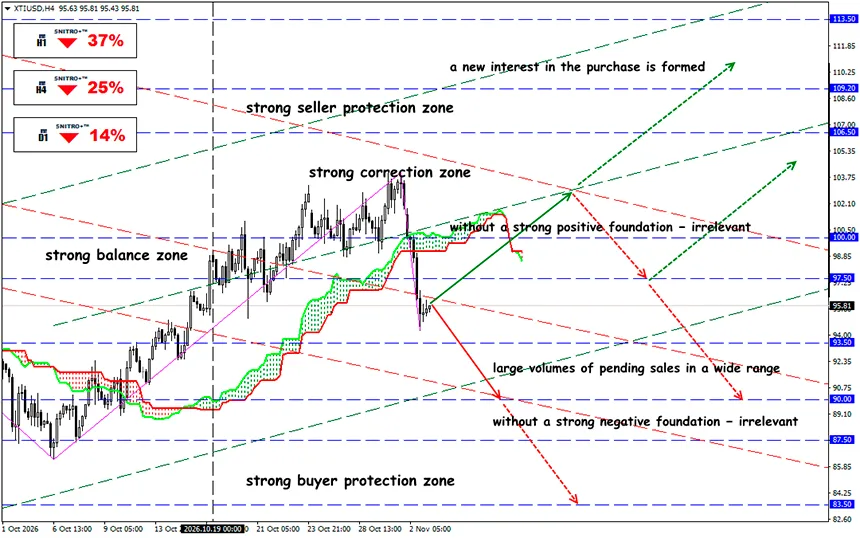
XTI/USD
Key zone: 94.50 - 97.50
Buy: 97.50 (on a decisive break above 96.50); target 101.50; StopLoss 96.80
Sell: 93.50 (on strong negative fundamentals); target 90.00; StopLoss 94.20
The U.S. midterm elections could change the balance of political risks in global markets. Republicans losing control of Congress would complicate the implementation of Trump's economic agenda, but would stop neither tariff wars nor actual wars.
A reminder:
Today, U.S. voters will determine the balance of power in Congress for the final two years of Donnie's presidential term: all 435 seats in the House of Representatives and 35 of the 100 Senate seats are up for election. Before the vote, Republicans retain majorities in both chambers: 218 seats versus 214 for Democrats in the House of Representatives (with one independent member and two vacancies), and 53 versus 47 in the Senate when independent senators who caucus with Democrats are included.
To gain control, Democrats need a net gain of four seats in each chamber.
The economic question is not only the president's ability to implement tax reforms, increase military spending, and support deregulation. It concerns the future of American protectionism, budget restrictions, and the cost of financing government debt.
We Need to Distinguish Between Losing Legislative Support and Losing Presidential Powers.
Even if Democrats gain majorities in both chambers, Trump will retain his veto power, significant executive authority, and the ability to use existing trade laws to impose tariffs. Overriding a presidential veto requires a two-thirds majority in each chamber.
Therefore, a change in the majority does not mean the automatic cancellation of tariffs. Above all, it changes the mechanisms of political oversight and the negotiating positions of the parties.
The key question for financial markets is how strongly the new Congress will be able to restrict further increases in import tariffs.
According to Reuters on November 1, Democrats are considering revising certain presidential tariff powers, including provisions of Section 122 of the Trade Act of 1974 and Section 338 of the Tariff Act of 1930. Measures under discussion include repealing certain tariffs, refunding collected payments, and strengthening congressional oversight of tariff exemptions.
This is where three channels of market impact emerge.
- Inflationary: Reducing import barriers could potentially lower costs for U.S. companies and price pressures on consumers, although political statements alone do not change existing tariffs. Sustained disinflation requires actual changes in legislation, executive decisions, or judicial practice.
- Corporate: Companies dependent on imported components, international supplies, and foreign markets are sensitive to trade restrictions. The prospect of tariff easing could support their valuations, while new trade conflicts increase uncertainty in earnings forecasts.
- Fiscal: A divided Congress could make it more difficult to agree on spending, tax initiatives, and increases in the government debt ceiling. For the bond market, this creates the risk of renewed political crises over government funding.
And What Was the Result?
The elections could change the market, but not its fundamental problems.
Restricting Trump's trade agenda does not necessarily mean a weaker dollar or a rising stock market, for which the consequences for corporate earnings, the cost of capital, and government spending are important.
For oil, the determining factor remains the development of the conflict with Iran. For gold, it is real interest rates, the dollar, and the geopolitical premium. For BTC, it is global liquidity and regulatory expectations. The elections affect these variables but do not replace them.
Regardless of the voting results, the main medium-term risk is associated with the coming year: budget negotiations, government debt, the president's trade powers, and the financing of defense programs could trigger a more prolonged repricing of assets than the vote itself.
Our task is to get a feel for changes in fundamental expectations, as well as the movements of DXY, real UST yields, gold, oil, and the S&P 500.
So we act wisely and avoid unnecessary risks.
Profits to y’all!


