



Australia vs. the Fed: AUD has a chance
Chinese demand and global risks could derail the rally
AUD/USD
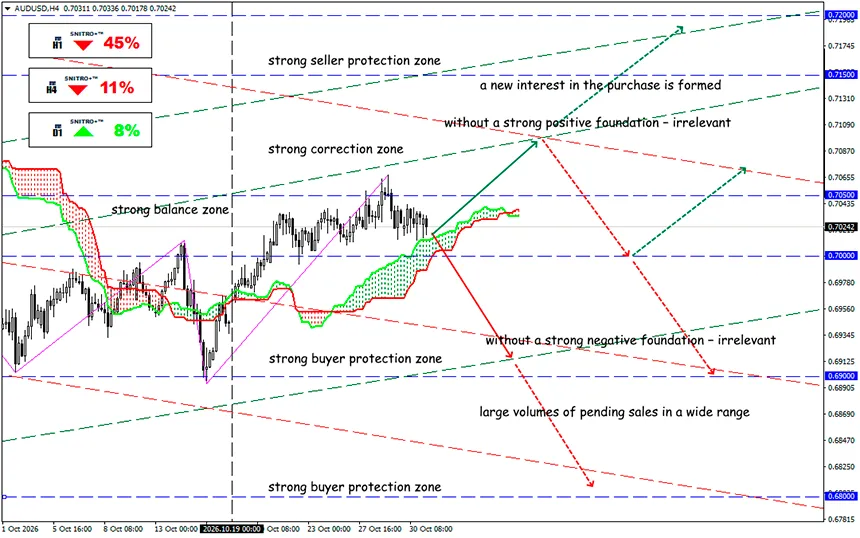
Key zone: 0.7000 - 0.7050
Buy: 0.7050 (on strong positive fundamentals) ; target 0.7150-0.7200; StopLoss 0.7000
Sell: 0.6950 (on a confident break of 0.7000) ; target 0.6800; StopLoss 0.7000
An interest rate adjustment to 4.85% could strengthen the AUD — the RBA is ready for a decisive move, while U.S. monetary policy is following a different path. Diverging yields create opportunities for Asian currencies, but Chinese demand and oil could change the balance of risks.
The Australian dollar enters November with a strong domestic fundamental factor — elevated inflation, which is forcing the RBA to continue tightening monetary policy. However, the currency market has already largely priced in a rate hike on November 3.
A reminder:
The current interest rate is 4.60%, and a 25-basis-point increase would bring it to 4.85% — the fifth monetary policy tightening in 2026.
- According to the Australian Bureau of Statistics (ABS), annual inflation accelerated to 4.3% in September, compared with 4.0% in August.
- Trimmed mean inflation, which excludes the most volatile components, reached 3.6%.
- The quarterly core inflation measure stood at 3.7% year over year.
All these figures exceed the RBA's 2–3% target range.
However, monetary tightening is always accompanied by economic risks. Unemployment reached 4.7% in September, its highest level in five years, consumption is slowing, and housing prices are falling.
The RBA continues to raise interest rates, while the Fed is keeping its rate unchanged for now, retaining the possibility of further tightening.
If the RBA raises its rate to 4.85% on November 3, the nominal differential relative to the upper bound of the Fed's rate will increase from 60 to 85 basis points.
This supports the Australian dollar through three channels:
- An increase in the relative yields of Australian instruments.
- Greater attractiveness of the AUD in carry trade strategies.
- A reassessment of expectations for the future path of interest rates and forward exchange rates.
However, rising yields do not guarantee currency appreciation. If U.S. inflation accelerates and U.S. Treasury yields rise, the dollar could retain its advantage due to demand for liquidity and safe-haven assets.
China remains the main external risk for the AUD, as it is the primary market for Australian commodity exports.
The most direct channels of influence on the AUD are associated with iron ore, coal, and liquefied natural gas (LNG). Copper serves primarily as an indicator of global industrial demand, electrification, and the investment cycle, rather than as the main export driver of the Australian currency.
Two opposing scenarios are possible:
- Recovery in Chinese demand. Improving PMI, rising infrastructure investment, and stabilization of the construction sector will support industrial metals and the AUD. Combined with further RBA tightening, this could create sustained upward momentum.
- Continued industrial downturn. Weak new orders, declining construction activity, and reduced commodity imports could increase pressure on copper and iron ore. In this case, even a high Australian interest rate does not guarantee AUD appreciation.
For copper trading, the RBA's decision itself is of secondary importance. More important are Chinese physical premiums, LME and SHFE warehouse inventories, trends in concentrate imports, and global supply conditions.
At the time of the RBA decision, it is advisable to wait for the market's initial reaction and the press conference before assessing whether the move is sustainable. For event-driven positions, it is reasonable to limit risk per trade to 0.5–1% of capital, taking into account slippage and possible price gaps.
And What Was the Result?
China will limit the Australian dollar's upside range. If Chinese industry continues to slow, AUD gains could prove short-lived regardless of the RBA's decision.
A position based on AUD appreciation should not rely on a single RBA rate hike, but on the alignment of three conditions — Australia's continued interest rate advantage, resilient global risk appetite, and stabilization of Chinese commodity demand. Without these confirmations, the probability of a false upward move after the meeting remains high.
So we act wisely and avoid unnecessary risks.
Profits to y’all!


