

















Apple unveils an iPhone for cryptocurrencies
iPhone duo smartphone as a crypto trading terminal
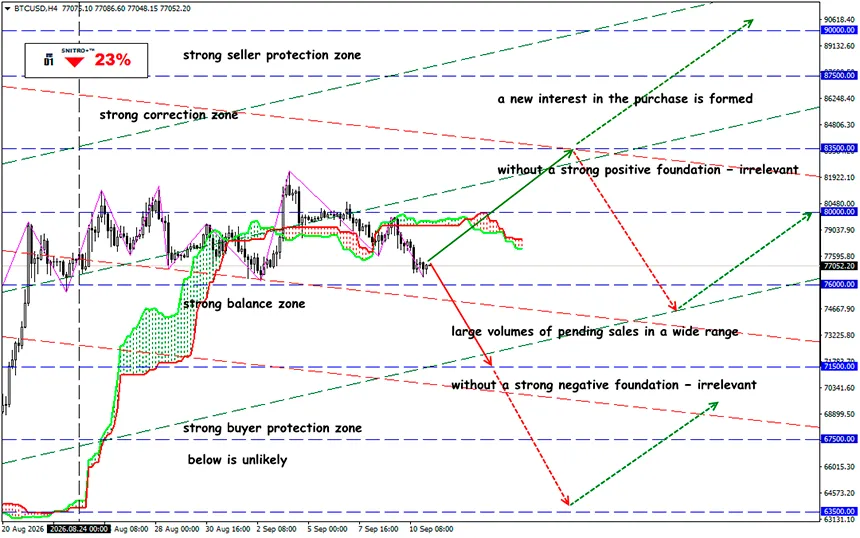
BTC/USD
Key zone: 76,000 - 78,500
Buy: 80,000 (on strong positive fundamentals); target 83,500-87,500; StopLoss 79,000
Sell: 75,000 (on a pullback following a retest of 76,500) ; target 71,500; StopLoss 76,000
Apple unveiled a new iPhone lineup, with its first foldable smartphone becoming the biggest surprise. Once again, not a word was said directly about digital assets, although the company has been moving closer to cryptocurrencies for many years, only to stop one step short of direct integration each time.
A reminder:
The industry leader did not add Bitcoin/USDC or its own wallet to the iPhone Duo, but the new foldable smartphone unexpectedly attracted the attention of the crypto industry. The interest is linked to the new form factor — a large screen, multitasking, and NFC infrastructure open to third-party payment solutions make the Apple ecosystem more convenient for trading and digital payments.
Inside is the A20 Pro. iOS 27 has been specifically adapted for the foldable form factor, while the interface makes it possible to work more efficiently with multiple apps and windows. This particular feature is of the greatest practical interest to active traders: a chart, trading terminal, news feed, or portfolio can all be located in a single workspace.
Crypto companies reacted to the iPhone Duo almost immediately.
- Gemini announced that its services are compatible with the new device, although no separate partnership with Apple was announced.
- Coinbase went further from a marketing perspective: the exchange played on the size of the foldable display by placing a huge monthly Bitcoin candle on it, joking that a phone capable of fitting it had finally arrived.
- Bitcoin Magazine highlighted how the price of an iPhone in bitcoins has changed over the years. According to the publication’s calculations, in the early 2010s an Apple smartphone could cost dozens of BTC, whereas today the price is already measured in hundredths of a coin.
Apple has not yet introduced its own crypto wallet, blockchain, or token — and this is fundamental. Moreover, Apple does not plan to purchase digital assets for its corporate balance sheet.
This makes it possible to create custom contactless payment scenarios within third-party apps without being limited to the traditional Apple Pay model.
Apple’s current rules allow apps for storing virtual currencies provided that developer requirements are met. Crypto exchanges may conduct digital asset transactions in countries where they hold the necessary licenses and permissions. Mining directly on the device, by contrast, is prohibited — computations must be performed outside the iPhone.
So, What Does This Mean?
AAPL’s initial reaction was mixed. After the Duo announcement, the stock initially gained: during the first 30 minutes after the news, the increase reached approximately 1.26%, and after an hour — 1.94%. However, on September 9, the stock closed at $315.34, losing 0.28% during the session. On September 10, the shares were already rising again by approximately 1.4%.
Product hype alone is not enough for a sustained revaluation of market capitalization. Investors need sales, margins, and evidence of a new revenue stream.
Apple’s presentation did not create an immediate fundamental driver for BTC or ETH. Therefore, buying Bitcoin solely on the basis of the iPhone Duo launch is a weak trading idea.
But there is a longer-term chain:
iPhone → open NFC/Secure Element → third-party crypto wallets → stablecoin payments → more convenient mobile transactions → potential growth in the mass adoption of digital assets.
BTC and ETH: There is currently no direct relationship between Duo sales and the value of the largest cryptocurrencies. Using Apple’s presentation as a standalone signal for opening a BTC/ETH position is not advisable. Official announcements of digital asset support at the iOS system level or major payment integrations would be much stronger signals.
If USDC, EURC, or other regulated stablecoins are able to use the iPhone’s hardware capabilities, this would be a qualitatively more important event than the appearance of a separate “Crypto” button in Apple Wallet.
So we act wisely and avoid unnecessary risks.


