












A new front in the technology war
Sanctions against Chinese AI could disrupt the Global Market
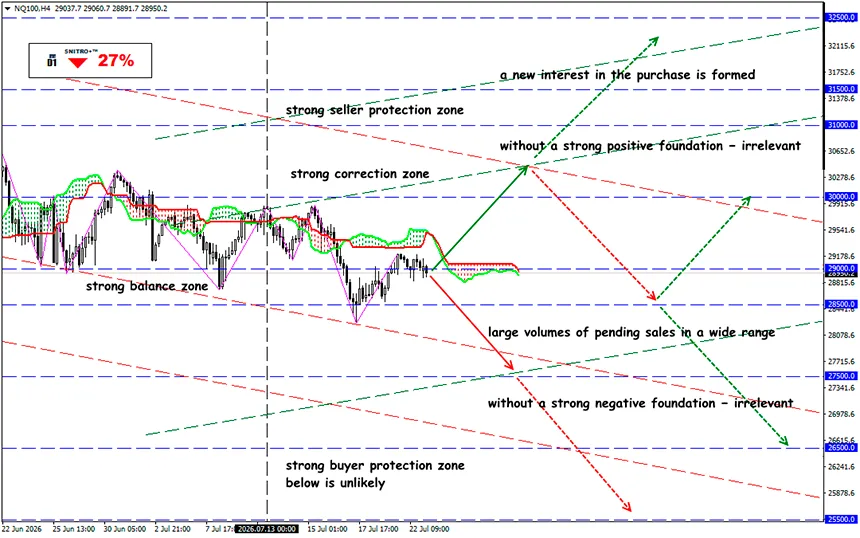
NQ100
Key zone: 28,500 -29,500
Buy: 29,700 (on strong positive fundamentals); target 31,500-32,500; StopLoss 29,000
Sell: 28,500 (on a pullback following a retest of 29,000); target 27,000-26,500; StopLoss 29,200
The conflict between the United States and China is entering a fundamentally new phase. Trump is prepared to impose sanctions on Chinese AI developers if an investigation confirms that U.S. intellectual property was used to create Chinese models.
Over the past several years, Washington has restricted Beijing’s access to advanced semiconductors, lithography equipment, and Nvidia accelerators. Now, however, the pressure is shifting directly toward the AI models themselves.
To recap:
Distillation is an AI training method in which a simpler model is created on the basis of an existing, more complex one. Last month, Anthropic sent a letter to the U.S. Senate claiming that Chinese companies had committed the largest-ever “theft of intellectual property.”
The allegations focused on Moonshot AI, the developer of the Kimi K3 model, which, according to the U.S. side, may have used covert model distillation technology involving Anthropic and OpenAI systems. It is more expensive than other Chinese models, but still costs half as much as Claude Opus and GPT-5.5.
This is not merely a diplomatic dispute. It concerns the formation of a new architecture for the global AI market, where restrictions may apply not only to hardware but also to the algorithms themselves.
Previously, U.S. policy centered on limiting China’s computing capacity. Export bans on Nvidia accelerators, restrictions on ASML equipment shipments, and sanctions against chip manufacturers were intended to slow the development of Chinese AI.
However, this strategy did not produce the expected results.
After the emergence of DeepSeek, the market saw that competitive language models could be developed at a significantly lower cost than their U.S. counterparts. In effect, the United States is attempting to create a new class of export controls that would apply not to physical technologies, but to the output of the world’s largest artificial intelligence laboratories.
Possible measures include:
- a ban on cooperation between U.S. companies and Chinese AI developers;
- restrictions on access to U.S. cloud platforms;
- a ban on software licensing;
- restrictions on U.S. investors;
- the expansion of export controls to software technologies.
This scenario would mark the beginning of a new stage in the technological fragmentation of the global economy. Two independent ecosystems are taking shape.
- The U.S. ecosystem is being built around OpenAI, Anthropic, Google, Microsoft, Nvidia, and Western cloud platforms.
- The Chinese ecosystem is forming around Alibaba, Tencent, Baidu, Huawei, Moonshot AI, and other domestic developers.
Every new package of restrictions accelerates this process. If sanctions constrain the development of Chinese companies, the potential market for equipment may also shrink. This would lead to higher long-term costs, lower efficiency in global competition, and a stronger geopolitical risk premium across the technology sector.
What does this mean in practice?
For traders, it means the emergence of a new structural market driver.
In the short term, this is likely to increase volatility across the technology sector. The most sensitive assets remain shares of companies connected to AI, semiconductors, cloud infrastructure, and data centers.
Particular attention should be paid to the performance of the Nasdaq 100, Nvidia, AMD, Broadcom, Microsoft, Alphabet, and the largest Chinese technology companies.
The medium-term outlook is considerably more interesting.
If sanctions continue to expand, investors will be forced to price a new permanent risk factor into technology stocks. In that case, the key valuation driver will no longer be limited to the speed of AI development, but will also include the ability of each ecosystem to operate autonomously without access to a rival’s technologies.
So we act wisely and avoid unnecessary risks.
Profits to y’all!


