



Yields are killing the Nasdaq
Why the market is trading against the Fed again
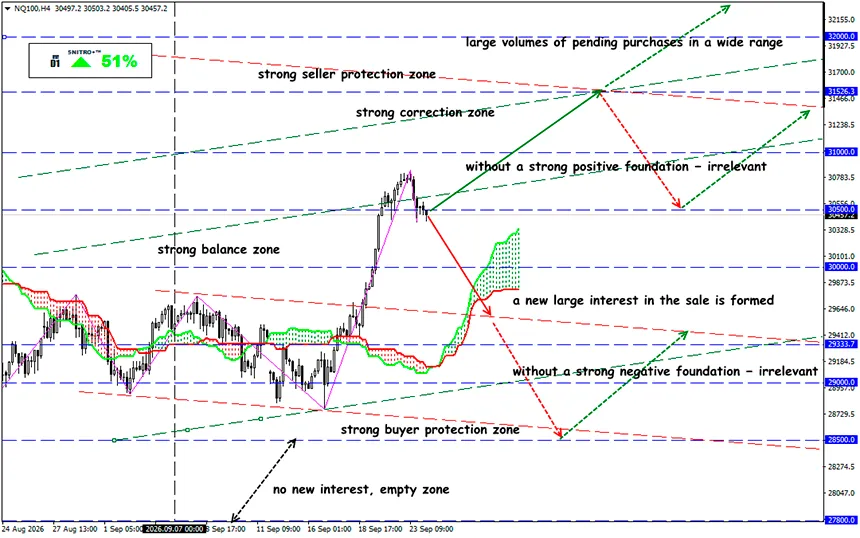
NQ100
Key zone: 30,500 - 31,000
Buy: 31,200 (on a pullback following a retest of 31,000); target 32,500; StopLoss 30,700
Sell: 30,000 (on strong negative fundamentals); target 28,500; StopLoss 30,500
The 10-year Treasury yield has broken above 5.1%, the probability of another rate hike has approached 76%, and expensive oil is bringing the “higher for longer” scenario back to the market. The main threat to technology stocks is now not in corporate earnings reports but in the debt market.
The 10-year Treasury yield rose to 5.14%, while the 30-year yield approached 5.44%, its highest level in more than two decades. The market is pricing in a 76% probability of another Fed rate hike, while Brent has returned above $100. Expensive energy and a strong U.S. economy are creating a dangerous combination for the Nasdaq and other expensive assets.
A reminder:
The U.S. market came under renewed pressure from bonds on September 24. Nasdaq-100 futures lost around 1% during the morning session, S&P 500 contracts fell about 0.6%, and Dow Jones futures declined around 0.4%. And the main source of pressure is not in the equity market.
This is a fundamental change in the environment for the stock market.
When the risk-free yield exceeds 5%, it becomes significantly harder for investors to justify extreme multiples for growth companies. Stocks whose expected profits lie far in the future are particularly vulnerable. That is precisely why the Nasdaq reacts more strongly to movements in Treasuries than the Dow.
The latest surge in yields was caused by more than just oil prices.
The preliminary S&P Global US Composite PMI rose from 56.0 to 58.4 in September — the highest reading since July 2021. Economic activity is accelerating for the fourth consecutive month. At the same time, employment growth at companies reached its strongest level in more than four years.
But there is an unpleasant detail for financial markets.
Companies’ costs are rising at the fastest pace in almost four years. S&P Global directly links part of this acceleration to higher energy prices and production capacity constraints.
This creates an almost perfect combination for Fed hawks:
strong demand + resilient labor market + expensive energy + accelerating costs.
For bonds and expensive technology stocks, this is a problem.
On September 16, the Fed raised rates by 25 basis points for the first time since 2023 — now the market is preparing for the cycle to continue.
Higher oil prices affect the market through several channels at once:
- increase fuel and transportation costs;
- increase production costs;
- worsen inflation expectations;
- reduce the Fed’s room to ease policy;
- support Treasury yields;
- increase the discount rate for equities.
For the Nasdaq, this creates a particularly unpleasant chain:
oil ↑ → inflation expectations ↑ → Fed rate expectations ↑ → Treasury yields ↑ → growth stock multiples ↓.
In other words, the market has to compete with an asset offering more than 5% nominal yield with minimal credit risk. The higher the Treasury yield, the higher the required risk premium for holding equities.
Consequently, to maintain previous valuations, companies need to demonstrate even faster earnings growth.
And What Is the Result?
In the current environment, trading the Nasdaq without monitoring the Treasury market is becoming dangerous. We analyze three indicators:
US10Y: A sustained return of the yield below 5% would be a positive signal for the technology sector. Consolidation above 5.15–5.20%, by contrast, would confirm continued pressure on multiples.
Brent: Oil stabilizing below $100 would reduce the inflation premium. Brent consolidating above $105–110 could strengthen expectations of further Fed tightening.
Rate expectations: As long as the probability of an October rate hike remains around 75% or higher, an aggressive strategy of buying Nasdaq dips carries elevated risk.
If the 10-year Treasury yield consolidates above 5%, the U.S. market will have to prove that expected earnings growth can compensate for the new cost of capital.
If it cannot, the next phase of the correction will come not through a revision of Fed expectations, but through a compression of technology company valuations.
So we act wisely and avoid unnecessary risks.
Profits to y’all!


