



Why Nvidia needs Wall Street
Nvidia — the guarantor of AI Technology development
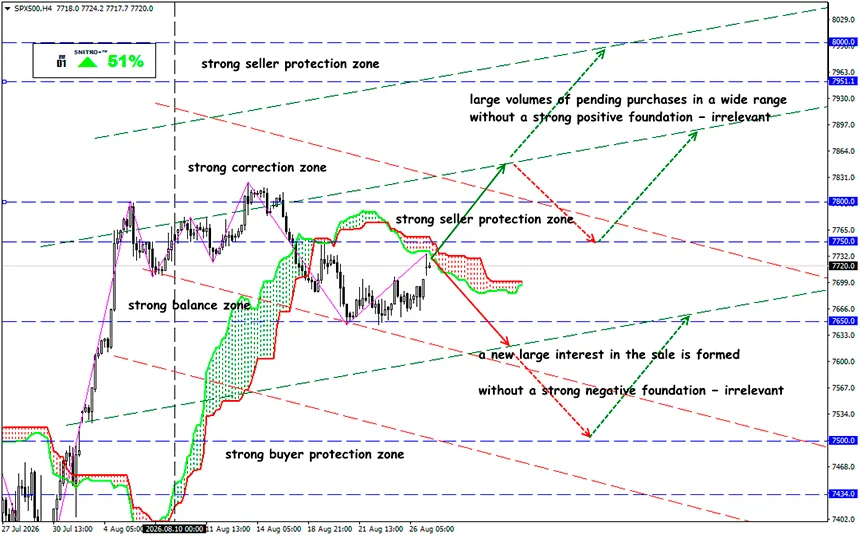
SP500
Key zone: 7,680 - 7,750
Buy: 7,800 (on a decisive break above 7,800); target 7,950; StopLoss 7,720
Sell: 7,650 (on strong negative fundamentals); target 7,500-7,350; StopLoss 7,720
Nvidia’s financial position remains exceptionally strong, and the AI boom shows no intention of slowing down yet. But as the business grows, the company’s role in the market is changing: from a supplier of accelerators, it is gradually becoming one of the key financiers of AI infrastructure.
Nvidia used to depend mainly on how many GPUs its customers were willing to buy. Now the company depends on whether those customers can generate enough money to service the infrastructure built around those GPUs.
A reminder:
The latest report says Nvidia’s revenue reached a record $96.2 billion (+18% quarter over quarter) and +106% year over year. Data Center revenue totaled $89 billion (+117% year over year). Net income reached $59.7 billion, while GAAP operating income came in at $63.7 billion. Gross margin remained at 75%.
The company expects $108 billion in revenue next quarter. Nvidia forecasts sales growth of approximately 70% in the next fiscal year as well.
Nvidia Is Becoming a Bank for Its Own Ecosystem
- Customer financing is evolving from isolated deals into a standalone element of Nvidia’s strategy.
- The company provides guarantees, supports data center financing, makes commitments related to compute capacity utilization, invests in neocloud companies, and works with financial groups to create mechanisms for raising hundreds of billions of dollars in capital.
- Nvidia announced the creation, together with Apollo, BlackRock, Blackstone, Brookfield, Goldman Sachs, and KKR, of financial platforms capable of mobilizing more than $500 billion in private capital to build AI infrastructure.
- The company is now interested not only in whether a customer wants to buy GPUs, but also in whether a bank, infrastructure fund, or private-equity investor is willing to finance that purchase.
On August 17, Nvidia announced its participation in the PORTS-Pike project in Ohio together with SB Energy and OpenAI.
Nvidia is providing credit support for land, energy infrastructure, and construction of the initial 4.25 GW, has the option to expand the project by another 3.75 GW, and is also investing $1.5 billion in SB Energy. The first capacity is expected to come online starting in 2028. Nvidia’s potential support for the project could reach approximately $105 billion.
The economic logic is obvious:
more demand → more data centers → more financing → more GPUs → more cloud capacity → cheaper AI compute → more new AI applications → even more demand.
With Nvidia’s support, lenders receive additional protection, OpenAI gets infrastructure, SB Energy gets capital, while Nvidia itself gains a potential market for enormous quantities of its own accelerators, processors, and networking equipment.
So, what does this mean?
Investments are already beginning to have a significant impact on profits, but operational risk is rising: the cost of the next stage of the AI revolution has become too large even for Big Tech.
Nvidia expects AI infrastructure to be financed not only by Microsoft, Amazon, Meta, or Alphabet, but also by pension funds, insurance companies, infrastructure funds, private capital, and debt investors.
Nvidia’s main risk is correlation. If returns on AI projects fall short of expectations, company valuations will decline, GPUs will lose residual value faster, lenders will demand more collateral, and new data centers will become more difficult to refinance.
So investors can no longer afford to monitor only Nvidia’s revenue, Blackwell, and Rubin. Important indicators now include the debt burden of neocloud companies, GPU utilization, refinancing costs, the residual value of previous generations of accelerators, and the volume of guarantees Nvidia is willing to take onto its own balance sheet.
It remains unclear what internal limits Nvidia has established for such deals and whether it is creating separate cash reserves for potential guarantee payments. But confidence in its new financial strategy remains weak.
Let’s see how this plays out.
So we act wisely and avoid unnecessary risks.
So we act wisely and avoid unnecessary risks.


