



Why Japan lost its leadership
Japan is the third largest creditor after germany and china
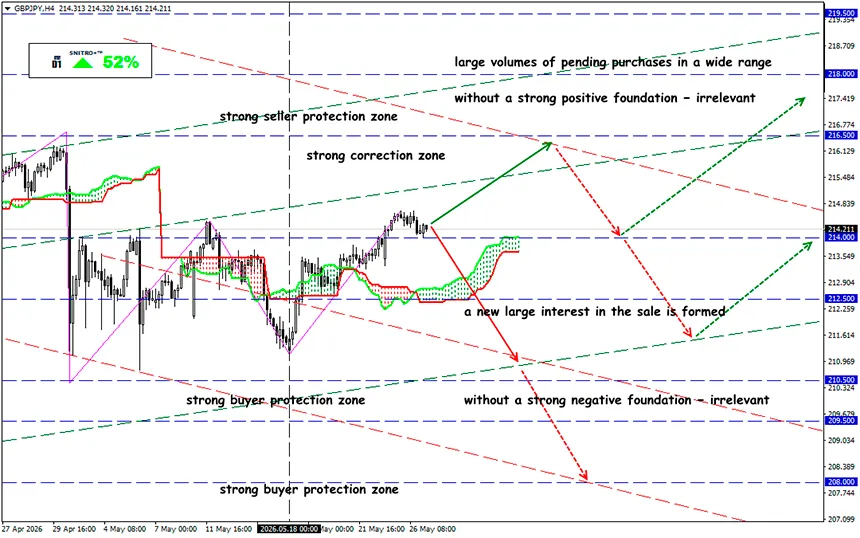
GBP/JPY
Key zone: 213.50- 214.50
Buy: 215.00 (on strong positive fundamentals); target 216.50-218.00; StopLoss 214.50
Sell: 213.00 (on a pullback after retesting 214.50) ; target 211.00-210.50; StopLoss 213.50
Germany retained first place in 2025 with debt totaling $4.2 trillion (¥675.5 trillion). The situation appears paradoxical: Japan’s foreign assets updated a historical maximum — Japan’s net foreign assets reached a record ¥561.8 trillion ($3.5 trillion) by the end of 2025, yet this proved insufficient. The main reason is the very weak yen.
In addition to the currency factor, the structure of the global economy played an important role. Germany remains one of the world’s largest exporters of industrial products, while China continues actively increasing foreign investments and currency reserves. Japan, meanwhile, faces internal limitations: weak domestic demand, a demographic crisis, and record government debt.
Let us recall:
A creditor nation is a state whose foreign assets exceed its liabilities to the outside world. In practice, this refers to accumulated financial influence. The higher the volume of net foreign assets, the stronger the country’s influence on global capital markets, debt markets, and currency flows.
Fresh statistics showed that Japan’s foreign assets increased by 8.5% compared with last year and reached approximately ¥1806 trillion. This is linked to increased investments in foreign businesses, especially in the United States and Switzerland. The ministry reported that significant Japanese investments were directed into sectors such as finance and insurance, transportation equipment, and non-ferrous metals. Liabilities rose by 10.5% to ¥1244 trillion. The Nikkei 225 index rose by 26% in 2025, surpassing 50,000 points.
For a long time, Japan held the leading position among creditor countries, which explained the yen’s status as a safe-haven asset.
For Japan, this status was especially important because for decades Japanese banks, insurance funds, and pension institutions were among the largest buyers of American and European bonds. Japan’s large foreign assets were previously considered the key reason why the yen was used as a safe-haven currency during periods of market instability.
For Forex, the situation carries strategic significance.
- The loss of leadership increases long-term pressure on the yen.
- Investors perceive the decline of Japan’s global financial dominance as an additional factor of structural weakness for JPY.
For traders, this means that the USD/JPY pair will remain highly sensitive to capital flows and Bank of Japan policy. If Japanese investors begin reducing investments in foreign bonds because of rising domestic rates, this could become a driver for JPY strengthening and a correction in the American debt market.
For the Japanese stock market, this is a mixed signal.
- A weak yen supports exporters — primarily Toyota, Sony, Mitsubishi, and other global corporations.
- The decline in the country’s international financial influence intensifies questions regarding the long-term sustainability of the Japanese economy.
And what is the result?
Japan remains one of the world’s largest creditors, meaning Japanese investors continue to control colossal volumes of foreign capital. During periods of market stress, this may provoke repatriation of funds back to Japan, which traditionally supports the yen as a safe-haven asset.
The current situation forms several trading conclusions at once:
- the long-term trend in USD/JPY remains sensitive to Bank of Japan policy and the dynamics of US Treasury yields;
- Germany’s strengthening as the world’s largest creditor increases the importance of the euro in international capital flows;
- China continues strengthening its position in the global financial system, gradually approaching the status of a dominant creditor.
The change of leaders among global creditors is not just statistics. It is a reflection of a massive redistribution of capital that in the coming years may alter the dynamics of currencies, bonds, and global investment flows.
So we act wisely and avoid unnecessary risks.
Profits to y’all!


