



What should you buy when inflation becomes a problem?
Investing during inflation
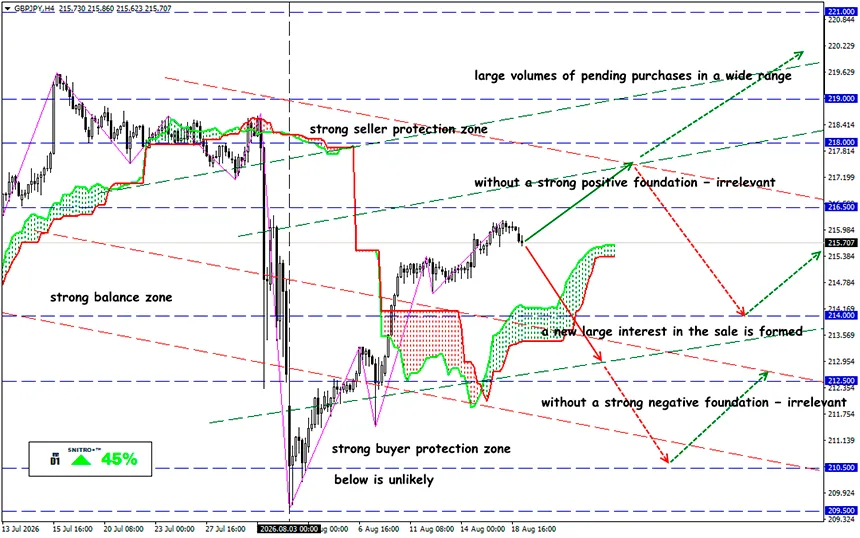
GBP/JPY
Key zone: 215.00 - 216.00
Buy: 216.50 (on strong positive fundamentals); target 218.00-218.50; StopLoss 215.80
Sell: 214.50 (on a decisive break of 215.00) ; target 213.00; StopLoss 215.20
The inflationary scenario in 2026 has turned out to be significantly tougher than initially expected. The IMF raised its global inflation forecast to 4.7%, while supply disruptions through the Strait of Hormuz continue to support energy prices. As of August 19, Brent is trading at around $91.56 per barrel, with only a few vessels passing through the strait each day.
A reminder:
The main problem now is not simply high inflation, but the risk of stagflation. And this is about more than just rising CPI. The energy shock is simultaneously weighing on economic growth and increasing business costs. In the U.S., July inflation came in at 3.4% year over year, while core inflation was 2.5%. At the same time, energy risks remain elevated: as recently as June, energy prices were up 15.7% year over year.
Therefore, under current conditions, a portfolio should not be built around the assumption that “inflation will definitely accelerate,” but around the ability of assets to withstand both scenarios: persistent inflation and a renewed acceleration.
Short-Term Bonds
10-year Treasuries currently yield around 4.7%, while 3-month securities yield about 3.9%. If inflation accelerates, long-term bonds will react more strongly to rising yields through falling prices.
Therefore, it makes more sense to allocate the conservative portion of a portfolio across Treasury bills, money market funds, and short-term government bonds.
TIPS
To protect the purchasing power of the dollar-denominated portion of a portfolio, TIPS are a more logical choice. Their principal is adjusted for inflation, making them significantly better suited than conventional fixed-rate bonds for inflation hedging. This is particularly relevant if actual inflation is expected to exceed what the market has already priced in. But TIPS are not deposits: rising real interest rates can reduce their market value.
Gold
The most obvious component of a defensive portfolio. Gold serves as insurance rather than a source of current cash flow. But gold can no longer be viewed as an asset that should be bought at any price. Technical corrections should be used to gradually build a position rather than committing the entire allocation after a sharp price surge.
Energy
With Brent around $91.56, oil remains the primary market source of inflationary pressure. Therefore, energy companies and broad commodity instruments have a more direct connection to the current shock than most defensive stocks.
However, oil-related assets should be bought cautiously after a sharp rally: normalization of shipping through the Strait of Hormuz could quickly remove the geopolitical premium from prices.
Stocks
Inflation does not automatically make stocks a defensive asset. The key question is whether a company can pass rising costs on to customers.
Priorities include:
- companies with high gross and operating margins;
- low debt levels;
- stable cash flow;
- essential goods;
- a strong brand or a virtually irreplaceable product;
- the ability to raise prices without a significant decline in sales volumes.
Caution is warranted with companies whose valuations are based on earnings expected 5–10 years from now, particularly when they are highly sensitive to bond yields. Rising 10-year Treasury yields are already putting pressure on expensive technology stocks.
So, what does this mean?
The optimal strategy is not to search for a single “perfect” inflation asset. The situation in 2026 does not yet justify turning an entire portfolio into a bet on hyperinflation. The IMF expects global inflation of 4.7%, but at the same time forecasts global economic growth of 3%.
Therefore, the most rational approach is to hold part of the capital in TIPS, maintain a moderate allocation to gold, and invest in high-quality companies with a proven ability to raise prices. If the problems around Hormuz persist, real assets will have an advantage; if the situation normalizes, capital can shift back toward bonds and growth stocks.
So we act wisely and avoid unnecessary risks.
Profits to y’all!


