



Washington vs. Caracas: no oil problems in sight

US pressure on Venezuelan oil continues
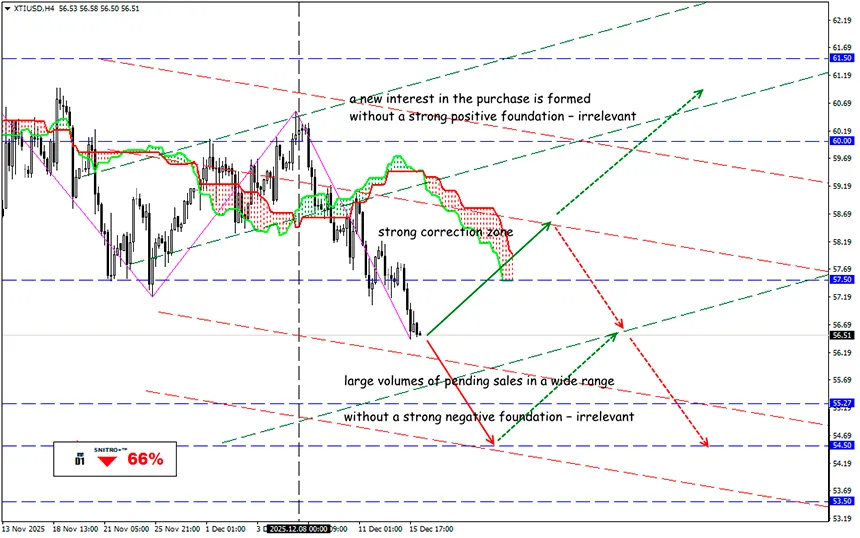
XTI/USD
Key zone: 56.00 - 57.50
Buy: 57.50 (on a confirmed break of the 57.00 level); target 59.00-60.50; StopLoss 56.80
Sell: 56.00(on strong negative fundamentals); target 54.00-53.50; StopLoss 56.80
US attempts to tighten control over oil exports from Venezuela will affect production and hit President Maduro's main source of income, but will not have a significant impact on the global oil market.
Last week, the US Coast Guard intercepted a supertanker carrying oil from Venezuela bound for Cuba. This event was part of a broader campaign in which the US military is stepping up its presence in the Caribbean to levels comparable to those seen during the Cuban missile crisis.
The US is publicly signaling that the interception of the Skipper is not a one-off action, but a working plan. This is already changing the behavior of shipowners and insurers. Against this backdrop, there are signs of regional militarization: for example, Trinidad and Tobago has agreed to provide airports for US logistical support. Venezuela has responded by announcing the termination of gas agreements and accusing its neighbors of assisting the US. In addition, PDVSA has reported a cyberattack, which it has linked to the US; Reuters sources have reported system failures and disruptions in cargo shipments.
The US also imposed new sanctions against the Maduro family, six oil tankers, and related shipping companies.
Kpler analysts predict that Venezuelan crude oil exports will fall to 702,000 barrels per day in December, the lowest level in six months. Asian buyers are asking for significant discounts on Venezuelan oil due to growing trade risks.
As a reminder:
More than 60% of Venezuelan crude oil is heavy oil, which has a resinous consistency when extracted. This type of oil requires the use of special substances to reduce its viscosity, which allows it to be transported through pipelines and exported via terminals and tankers. Venezuela is forced to import these chemicals.
The sharp decline in exports threatens production in Venezuela.
The decline in heavy oil supplies may hit certain consumers (such as the US Gulf Coast) harder. Despite growing tensions, oil production in Venezuela is unlikely to stop completely. The Trump administration has granted Chevron, the second-largest oil producer in the US, a special license to continue operating joint ventures in Venezuela's Orinoco Belt, where about 250,000 bpd are produced. Any shortage of heavy oil is likely to be offset by increased production in Canada and the Gulf of Mexico, where such grades are also produced.
Chevron Corp has already lowered the prices of Venezuelan oil offered to US refineries.
The current escalation between the US and Venezuela is already reducing exports and putting pressure on Venezuela's production through logistics, as well as forcing the market to factor in sanctions and military risk. This is not yet a military conflict, but only a "conflict of coercion" that directly affects oil exports from Venezuela. At the moment, there is a sharp decline in freight traffic.
But the effect on global prices is limited because the underlying backdrop is the expectation of a surplus/growth in reserves in 2026. So the "Venezuela shock" is only redistributing flows and widening discounts.
Oil is not even trying to rise in price, and volatility signals a fragile balance. At the moment, the market is sending a clear signal that the oil market is balanced but vulnerable to fundamental factors. Attempts at growth can only be seen as a technical correction, as there are no real grounds for a bullish trend yet.
So we act wisely and avoid unnecessary risks.
Profits to y’all!


