



War: where the money is and how to profit

The Middle East conflict is shifting the balance of power in the markets
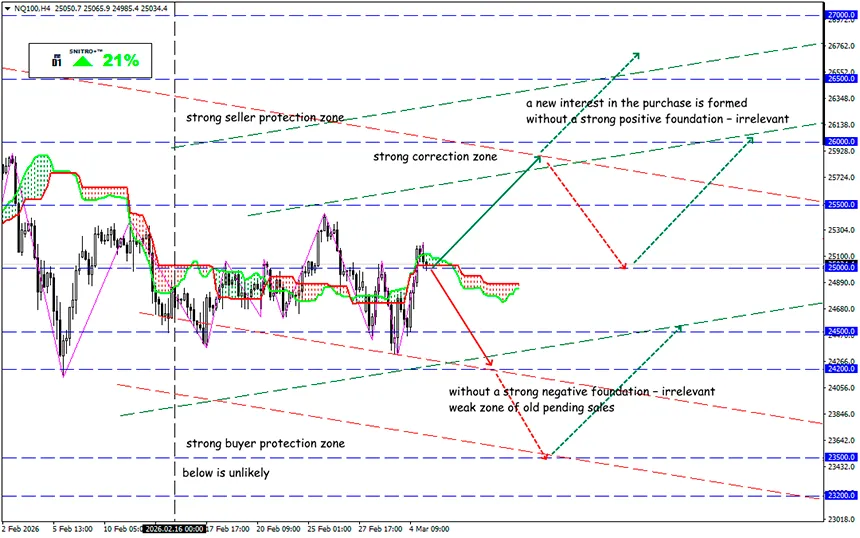
NQ100
Key zone: 24,500-25,000
Buy: 25,500(on strong positive fundamentals); target 27,000-27,500; StopLoss 25,000
Sell: 24,300(on a confident breakout of the 24,500 level); target 23,200; StopLoss 25,200
Panic has already wiped out $1 trillion from the U.S. stock market, while the blockade of the Strait of Hormuz is pushing oil toward the $100 mark. The escalation around Iran threatens markets and the Federal Reserve’s policy.
The process of drawing additional players into the conflict is accelerating, and attacks on oil infrastructure are intensifying. A Fed rate cut is under threat due to renewed inflationary pressure.
As early as Tuesday, the U.S. stock market opened with a sharp decline: the Dow Jones Industrial Average fell by 1%, while the S&P 500 and Nasdaq Composite dropped more than 1.1% amid oil supply concerns. Today buyers recovered part of the losses.
- The conflict has revived the topic of nuclear threats, but the market does not price it in, since in the event of real nuclear weapons use any stock market profit loses meaning, while right now the key goal is not to miss a potentially profitable entry point.
- Markets are balancing between panic selling of risky assets and a sharp rally in sectors that benefit from the crisis.
- Mass flight cancellations and the closure of key hubs such as Dubai have paralyzed global aviation.
- European tourism giant TUI lost about 10% of its value, while shares of airline groups Lufthansa and the owner of British Airways — IAG — fell more than 5%. In the U.S., Delta Air Lines, United Airlines and American Airlines dropped by 2–4% despite their relatively limited direct exposure to Middle Eastern markets.
- Asian carriers were also under pressure: shares of Singapore Airlines, Cathay Pacific, Qantas and Japan Airlines fell more than 4%.
- The oil and gas and defense sectors are showing abnormal growth.
- The EU is suffering the most, as its “independence” in energy now effectively means a lack of it.
- After Qatar preemptively halted LNG production due to the threat of strikes, European gas prices jumped 25% in one day. Against this backdrop, the pan-European Stoxx 600 index and Germany’s DAX opened lower.
The sharp jump in oil prices lifted shares of energy giants: European companies Shell and BP gained about 5%, while American ExxonMobil and Chevron became trading favorites on expectations of windfall profits. Even Saudi Aramco increased its capitalization by 3% despite risks of strikes on local infrastructure, including the Ras Tanura terminal.
At the same time, shares of defense corporations surged as investors began pricing in expectations of new large-scale orders. Shares of U.S. giant Raytheon Technologies (RTX) rose 5.81%, Lockheed Martin gained 2.81%, and Britain’s BAE Systems managed to rise 3.40% despite the overall decline in indices.
The high concentration of oil and defense companies made some national indices more resilient than others. The British FTSE 100 fell by only 1%, showing significantly better performance than broader European benchmarks. A real paradox came from the Israeli market: the Tel Aviv 35 index hit a historic high, jumping 5%, while the shekel strengthened by 1.5%.
Trump’s global tariff agenda has moved out of focus. Temporary import tariffs of up to 15%, introduced by Trump after the Supreme Court ruling, will remain valid for 150 days without Congressional approval. What happens next is not something markets are thinking about yet.
Geopolitical turbulence is also increasing interest in assets outside the traditional financial system that are perceived as “apolitical” and resilient to global shocks. For example, cryptocurrencies within any exchange-traded asset environment.
And what is the result?
The overall trend of capital redistribution remains obvious. Money is flowing out of risky consumer-demand sectors and technology stocks into industries that ensure energy and defense stability.
Such a scenario will support the energy sector, while airlines, industrial companies and consumer-oriented businesses will face rising costs. Pressure on the S&P 500 and Nasdaq may intensify as rising bond yields and renewed inflation expectations trigger another revaluation of large-cap stocks.
The decisive factor is the duration of supply disruptions. If the route through the Strait of Hormuz is not restored within 2–3 weeks, oil prices may stabilize above $100, which would significantly weaken corporate earnings forecasts in the U.S. and Europe.
So we act wisely and avoid unnecessary risks.
Profits to y’all!


