



War, oil, and windfall profits
Where to invest during a crisis
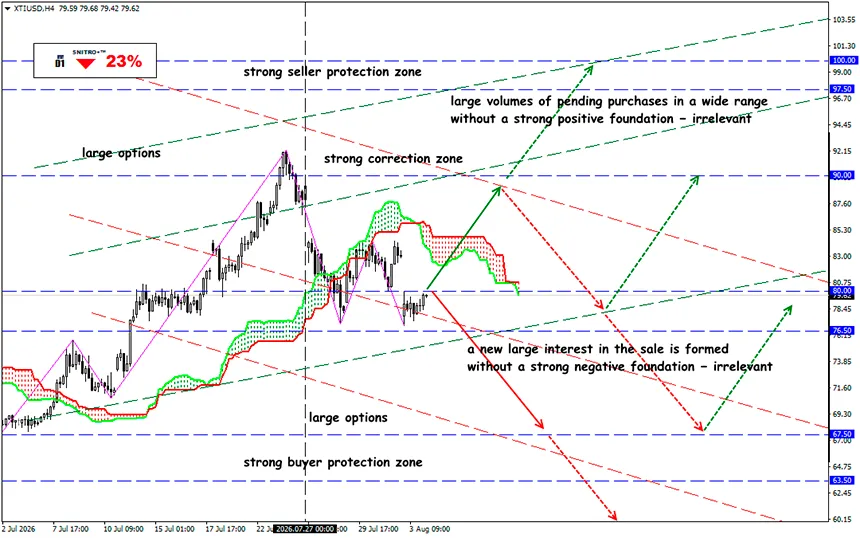
XTI/USD
Key zone: 76.50 - 81.50
Buy: 83.50 (on a decisive break above 83.00); target 87.50; StopLoss 82.80
Sell: 76.00 (on strong negative fundamentals); target 73.50-71.50; StopLoss 76.70
The disruption of shipping through the Strait of Hormuz, reduced exports of refined petroleum products from Russia, and limited spare refining capacity have sharply increased refining margins. As a result, refined fuel prices have risen much faster than crude oil prices, while the industry's key profitability indicator—the crack spread, or the difference between fuel prices and crude oil acquisition costs—has widened dramatically.
Let's recap.
In the second quarter of 2026, the refining industry became one of the world's most profitable energy sectors. Analysts note that many companies posted their strongest financial results in years thanks to record refining margins and robust demand for petroleum products.
The military conflict involving Iran has largely benefited refining companies located outside the Middle East. Supply disruptions through the Strait of Hormuz simultaneously pushed crude oil prices higher while creating an even greater shortage of diesel, jet fuel, and gasoline.
U.S. refiners benefited the most, as they have access to crude supplies from the United States, Canada, and Venezuela and are not directly dependent on shipments through the Strait of Hormuz.
As of early August 2026, U.S. diesel and jet fuel prices were approximately 41% higher than before shipping restrictions were imposed in the Strait. During the peak of the escalation, Brent crude climbed to $126 per barrel. At the same time, exports of refined petroleum products from Russia and China declined, allowing efficiently operating refineries to effectively dictate prices in the global market.
- Companies currently generating the strongest profits include Valero Energy (NYSE: VLO), Marathon Petroleum (NYSE: MPC), Phillips 66 (NYSE: PSX), ExxonMobil (NYSE: XOM), Chevron (NYSE: CVX), HF Sinclair (NYSE: DINO), and PBF Energy (NYSE: PBF).
- From the perspective of balancing business resilience and growth potential, Valero Energy, Marathon Petroleum, and Phillips 66 appear to be the most attractive investments. These companies operate the largest refining networks, maintain strong balance sheets, and are capable of sustaining elevated profitability even if crude oil prices gradually decline.
- Investors willing to accept higher risk in pursuit of greater potential returns may find HF Sinclair and PBF Energy particularly attractive. These companies benefit more than most from expanding refining margins but are also more vulnerable if those margins begin to narrow.
Naturally, governments' immediate priority is replenishing fuel inventories that were depleted during the conflict. According to the U.S. Energy Information Administration (EIA), global oil inventories declined by 5.1 million barrels per day in the second quarter and are expected to decrease by another 2.2 million barrels per day in the third quarter. Rebuilding diesel, jet fuel, and gasoline inventories will take considerable time, supporting sustained demand for refined products.
Political pressure remains an additional risk factor. President Trump has already publicly criticized major oil companies for reporting record profits and urged them to lower gasoline prices, potentially increasing the likelihood of tighter government oversight of the industry.
So, what does this mean?
Nevertheless, investors should not expect windfall profits to last indefinitely. A lasting ceasefire with Iran, the full reopening of the Strait of Hormuz, and the restoration of exports could quickly narrow crack spreads. At the same time, persistently high gasoline prices may weaken demand and trigger political responses ranging from export restrictions to windfall profit taxes. Additional risks include refinery accidents, maintenance shutdowns, rising costs of heavy crude, and a slowdown in the global economy.
The base-case scenario for the next two to three quarters remains favorable for the refining sector. Even a partial reopening of shipping through the Strait of Hormuz will not immediately eliminate the shortage of refined products. Global spare refining capacity remains limited, building new refineries takes years, and damaged or idled facilities cannot be returned to operation quickly.
So we act wisely and avoid unnecessary risks.
Profits to y’all!


