


















Vibe trading: a recipe for profit or a beautiful illusion

How trading logic is changing in the AI era
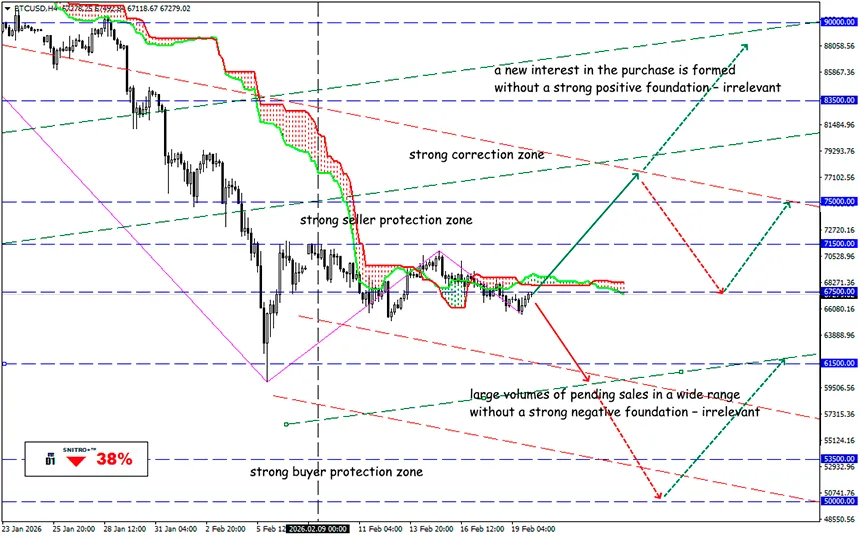
BTC/USD
Key zone: 66,000 - 68,500
Buy: 70,000 (on a confident breakout of the level) ; target 73,500-75,000; StopLoss 69,000
Sell: 67,000 (on a strong negative fundamental basis) ; target 63,500-60,000; StopLoss 68,000
Intuitive trading has always existed. On Wall Street in the 1980s, traders relied on “tape reading” and order flow. However, by 2020, 60–70% of U.S. equity trading volume was already driven by algorithmic strategies. The space for impulsive decisions in traditional finance has significantly narrowed.
Today, the term “vibe trading” more often describes a combination of emotional trading and following crowd sentiment. But in the AI era, it takes on new meaning: data and chart analysis are handled by algorithms, while humans interact with them through a convenient interface.
If in traditional finance investor sentiment is an additional factor, in cryptocurrencies it often becomes the primary price driver.
Vibe Trading in Traditional Markets
The FX and equity markets are highly competitive and consistently liquid environments. Major players — banks, hedge funds, and market makers — rely on mathematical models and high-frequency algorithms.
In such a system, decisions based on “gut feeling” offer no edge. The market is close to efficiency, and room for subjective action is minimal. There are news- and sentiment-based strategies, but these are statistical, quantitative models — not intuitive decisions by individual traders. Therefore, in stocks and financial derivatives, vibe trading turns into emotional and highly inefficient speculation.
What Vibe Trading Means for Cryptocurrencies
The crypto market functions differently. Social media and communities play a massive role. For example, in 2021, Dogecoin rose more than 12,000%, largely due to media-driven momentum. Meme tokens on Solana in 2023–2024 also showed short-term price surges driven by viral trends on X and Telegram.
Reminder:
The concept of “vibe” comes from digital culture and refers to atmosphere, mood, or the overall feel of a situation. In trading, it describes decisions based not on a formalized model, but on subjective perception of market movement.
Vibe trading generally refers to strategies built around analyzing collective emotions, narratives, and the dynamics of social capital surrounding an asset. Unlike fundamental analysis (protocol value, cash flow, adoption) or classic technical analysis, vibe trading relies on:
- the speed at which an idea spreads;
- the intensity of audience engagement;
- market reflexivity;
- liquidity inflows within a specific narrative.
In crypto markets — where fundamental valuation is often blurred and liquidity fragmented — “vibe” becomes a tradable factor.
Vibe trading in crypto is essentially working with impulses of collective sentiment expressed through:
- social media (X, Telegram, Discord);
- growth in on-chain activity;
- accelerating trading volumes;
- narrative cycles (AI, RWA, meme coins, L2, etc.).
The key principle: price rises not because the asset’s value changed, but because participants’ belief changed.
As a result, price becomes a reflection of how quickly an idea spreads — not of financial metrics.
The Nansen Platform: A First Case Study
In 2026, the platform Nansen, which analyzes activity across more than 500 million crypto addresses, introduced AI-agent-based trading on the Solana and Base networks. Data and chart analysis are handled by algorithms, while humans interact through a user-friendly interface.
If a few years ago a crypto trader simultaneously kept open an exchange, charts, social media feeds, and news sources, today part of that cycle has been compressed into a single window. Users can now execute trades through dialogue — literally in chat format — turning trading decisions into a conversation with an algorithm.
So What’s the Result?
Effective vibe trading does not mean following feelings; it means systematically working with measurable sentiment indicators such as:
- trends in social media and media mentions;
- movements of large on-chain wallets;
- exchange inflows and outflows;
- changes in liquidity;
- correlations with macroeconomic events.
An AI agent is not a “one-click profit button,” but merely an interface for accessing large volumes of statistics. The trader formulates a hypothesis, the algorithm tests it, and proposes scenarios adjusted to a defined risk level. The difference between these approaches is comparable to the difference between professional trading and gambling in a casino.
So we act wisely and avoid unnecessary risks.
Profits to y’all!


