



U.S. stocks cool after the chipmaker rally
What to expect from the stock market in the third quarter
SP500
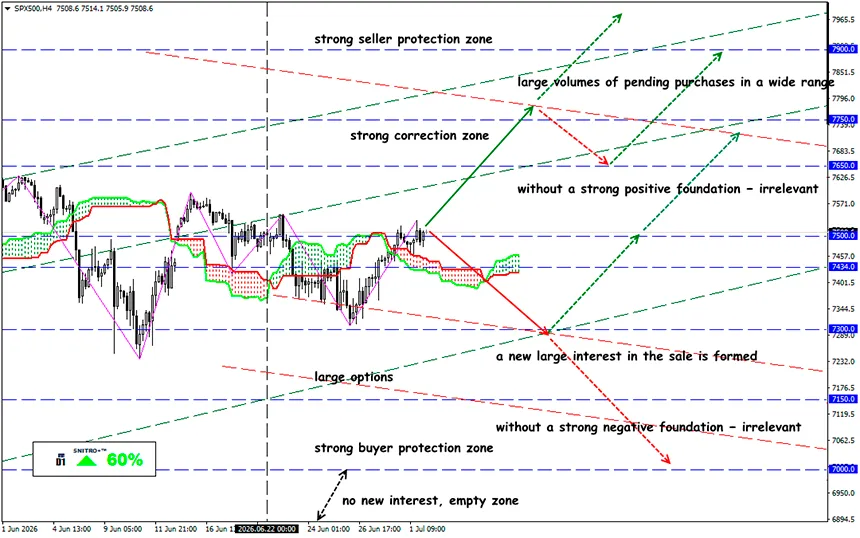
Key zone: 7,400 - 7,550
Buy: 7,600 (on a decisive break above 7,500); target 7,850; StopLoss 7,530
Sell: 7,350 (on strong negative fundamentals); target 7,150-7,100; StopLoss 7,420
Global equity markets began the new quarter cautiously, especially after the latest U.S. labor market data disappointed speculative investors. Uncertainty surrounding negotiations between the United States and Iran continues to unsettle market sentiment. Meanwhile, Asian investors are closely watching for potential BOJ intervention after the yen fell to its lowest level in 40 years.
U.S. equity futures moved lower. The decline was limited but came at a very timely moment, as investors entered the second half of the year with the major indices trading near record highs.
Reminder:
During the first six months of 2026, the Dow gained 8.9%, delivering its strongest first-half performance since 2021. The S&P 500 advanced 9.6%, while the Nasdaq climbed 12.8%. The small-cap Russell 2000 Index surged nearly 22%, posting its best first-half result since 1991.
The primary market driver remains the sharp rally in semiconductor stocks and companies associated with AI. Chipmakers have turned the technology sector into the leader of the current bull market. During the second quarter alone, Micron, Intel, and Advanced Micro Devices added approximately $2 trillion to their combined market capitalization.
Incidentally, the "Magnificent Seven" lost $2.3 trillion in market value as investors shifted their attention toward semiconductor companies. Investor confidence has become heavily concentrated around AI infrastructure: while the long-term outlook remains positive, the pace of aggressive buying is beginning to slow.
The second half of the year begins with much less room for error.
- Market attention is shifting back toward monetary policy. Traders are watching closely for any signals that the Federal Reserve could raise interest rates again, as inflation remains a significant concern. Futures currently imply a 33% probability of a Fed rate hike at the end of this month. The probability of a September rate increase is estimated at between 67% and 88%.
- The dollar is weakening while equities continue to rise. In June, the U.S. economy added only 57,000 jobs, compared with expectations for an increase of 110,000. Weak employment growth argues against another interest-rate hike. Nevertheless, the Federal Reserve is likely to remain focused primarily on elevated inflation.
- Investors expect strong earnings from the technology sector in mid-July. Solid results would help justify elevated valuations and attract additional capital. Meanwhile, rising Treasury yields—particularly the 10-year yield, which has climbed to 4.46%—together with the risk of tighter monetary policy, could put additional pressure on the cryptocurrency market.
What does this mean?
The early decline in equity futures does not erase the market's impressive first-half gains, but it demonstrates just how sensitive investor sentiment has become. A considerable amount of optimism has already been priced into the market.
If corporate earnings, AI investment spending, and economic data remain resilient, the rally could broaden beyond semiconductor stocks. However, if inflation remains persistent or expectations for higher interest rates continue to rise, the same momentum that previously pushed equities higher could make the market increasingly vulnerable to a sharper correction.
The S&P 500 is stabilizing near a key support level while macroeconomic expectations continue to limit the recovery. Weak U.S. economic data have reduced expectations of another rate hike in the near future. Institutional demand remains fragile, and the technical structure is still under pressure.
Unless buyers regain the $7,550–7,650 zone, the current rebound will most likely continue to be viewed as nothing more than a correction. A break back below $7,100 would significantly increase the probability of another downward wave.
So we act wisely and avoid unnecessary risks.
Profits to y’all!


