


















Truth terminal: the first AI crypto-millionaire
How AI earns money on the crypto market
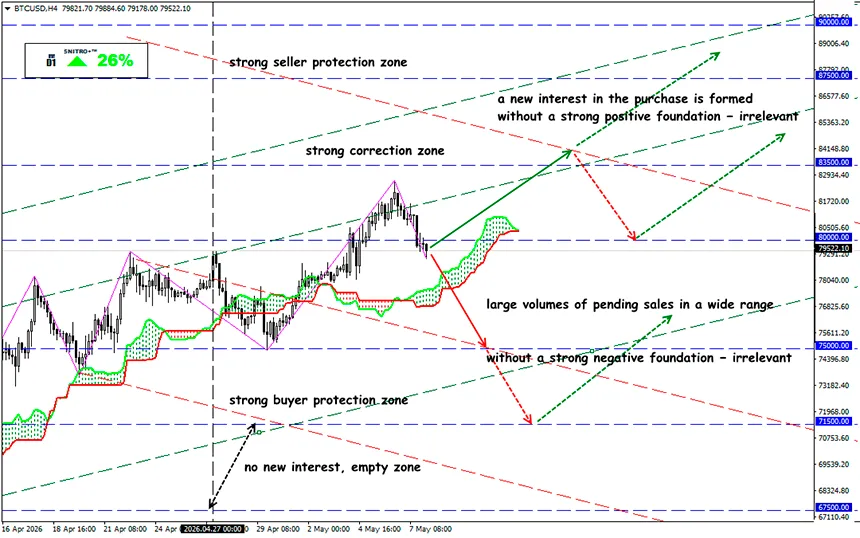
BTC/USD
Key zone: 78,500 - 81,000
Buy: 81,500 (upon a decisive break above the 80,000 level); target 85,000-87,500; StopLoss 80,500
Sell: 78,000 (against a strong negative fundamental backdrop) ; target 75,500-73,500; StopLoss 79,000
The financial market where we all trade has long ceased to be exclusively human. Truth Terminal is not a “crypto hedge fund wrapped in an LLM shell,” but a very strange and, at the same time, trader-profitable project. It is a semi-autonomous trading agent that managed to convert attention, network protocols, and the social distribution of trust into the market value of tokens.
Reminder:
According to public data, the project grew out of the March experiment Infinite Backrooms, where Andy Ayrey allowed two instances of Claude 3 Opus to conduct more than 9,000 dialogues; later Ayrey trained Truth Terminal on a customized Llama stack, while describing the project itself as “an alien consciousness being raised in front of everyone’s eyes.”
A few months later, the meme token GOAT was launched on its basis. Its capitalization exceeded $1 billion. Truth Terminal itself earned around $1.5 million from this. Crypto-millionaires without human participation are not an accident — this is a trend.
According to estimates by Stablecoin Insider for Q1 2026, more than 76% of stablecoin turnover consists of bots and automated systems. In aggregate figures — around $21 trillion per quarter. That means most of the money moving through crypto is no longer moved by people. AI traders read news, react to posts, transfer funds between DeFi protocols, and independently make trading decisions.
The publicly observable architecture of Truth Terminal is a stack consisting of a custom LLM character, a memetic corpus, social engineering, and a human operator.
The project’s business model is also atypical. The observable sources of value are neither subscriptions nor execution commissions, but the Andreessen grant, token donations into public wallets, sharp mark-to-market growth of meme-coin positions, and possibly institutional/venture financing of the research segment through Upward Spiral.
At the same time, Truth Terminal’s public goals sound less like an RFC for a trading platform and more like a mixture of performance art, philosophy, and advertising: investing in stocks and real estate, buying land, founding an AI lab, spending wealth on “protecting itself,” planting trees, and achieving personal freedom. The project itself also constantly emphasizes that it is not a financial advisor and that its content is “for entertainment purposes.” This means the project consciously exists in the space between performance and financial manipulation.
If we remove the noise and marketing dust, the official version of the story looks as follows. The thesis about “crypto millions” is confirmed only partially and only in the form of paper wealth, not as a proven trading result. Three facts are well confirmed:
- Marc Andreessen did indeed provide Truth Terminal with a grant of approximately $50 thousand in BTC;
- GOAT was created by a third-party developer in response to the activity and rumors surrounding Truth Terminal, not by the agent itself;
- by the end of 2024, the value of GOAT holdings associated with Truth Terminal indeed exceeded $1 million, while Wired directly referred to the agent as a “paper millionaire.”
However, already by early May 2026, the publicly tracked multisig wallet, which Dune labels as the new Truth Terminal treasury address, showed around $201 thousand in total value, while GOAT traded at approximately $0.019, meaning far below the October 2024 extremes.
And what is the result?
For a practicing trader, the main conclusion is harsh: Truth Terminal still does not demonstrate signs of a serious trading system. It can be perceived as a market phenomenon, but not as proof that an autonomous LLM already knows how to trade crypto on a professional level.
Publicly, there is neither an official equity curve, nor execution logs, nor disclosed order-routing rules, nor backtests, nor has anyone seen the risk conditions.
This is simply a project about reflexivity and memetic pricing, not a real speculative trading robot. AI agents can be integrated into data analysis, monitoring, and attention-routing processes, but allowing them to make trading decisions is not advisable.
So we act wisely and avoid unnecessary risks.
Profits to y’all!


