



Trump’s latest “Deal”: oil in exchange for peace
Will Blackmail save venezuela?
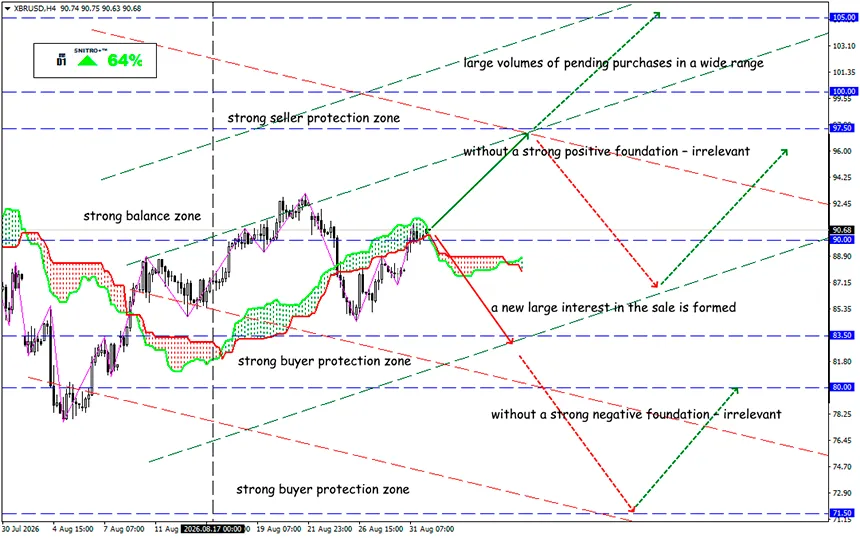
XBR/USD
Key zone: 87.50 - 91.50
Buy: 91.50 (on a pullback after retesting 90.00); target 93.50-95.50; StopLoss 90.80
Sell: 86.50 (on strong negative fundamentals); target 83.50-81.50; StopLoss 87.20
The U.S. could gain control over most of Venezuela’s oil production under a new agreement with the country. This would give Washington majority control over projects with more than 65 billion barrels of proven reserves.
Trump announced the agreements on Friday evening on Truth Social. According to him, the deal resulted from cooperation with private businesses and the Rodríguez administration.
A reminder:
Venezuela is considering leaving OPEC following the UAE. No decision has been made yet. For the oil market, the danger is not the withdrawal itself, but the further weakening of the Cartel. There will be no immediate increase in supply: Venezuela produces about 1.2 million barrels per day and is already exempt from OPEC+ quotas. Therefore, the short-term reaction in Brent should be limited.
The U.S. plans to control 55% of actual production and obtain oil at cost. The joint venture is expected to receive 100-year concessions for the fields. President Rodríguez said on television that the agreement would bring jobs and economic growth to the country, while Venezuela’s profit would amount to about $19 for each barrel produced.
Under the terms of the agreement:
- Washington plans to acquire 35% of the private company North American Blue Energy Partners, headed by Venezuelan businessman Alejandro Betancourt. He owns the country’s second-largest private oil business.
- The U.S. will receive the right to purchase, at cost, a guaranteed 20% of the oil from all existing and future fields managed by the company.
- Washington will also receive a preferential right to purchase the remaining 80% of production, giving it access to additional supplies in emergency situations.
- North American Blue Energy Partners plans to issue licenses or establish joint ventures with energy companies to develop 17 Venezuelan fields under 100-year concessions.
- Restoring the 17 fields and increasing production by approximately 1.5 million barrels per day will require about 10 years and $100 billion.
Trump says that by gaining control over 65 billion barrels of Venezuelan oil, he will solve several problems at once: increase U.S. oil reserves, attract investment into Venezuela’s devastated energy sector, and reduce gasoline prices for American consumers.
For modern U.S. policy, this level of direct government involvement in overseas oil projects is unusual. If the plans are implemented, the new structure will become the second-largest corporate holder of proven oil reserves after Saudi Aramco.
This oil will be used to replenish the U.S. Strategic Petroleum Reserve. The domestic factor is also important for Trump: the administration is trying to contain gasoline prices and inflation ahead of the November midterm elections to Congress.
Trump’s latest “deal” is being criticized by both his allies and the opposition. Political risks could deter investors.
For example, Chevron, the only U.S. corporation currently producing oil in Venezuela, declined to comment. ExxonMobil and ConocoPhillips also declined to comment on the agreement.
So, What Does This Mean?
Political risks exist both in Washington and Caracas. If investors are not confident that the agreement will survive a change of government in both countries, convincing them to invest billions of dollars will be difficult.
The new arrangement is expected to persuade U.S. companies to return to a country that has expropriated billions of dollars worth of their assets over the past several decades. Developing Venezuelan oil fields requires enormous expenditures. A significant share of the country’s reserves consists of extra-heavy, highly viscous crude that requires specialized equipment and technologies for production and refining. Venezuela needs oil gathering systems, pipelines, electricity, heavy-crude processing capacity, diluents, logistics, and the restoration of severely deteriorated infrastructure.
Moreover, the agreement could contradict Venezuela’s constitution. Betancourt’s involvement raises additional questions, as he has been investigated in Switzerland on suspicion of money laundering.
Therefore, lower gasoline and diesel prices for American consumers, which Trump is counting on, remain a distant prospect at best.
We will see what comes of it.
So we act wisely and avoid unnecessary risks.
Profits to y’all!


