



Trial against the president: will the market breathe easier?

Trump’s tariffs declared illegal
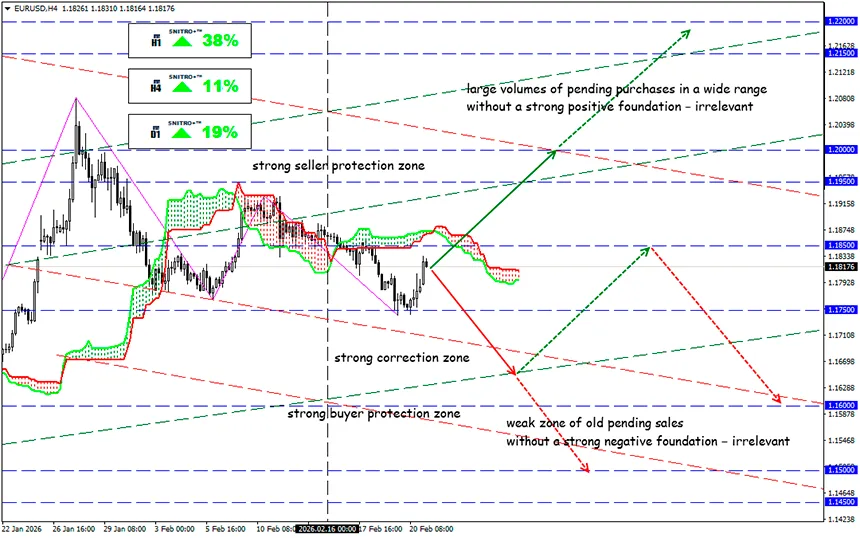
EUR/USD
Key zone: 1.1750 - 1.1850
Buy: 1.1850 (after retesting the 1.1800 level) ; target 1.2050-1.2150; StopLoss 1.1780
Sell: 1.1700 (on strong negative fundamentals) ; target 1.1500; StopLoss 1.1770
The U.S. Supreme Court ruled that the president violated federal law when he unilaterally raised tariffs against all of the country’s trading partners. The core verdict: Trump does not have the authority to impose tariffs “without limits as to amount, duration, and scope” unless he has a direct and clear mandate from Congress.
The case concerns tariffs introduced under the 1977 IEEPA law — the “International Emergency Economic Powers Act.” Trump declared the U.S. trade deficit a “national emergency” and separately cited threats related to fentanyl supplies. The Court stated that this “emergency” provision was not intended to grant the president authority to impose tariffs of such magnitude and that it “falls short” of the required level of power.
Nevertheless, the tariff war is not over, and the market has received a new dose of risk.
Reminder:
The market reacted not to the cancellation of all tariffs, but to the fact that the key mechanism for imposing them was declared unlawful. This reduces the likelihood of sudden decisions where tariffs are introduced quickly and without lengthy procedures.
The Supreme Court did not close the issue: the practical implementation of the ruling is now beginning — which tariffs exactly fall under the decision and how they should be handled. A separate painful issue is refunds to importers: the justices essentially left this to lower courts, so there will be no rapid automatic repayments. More than $175 billion may have been collected under these tariffs, and separate legal disputes may now arise around this sum.
So what is the outcome?
An enraged Trump revised his tariff stance within hours, raising them to a maximum of 15% under Section 122 compared to the initial 10%. But anger is a poor advisor.
- The “new” universal tariff turned out to benefit those whom Trump had actively criticized, such as China and Brazil. Their average tariff rates will now be significantly reduced.
- Strategic U.S. allies — the EU, the United Kingdom, Japan — will receive a new tariff blow, especially in high-tech and industrial segments.
- Countries that had not yet finalized a trade “deal” with Trump have halted negotiations.
At the same time as cryptocurrencies rose, demand for risk assets increased overall, while the dollar began to weaken. The dollar index declined, and yields on U.S. Treasuries rose — reflecting expectations that tariff pressure on the economy may ease.
The Supreme Court’s decision matters not as a “political news story,” but as a factor that changes the speed and scale of potential market shocks.
- The European Parliament was supposed to ratify the agreement on Monday but now intends to refuse; the European Commission says it awaits clarification from the U.S. regarding the tariff increase and urges Trump to adhere to the reached consensus.
- South Korea is in no hurry to ratify its agreement with the U.S. and will continue consultations.
- India will not only refrain from ratifying the trade agreement but will even postpone its visit to the U.S. until there is greater certainty.
- It is clear that no one wants to sign an agreement with Trump when it is more выгодно to pay 15% instead of 30% plus investment commitments and obligations to purchase U.S. goods.
- Trump may introduce new tariffs only for 150 days, and there are not enough votes in Congress to extend such tariffs.
Introducing global tariffs “in one step” will now be more difficult: such measures require direct Congressional approval rather than reliance on emergency powers. This reduces the risk of sudden tariff shocks and gives the market more time to adapt.
At the same time as cryptocurrencies rose, demand for risk assets increased overall, while the dollar began to weaken. The dollar index declined, and U.S. Treasury yields rose — reflecting expectations that tariff pressure on the economy may ease.
But uncertainty does not disappear completely — everyone understands that Trump remains unpredictable — the administration still has alternative legal mechanisms, meaning the tariff issue could return to the market agenda at any moment.
So we act wisely and avoid unnecessary risks.
Profits to y’all!


