



The Yen is falling, but it is not sinking yet
The Japanese currency is nearly three times undervalued against the dollar
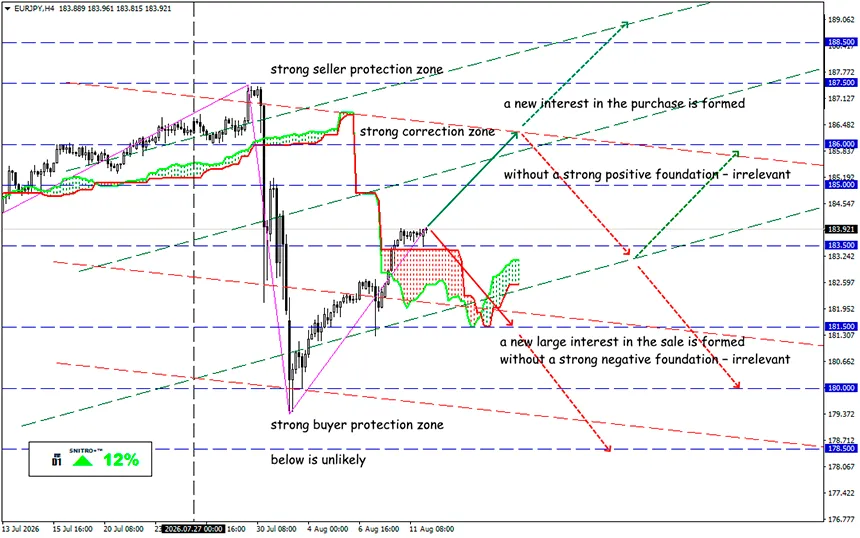
EUR/JPY
Key zone: 183.00 - 184.50
Buy: 185.00 (on strong positive fundamentals); target 187.50; StopLoss 184.30
Sell: 182.50 (after retesting 183.50) ; target 181.00-180.50; StopLoss 183.20
The yen does look extremely cheap in real terms, but that does not mean the market is obliged to return it immediately to some theoretical “fair value.” Currency valuation points to the direction of long-term asymmetry, while the timing of a reversal is determined by interest-rate differentials, carry costs, capital flows, the energy balance, and the Bank of Japan’s response.
There are no signs of a catastrophe yet, but some unconventional indicators suggest that if the goal were to bring purchasing power closer to the levels seen in other high-income countries, the yen would need to strengthen significantly.
Let’s recap:
The yen moved into the spotlight after the largest coordinated U.S.-Japan currency intervention in 15 years. Authorities entered the market after the Japanese currency fell to its weakest level against the dollar in 40 years. Since then, the yen has already given back roughly half of the gains achieved after the intervention.
Analysts at Bank of New York calculated a fair value for USD/JPY using the price of a popular Japanese dish, katsu curry. Their calculations suggest that the gap between the market exchange rate and the currency’s purchasing power is far wider than implied by The Economist’s famous Big Mac Index. The price of rice with a pork cutlet and curry sauce appears to show more clearly just how strongly the yen’s decline is being felt inside Japan.
So, the market rate is roughly ¥159 per dollar, while calculations based on the Katsu Curry Index imply a rate of only ¥62.18 per dollar.
- A weak yen increases the cost of fuel, food, raw materials, equipment, and imported consumer goods. The BoJ notes that exchange-rate pass-through into final prices has become stronger than in previous periods, as companies are now more willing to raise prices and wages at the same time.
- If even a serving of katsu curry or a bowl of ramen becomes too expensive for Japanese consumers, pressure for a change in economic policy is likely to intensify.
- The broad real effective exchange rate of the yen, calculated by the BIS using trade weights and relative inflation, fell to 65.30 in June 2026, with 2020 set at 100. That is 34.7% below the base-year level and roughly 11.8% below the June 2025 reading.
- In price-based and purchasing-power models, the yen is extremely cheap. In balance-of-payments models, however, its apparent fundamental undervaluation has not been conclusively proven.
This explains why the currency cannot be bought simply because its REER is at historically low levels. A catalyst is needed for the value factor to materialize: faster BoJ rate hikes, a reduction in foreign carry trades, capital repatriation, or a sustained decline in energy prices. Japan’s external market position still broadly corresponds to its fundamental conditions.
In its July outlook, the BoJ’s median forecast for inflation excluding fresh food in fiscal 2026 is 2.5%. The same figure is expected for the index excluding fresh food and energy. The central bank sees inflation risks as tilted to the upside and explicitly states that it intends to continue raising rates as the baseline scenario unfolds.
The BoJ notes that higher oil prices reduce corporate profits and real incomes, while a weaker yen raises import prices and hits small and medium-sized businesses particularly hard. At the same time, global Japanese companies benefit from the currency translation of overseas earnings.
So, what does this mean?
In other words, the euro may partially offset yen strength. For example, if USD/JPY falls while EUR/USD rises at the same time, the decline in EUR/JPY may be much smaller than expected.
As long as the price remains below 184.57, the recovery after the intervention-driven decline looks more like a correction than a full resumption of the uptrend. But a sustained move above 188 would change that assessment.
So we act wisely and avoid unnecessary risks.
Profits to y’all!


