



The U.S. treasury is trying to save the dollar
The Treasury is increasing the volume of government debt buybacks
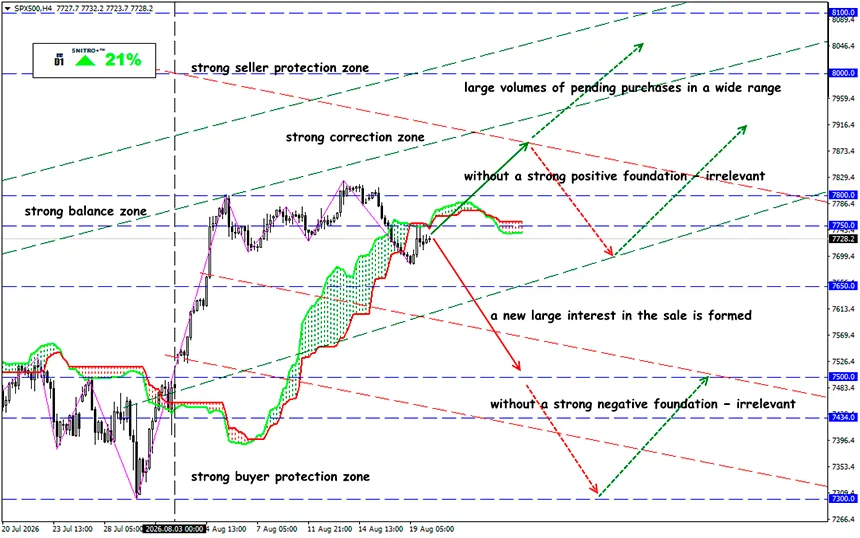
SP500
Key zone: 7,700 - 7,800
Buy: 7,850 (after retesting 7,600); target 8,100; StopLoss 7,780
Sell: 7,650 (on strong negative fundamentals); target 7,450-7,350; StopLoss 7,720
The dollar is becoming a potential casualty of Washington’s efforts to contain long-term borrowing costs in the U.S. Investors are reassessing the currency after the Treasury expanded its purchases of outstanding government bonds, raising questions about how far policymakers are prepared to go to contain yields.
The Treasury will at least double its buybacks of long-term government bonds after yields reached their highest levels. The new limit will be at least $4 billion per operation.
A reminder:
Long-term bonds around the world are under intense pressure: investors are demanding a higher premium for holding debt for several decades. In the U.S., this pressure is being amplified by concerns over the budget deficit, substantial borrowing needs, and rising costs of servicing the federal debt.
- Treasury bond buybacks are primarily not intended to reduce the overall level of government debt. Instead, they allow the department to repurchase older and less liquid securities, improving market functioning.
- The current buyback process is aimed at supporting liquidity in the segment of the market ranging from 10-year to 30-year bonds, where selling pressure has been the strongest. Lower yields put pressure on the dollar.
- The market reacted quickly: the 30-year Treasury yield fell to around 5.185%.
- Today, the dollar index remained near a three-month low after falling about 0.8% the previous day. The yen, Swiss franc, and New Zealand dollar were among the currencies that strengthened against the dollar.
- The Treasury is also preparing to issue $16 billion in new 20-year bonds, which will provide another test of demand for long-duration debt.
What this means for bond markets
The announcement shows that the Treasury is prepared to respond to deteriorating liquidity at the long end of the yield curve. This could help reduce volatility and improve trading conditions, especially for older securities that are more difficult to buy and sell.
Nevertheless, buybacks do not eliminate the factors pushing yields higher. Substantial government borrowing, a large budget deficit, and persistent inflation risks remain key problems. If these pressures continue, the effect of increased buyback volumes may prove temporary rather than lead to a sustained reversal in long-term yields.
So, what does this mean?
The Treasury’s intervention in the open market solves one problem while potentially creating another. Lower long-term yields may ease financing conditions, but at the same time weaken one of the dollar’s main pillars of support.
Confidence in U.S. economic policy is declining: the substantial budget deficit requires massive Treasury issuance, while keeping borrowing costs at acceptable levels is becoming increasingly important for Washington.
Some investors are now questioning whether bond buybacks signal growing fiscal pressure on the currency. For now, the dollar continues to receive support from deep capital markets, strong demand for U.S. assets, and AI-related investment.
If the U.S. Treasury continues to contain long-term yields through buybacks while fiscal borrowing remains elevated, investors will increasingly shift capital into alternative assets — the yen, Swiss franc, euro, and gold.
And Trump definitely won’t like that.
So we act wisely and avoid unnecessary risks.
Profits to y’all!


