



The Pound vs. the budget
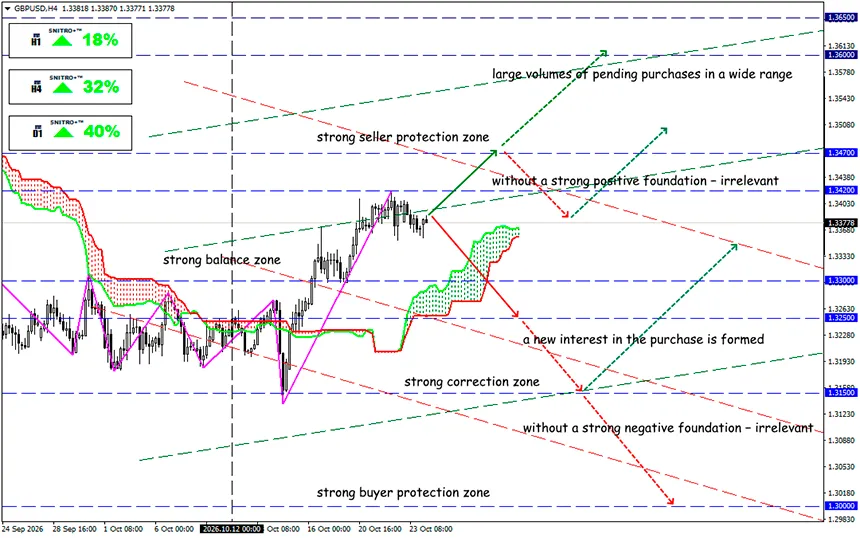
Can GBP/USD withstand the threat of new taxes?
GBP/USD
Key zone: 1.3300 - 1.3400
Buy: 1.3420 (on strong positive fundamentals) ; target 1.3600-1.3650; StopLoss 1.3350
Sell: 1.3250 (on a pullback after retesting 1.3350) ; target 1.3100-1.3050; StopLoss 1.3320
The UK budget will test investors' confidence in government debt and present another challenge for the British pound. High inflation, rising gilt yields, and shrinking fiscal headroom are limiting the government's room for maneuver. New taxes could strengthen creditors' confidence but also slow economic growth.
A quick recap:
On October 28, UK Chancellor of the Exchequer John Healey will present the Autumn Budget to the House of Commons. Following the budget statement, the Office for Budget Responsibility (OBR) will publish its updated Economic and Fiscal Outlook, including forecasts for economic growth, inflation, government borrowing, and the debt burden through fiscal year 2031/32.
The main question is not which new taxes will be introduced, but whether the government can ensure fiscal sustainability amid high interest rates and an energy shock.
In March, the government's fiscal headroom against its budget rules stood at approximately £24 billion. However, the subsequent rise in bond yields increased expected debt-servicing costs. Ahead of the budget, market estimates of available headroom had fallen to approximately £10–12 billion. This is a preliminary estimate, not a published result from the OBR's new forecast.
Existing political commitments restrict the government's ability to raise the main rates of income tax, VAT, and National Insurance contributions for working people. Investors are therefore focusing on potential changes to smaller taxes, tax reliefs, and revenue-raising mechanisms.
Three mechanisms matter for the currency market.
- Taxes and the budget deficit. A credible increase in government revenue reduces projected borrowing and could lower the fiscal risk premium.
- Taxes and economic growth. A higher tax burden on households and businesses constrains domestic demand, weakening the outlook for corporate earnings and investment.
- Taxes and inflation. Weaker demand could ease core inflation and reduce the need for further Bank of England (BoE) tightening. However, increases in indirect taxes could initially push consumer prices higher.
The key takeaway for traders: a fiscally restrictive budget does not necessarily mean a stronger pound.
The budget will be released just eight days before the next BoE meeting on November 5. In September, the BoE approved a multiyear plan to reduce its remaining government bond portfolio, involving annual sales of £20 billion and an average annual portfolio reduction of approximately £46 billion through the end of 2034. This maintains additional bond supply in the market.
In early October, 30-year gilt yields exceeded 6%, reaching approximately 6.05%, while 10-year yields tested the 5.53% area. By October 21, these yields had declined to approximately 5.83% and 5.40%, respectively.
A simultaneous rise in 30-year gilt yields, widening spreads against comparable foreign bonds, and a decline in GBP/USD would indicate an increase in the UK's risk premium rather than simply expectations of higher interest rates.
Traditionally, a weaker GBP supports the sterling-denominated revenue of international corporations when their dollar earnings are translated into pounds. However, this effect does not apply equally across all industries. Therefore, assessing the budget's impact requires comparing the FTSE 100 with the more domestically focused FTSE 250 rather than relying on the performance of a single index.
So What Is the Outcome?
Exchange rates depend on confidence, not just interest rates. Even a favorable market reaction to the UK budget does not guarantee that GBP/USD will continue rising: more hawkish Fed rhetoric could reverse the pair's direction on the same day.
The base-case scenario is elevated GBP/USD volatility within the 1.3200–1.3500 range, with the possibility of a subsequent directional breakout. The current technical structure moderately favors the pound, but resistance at 1.3400–1.3420 has yet to be overcome.
For medium-term traders, the most justified strategy is to wait for the OBR publication, assess the reaction in gilts, and then confirm the direction following the Fed's decision. Until then, opening a large directional position carries substantial speculative risk.
So we act wisely and avoid unnecessary risks.
Profits to y’all!


