



2025 Results: the market makes money on the dollar

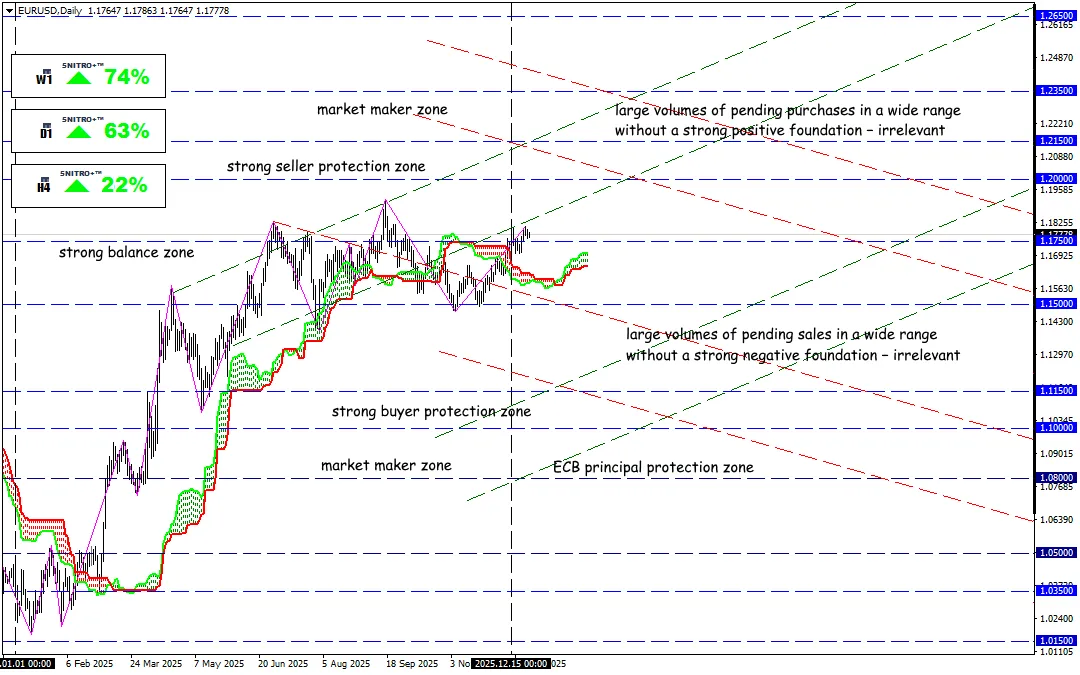
The Dollar as the Main Growth Driver
In the outgoing year, the greenback showed its worst performance in eight years, falling by about 9% against a basket of major currencies. This was driven by the market’s systematic re-pricing of future Federal Reserve policy, as well as rising fiscal risks and political uncertainty. The most profitable trading idea of last year was the trend of G10 currencies strengthening against the US dollar.
Even amid strong data (such as US GDP growth in Q3), the market toward year-end remained focused on expectations of monetary easing in 2026 rather than on the current state of the US economy.
Trump’s tariff policy destroyed traditional market arguments, forcing currencies to build their own narratives.
Euro
The European currency became a clear beneficiary of a weak USD: EUR/USD rose by approximately 13–14%.
The ECB paused its rate-cutting cycle, yet paradoxically the euro strengthened even while the ECB was easing monetary policy. The main risks for the EU remain trade barriers and geopolitics, particularly the need for structural economic restructuring in connection with the war in Ukraine.
British Pound
GBP performed better than expected thanks to the cautious policy of the Bank of England, but still rose only about 8%.
In December, the BOE nevertheless cut rates to 3.75%, while stating it was not ready for further easing due to inflation risks.
Yen
Despite a policy shift by Japan’s monetary regulator, USD/JPY remains elevated due to the interest rate differential. What matters to the market is not the fact of BOJ rate hikes, but the pace of normalization and the final “neutral” rate. If the BOJ moves slowly while US yields remain relatively high, USD/JPY may stay elevated.
Australian Dollar
The Aussie leveraged the US–China conflict, using a weak dollar as a tailwind: AUD/USD rose by about 8.5% over the year. The RBA continues to hold rates around 3.85%. The key drivers remain expectations of Chinese demand and overall risk appetite in commodity markets.
Canadian Dollar
The CAD continues to suffer: USD/CAD fell by about 4.8%. Although oil prices in 2025 reacted surprisingly calmly to geopolitics, this reduced the resilience of the traditional “oil support” for the Canadian currency. US trade policy remains a key risk, with uncertainty around USMCA trade terms in 2026 weighing on investment.
Throughout the year, markets reacted excessively to debates, conflicts, negotiations, and agreements related to tariffs and revisions of existing trade deals. These factors fueled speculation and continued to worsen long-term expectations for the US. Most major conflicts have now stabilized, except for one: US–China.
All geopolitical factors remain relevant. Conflicts in the Persian Gulf and Ukraine are far from resolution, while China has begun provocative military maneuvers near Taiwan — a clear signal of a potential new armed conflict involving the US. If this materializes, the dollar will come under severe pressure, and capital will once again flow into derivatives and commodities.
For now, at least through the first quarter, we continue to trade based on the fundamental influence of the greenback — that is, we look not for strong currencies, but for a weak dollar.
If the Fed shows indecision and the market continues to price in US rate cuts, the dollar will remain weak. New trade or military conflicts may trigger sharp moves, but without a sustainable trend. The medium-term direction of the dollar will be determined exclusively by the US economy, so close attention to US macroeconomic data — now expected to return to a normal publication schedule — is essential.
So we act wisely and avoid unnecessary risks.
Profits to y’all!


