



Don’t Trust Politicians: The Market Makes Its Own Decisions

How Verbal Interventions Threaten Stability
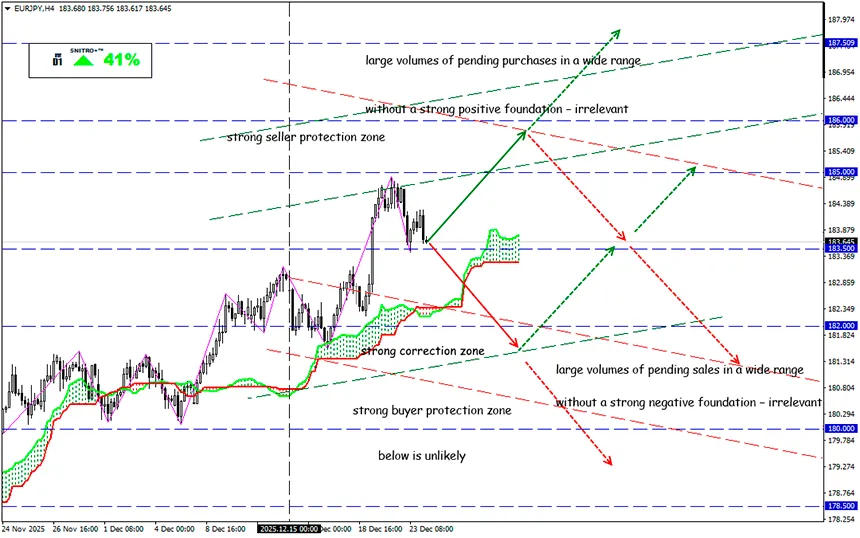
EUR/JPY
Key zone: 183.50- 184.50
Buy: 185.00 (on strong positive fundamentals) ; target 187.00-187.50; StopLoss 184.30
Sell: 183.00 (on a pullback after retesting the 184.50 level) ; target 181.50; StopLoss 183.70
Financial markets are a fragile, nervous system. Investors, politicians, analysts, and financial officials with varying levels of responsibility constantly debate, promise, and issue threats. Over the past two weeks, the information space has been flooded with discussions about monetary policy in major economies, particularly the ECB.
Where did the idea come from that the European regulator has completed its rate-cutting cycle?
In early December, ECB Executive Board member Isabel Schnabel, in private comments, acknowledged the possibility of rate hikes next year. Any central bank must remain flexible given economic conditions, but there was no hidden signal or concrete guidance in her words.
Nevertheless, markets immediately began speculating about monetary tightening.
The ECB is indeed closer than other central banks to a potential tightening phase, while the Fed and the Bank of England are expected to continue easing into 2026. However, no concrete decisions are planned in the near term.
It is important to remember that inflation is the key variable guiding central bank decisions. If inflation accelerates, tightening becomes possible. At present, inflation is near the ECB’s target, and its future trajectory is highly uncertain.
Our base case suggests that European rates are unlikely to change for at least six months. So why the panic?
A second example is the Japanese yen, which received verbal support from Japanese officials signaling readiness for currency intervention.
Japan’s Finance Minister Satsuki Katayama stated that public debt remains high and that reducing new bond issuance may be considered in the 2026 fiscal budget. Excessive yen volatility triggered stop-losses on both sides of the market, despite the fact that such measures would have, at best, a medium-term effect and would not materialize without fiscal action or changes in Bank of Japan policy.
Information pressure increases demand for safe-haven assets, temporarily supporting the yen. However, there is no strong fundamental basis for a sustained move.
Fresh US macro data has also fueled skepticism and disproportionate reactions.
Take US GDP as an example:
Q3 GDP showed strong growth of 4.3% (versus expectations below 3%), yet the GDP deflator indicates that growth was driven by higher prices rather than real output.
How can the US economy post such GDP growth amid rising unemployment, declining inflation, weak business activity, industrial slowdown, and soft retail sales?
This “anomaly” can only be explained by distorted data and fiscal effects from Trump’s import tariffs.
Following the GDP release, expectations for a January Fed rate cut dropped below 10%.
But how can monetary forecasts be taken seriously when Trump has stated he will never appoint a Fed chair who disagrees with him on any issue? Fundamental factors may be ignored, but speculators will continue to exploit this narrative aggressively.
Long-term prospects for the dollar remain uncertain, and downside risks could intensify depending on January macroeconomic releases.
So we act wisely and avoid unnecessary risks.
Profits to y’all!


