



The Greenback turned the market around
Why the bet on a falling dollar isn’t working
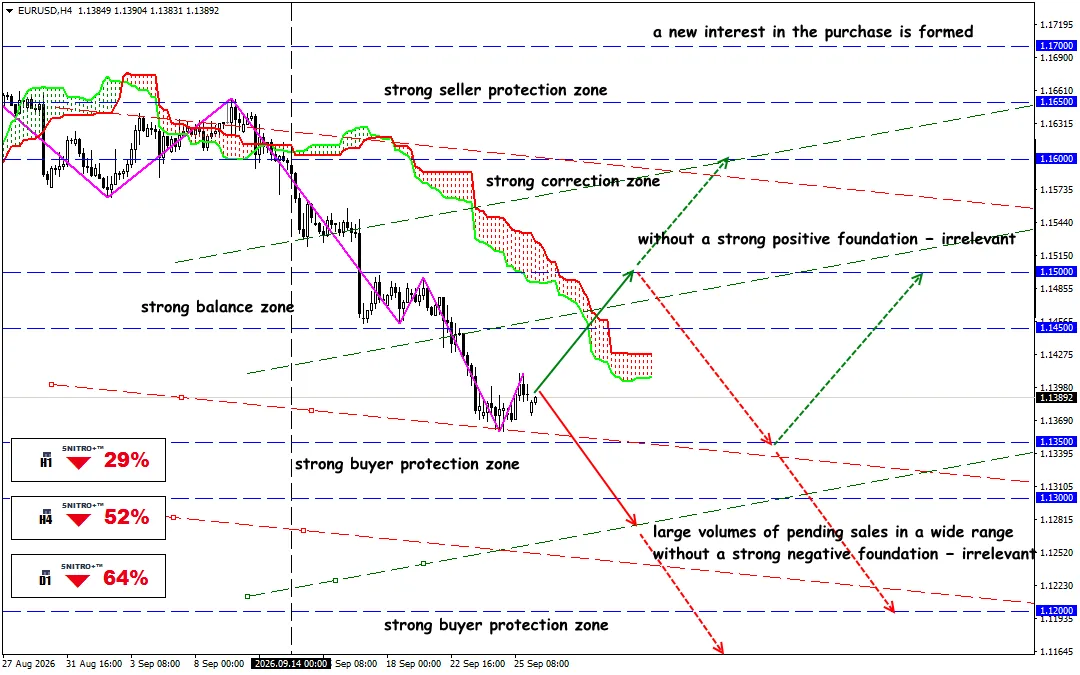
EUR/USD
Key zone: 1.1350 - 1.1400
Buy: 1.1450 (on a strong positive fundamental basis) ; target 1.1650; StopLoss 1.1380
Sell: 1.1300 (on a pullback following a retest of 1.1350) ; target 1.1150-1.1100; StopLoss 1.1370
A hawkish Fed, Treasury yields above 5%, and the geopolitical premium are shifting the balance of power in financial markets. But an overheated dollar already calls for more cautious tactics: the next impulse will depend on inflation, oil, and rate expectations.
The dollar has shifted from defense to offense: Fed rates, Treasury yields, oil, and geopolitics are creating a new impulse. But DXY has already approached 100.50, while fund positioning is turning bullish — simply buying the dollar at the highs is losing its edge.
A reminder:
Until recently, gradual weakening remained the base-case scenario for the dollar. Now the market is being forced to reposition following the Federal Reserve’s September 16 decision. The U.S. Federal Reserve raised the target range for the federal funds rate by 25 bps — to 3.75–4.00%. This was the first increase in three years. At the same time, the regulator explicitly indicated that inflation remains elevated, while economic activity, consumer demand, and productivity remain resilient.
The median rate forecast for the end of 2026 stands at 4.1%, compared with 3.8% in the June version. At the same time, the median forecast for PCE inflation in 2026 was raised to 3.7%, while core PCE was raised to 3.4%.
In other words, the market received exactly the combination of factors capable of supporting the dollar: a higher rate + higher inflation + no need to urgently rescue the economy by lowering the cost of money.
The rates market quickly reflected this. For the FX market, this is a fundamental shift. The dollar no longer needs to demonstrate a perfect economic picture. It is enough for U.S. rates to remain higher than expectations for rates in other developed economies.
The U.S. government debt market is becoming the main factor. The 10-year Treasury yield rose to 5.23% on September 25, its highest level since 2007. The 30-year yield reached 5.49%, its highest level since 2004.
This is no longer simply a technical move in bonds. Rising long-term rates imply a massive repricing of the cost of capital across the global financial system.
The current dollar impulse has another unconventional argument — energy.
Brent repeatedly climbed above $100 per barrel in September. When oil rises because of geopolitical risk, the market experiences two effects simultaneously:
- inflation expectations increase;
- the probability of the Fed maintaining tight policy rises.
As a result, oil can paradoxically support the dollar even when it itself poses a threat to economic growth.
For traders, this leads to a simple conclusion: watching DXY alone is no longer enough.
Brent and 10-year Treasuries need to be monitored simultaneously. A sustained rise in both indicators at the same time would create the strongest fundamental environment for the USD.
And What Is the Result?
The dollar is rising not because its problems have disappeared. The mistake made by investors and analysts was to automatically interpret the structural problems of the U.S. — enormous government debt, the budget deficit, and political risks — as arguments against the dollar.
more debt → higher yields → higher funding costs → tighter financial conditions → stronger dollar in the short term.
Therefore, the current USD move cannot automatically be interpreted as the beginning of a multi-year bull cycle.
But the higher DXY climbs, the more the market will depend on new macroeconomic data. Therefore, the main trading idea is not to buy the dollar at any price, but to use corrections to build positions when high U.S. rates and yields are confirmed.
If oil, inflation expectations, and Treasury yields begin to decline simultaneously, the current dollar impulse will become vulnerable much earlier than this becomes visible in the fundamental indicators of government debt.
So we act wisely and avoid unnecessary risks.
Profits to y’all!


