



The ghost of a truce in the commodity market

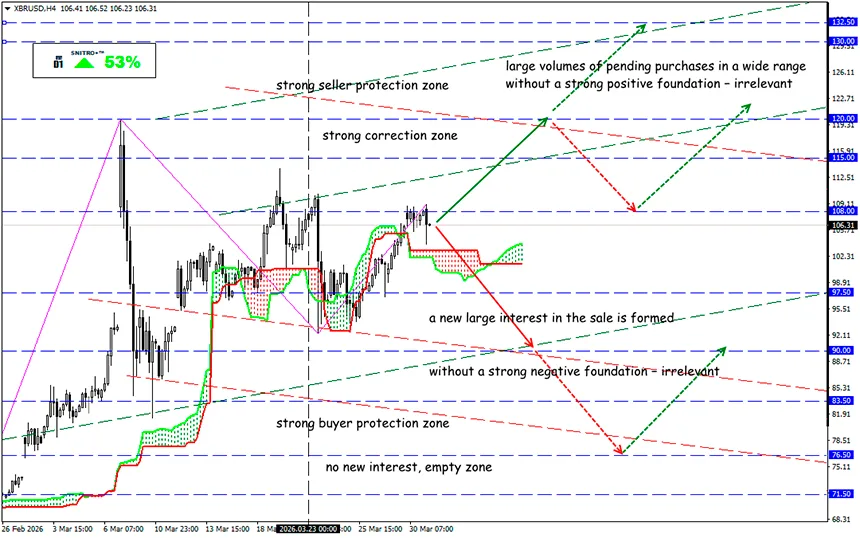
What will happen to oil prices
XBR/USD
Key zone: 105.00 - 108.00
Buy: 108.50 (on strong positive fundamentals); target 110.50-112.00; StopLoss 107.50
Sell: 103.50 (on a decisive break above 105.00); target 100.00; StopLoss 104.50
In March, the price of Brent surged by more than 55%, which became the most significant monthly increase in history. Oil is preparing for a new assault on the $108–100 zone after the Yemeni Houthis opened a new front in the conflict with Iran. The region’s transport logistics remain paralyzed.
The price of Brent futures with May delivery increased by 2.5% (to $115.45), WTI futures with the same delivery rose by 1.5% ($101.17).
Trump stated his intention to “seize oil” in Iran and redirect it to new markets, which increases concerns about growing risks to energy supplies in the Middle East.
Let us recall:
In Venezuela, the United States has effectively established control over the oil sector after the overthrow of Nicolás Maduro. Crude from Venezuelan fields is being sent directly to the U.S. market.
Prolonged disruptions in oil supplies in the Middle East may trigger a price spike to $150 as early as April.
A minor decline in price caused by Trump’s verbal interventions is quickly offset by panic due to supply problems through alternative routes, for example through the Bab-el-Mandeb Strait between the Gulf of Aden and the Red Sea. Approximately 4–6 million barrels of oil per day pass through this strait, and production capacity is insufficient to increase this volume.
By the way, Saudi Arabia has increased oil exports through the Red Sea to almost 5 million barrels per day, which makes it possible to compensate for 45% of the supply volume that previously went through the Strait of Hormuz.
What should we expect from oil under such conditions?
- Global stock markets are expecting a long-term (not speculative!) increase in prices and higher interest rates, taking into account the growing probability of a prolonged conflict. The blockade of the Strait of Hormuz increases the risk of recession, not only in the U.S., but also in the countries of the conflict region.
- The seizure of Iran’s export center — Kharg Island, through which about 90% of the country’s oil supplies pass — will effectively stop the inflow of dollars into Iran. This will intensify a large-scale escalation with retaliatory strikes on critically important infrastructure in the Persian Gulf countries.
- This escalation may quickly spread to global supply routes. Even if alternative routes through the Suez Canal are used, capacity will drop sharply, which may potentially lead to a reduction in market supply by 4–5 million barrels per day.
And what is the result?
Throughout the entire month the oil market has been operating in a force majeure mode, and this mode is still in place.
Even if information about Trump’s readiness to stop military actions without lifting the blockade of the Strait of Hormuz is confirmed, the restoration of ship traffic through the strait is possible no earlier than mid-April.
A stable long-term rise in oil looks unlikely: such prices inevitably create recession risks. The only question is timing — it may take months. If we look beyond a 6-month horizon, a price decline looks like the more likely scenario.
- A complete and long-term blockade of the Strait of Hormuz is impossible. The United States, the United Kingdom and their allies may organize a convoy or take military action. Even Iran understands that a full closure of the strait would cause serious damage to its economy.
- Demand elasticity: when prices reach $150 and higher, consumers reduce oil consumption, companies cut costs, and the development of renewable energy accelerates. As a result, prices may stabilize in the $120–150 range.
At the moment, investors are actively searching for the “pain point” that will force Trump to change his approach to the war. The consolidated forecast of analysts suggests a Brent price around $125 — one should be very careful with short positions.
So we act wisely and avoid unnecessary risks.
Profits to y’all!


