



The Fuel market crisis is going global
There is enough oil. The Problem is refining and logistics
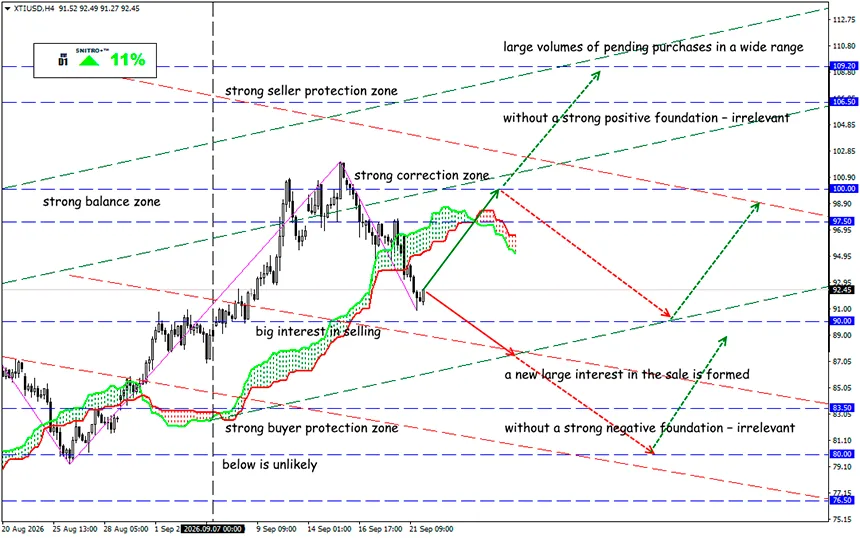
XTI/USD
Key zone: 90.00 - 93.50
Buy: 94.00 (on a confident break above 93.50); target 96.50; StopLoss 93.30
Sell: 88.50 (on strong negative fundamentals); target 86.50-85.50; StopLoss 89.20
The diesel market is entering a shortage zone where the main constraint is no longer the availability of crude oil, but the ability to quickly turn it into fuel and deliver it to consumers. Historically low inventories, record refinery margins, military conflicts, and the disruption of supply logistics are turning diesel fuel into an independent inflationary factor.
The U.S. market is sending the strongest signal. The EIA expects U.S. distillate inventories to fall below 100 million barrels as early as September. This is no longer a normal seasonal fluctuation, but a structural supply problem.
The diesel shortage has already reached gas stations. Wholesale pressure is quickly feeding through to retail prices. On September 21, the average price of diesel fuel in the U.S. reached a record $6.51 per gallon, compared with $6.23 a week earlier and $3.70 a year ago.
The chain looks like this: diesel becomes more expensive → transportation costs rise → carriers increase fuel surcharges → the cost of goods rises → corporate margins are squeezed → inflationary pressure reaches the end consumer.
That is precisely why diesel can become a more persistent inflationary factor than gasoline. The price of gasoline is visible directly at gas stations. A significant part of the cost of diesel is hidden inside the price of virtually every product transported by truck.
A reminder:
Empty storage tanks are one of the most alarming signals. Fuel storage capacity available for lease in North America and the Caribbean for October has risen to 13 million barrels — the highest level in four years, compared with 11 million in June. Traders and refiners are not renewing leases because they have nothing to store. Storage tank contracts are typically signed for 6–12 months, meaning market participants do not expect commercial inventories to recover quickly.
The market effectively pays for storage only when there is a product worth storing.
An even stronger signal is coming from refining. The record crack spread shows where the shortage is.
On September 14, the U.S. ULSD crack spread — the premium of ultra-low-sulfur diesel futures over U.S. crude oil — reached a record $118.62 per barrel.
A crack spread of this magnitude is not the new market norm. It is the price of scarcity.
The EIA expects the average U.S. diesel crack spread to remain above $2 per gallon from August through November, after which it will begin to decline through mid-2027. But this forecast assumes the normalization of tanker flows through the Strait of Hormuz and a recovery in petroleum product exports from the Middle East. If restrictions persist beyond the end of 2026, global crack spreads could be significantly higher than the current baseline scenario.
The U.S. market is the most obvious indicator, but fuel shortages are also being seen in Europe and Asia. Analyzing only Brent and WTI is becoming insufficient. Several indicators are much more important for assessing the state of the diesel market.
- EIA distillate inventories — the zone below 100 million barrels is becoming a key indicator.
- ULSD crack spread — a sustained decline in margins will be one of the first signs that additional production is actually beginning to catch up with demand.
- U.S. refinery utilization — record margins should translate into a physical increase in supply. If that does not happen, the problem is no longer price, but available refining capacity.
- PADD 1, the U.S. East Coast. National statistics may appear acceptable while an individual region is already facing a shortage and is forced to import additional volumes.
- China’s export volumes, the state of Russian refining, and physical flows of petroleum products through the Middle East.
It is precisely the combination of these indicators that will make it possible to distinguish a normal price spike from a prolonged shortage of physical fuel.
And What Is the Result?
The Brent price shows the cost of crude oil. The ULSD crack spread shows the extent to which the market is experiencing a shortage specifically of refined fuel. Record margins are already creating an economic incentive for refineries to increase output, while the EIA expects the crack spread to gradually decline as transportation normalizes and supply recovers. Therefore, gradual market stabilization during 2027 remains the baseline scenario.
But until this process begins in the physical market, the margin of safety remains minimal. In the coming months, petroleum products may prove more important than crude oil itself: the market will trade not only the cost of a barrel of crude, but also the ability to turn it into diesel and deliver it where it is needed.
So we act wisely and avoid unnecessary risks.
Profits to y’all!


