



The Fed’s stress test: a signal of strength and optimism
U.S. banks increased dividends
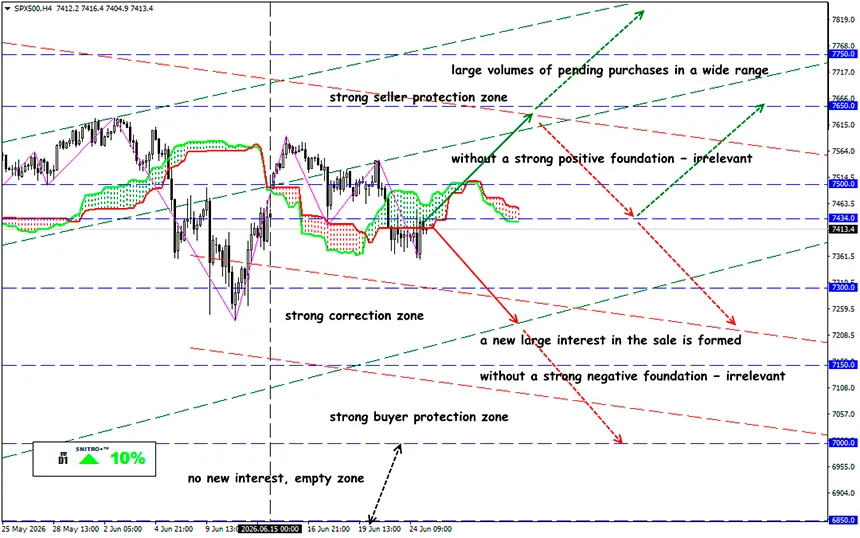
SP500
Key zone: 7,350 - 7,450
Buy: 7,500 (on a pullback after retesting 7,400); target 7,650-7,780; StopLoss 7,430
Sell: 7,300 (on strong negative fundamentals); target 71,500-70,000; StopLoss 7,370
The U.S. Federal Reserve has completed its annual stress tests of the financial system. The result was confidently positive: all 32 systemically important banks successfully withstood the simulation of a severe economic crisis, recession, unemployment rising to 10%, a real estate market crisis, and turmoil in global financial markets.
Banks received the regulator’s “green light” and immediately began sharing capital with shareholders. At the same time, the banking system as a whole maintained capital significantly above regulatory requirements.
After the results were published, announcements immediately followed about higher dividends and new share buyback programs:
- Wells Fargo announced an 11% dividend increase.
- JPMorgan Chase raised its quarterly dividend by 7% to $1.50 per share and approved a new $50 billion share buyback program.
- Bank of America increased dividends by approximately 8%.
- Goldman Sachs and Morgan Stanley also increased dividends, demonstrating confidence in the resilience of their businesses.
- Citigroup, which only a few years ago was under serious regulatory pressure, also gained the opportunity to increase shareholder payouts.
Reminder:
Over the past 10 years, stress tests have become less strict, and the easing of regulatory requirements may lead to excessive optimism among market participants. Banks are becoming better at adapting specifically to the tests, but not necessarily to real future risks.
Fed stress tests are not just a formal procedure. For investors, this is an annual health check of the U.S. financial system, because banks remain the main channel for lending to the economy. If bank capital is resilient, this means:
- The risk of a financial crisis decreases;
- The volume of stable lending to businesses and households increases;
- Dividend growth and buybacks increase the attractiveness of bank stocks, as earnings growth among U.S. companies is slowing;
- Additional demand for shares emerges through buybacks. When banks repurchase their own shares, the number of shares in circulation decreases, supporting earnings per share (EPS) and market valuations;
- The likelihood of emergency intervention by the government or the Fed decreases.
Despite the positive results, banks remain sensitive to several risks:
- a possible slowdown in the U.S. economy;
- a reduction in Fed interest rates, which could shrink banks’ net interest margins;
- problems in commercial real estate;
- growing competition from fintech companies and the private credit market.
Dividend growth is not just a gift to investors. Bank management teams are showing that they have excess capital even after modeling extreme economic shocks.
The Fed has already announced that the results of the 2026 stress tests will not affect capital requirements until 2027. This gives banks greater freedom in allocating capital between shareholders and business development.
And what is the result?
In essence, successful stress tests are an indicator of the resilience of the entire U.S. economy.
After the crises of recent years, the market is especially sensitive to the condition of the banking sector. Successful completion of stress tests reduces concerns about the financial stability of the largest players.
For now, the market sees the U.S. banking sector as one of the most resilient parts of the economy — and this is precisely what allows the largest players to return tens of billions of dollars to shareholders.
However, for investors, what matters now is not the size of payouts but banks’ ability to preserve profitability amid slowing economic growth, high funding costs, and possible Fed rate cuts in the coming quarters.
The increase in dividends by U.S. banks is a positive signal for the stock market and confirmation of the sector’s strong capitalization. For the S&P 500 index, this is an additional support factor, since the financial sector accounts for a significant share of the index.
So we act wisely and avoid unnecessary risks.
Profits to y’all!


