



The Fed prepares a double blow to markets
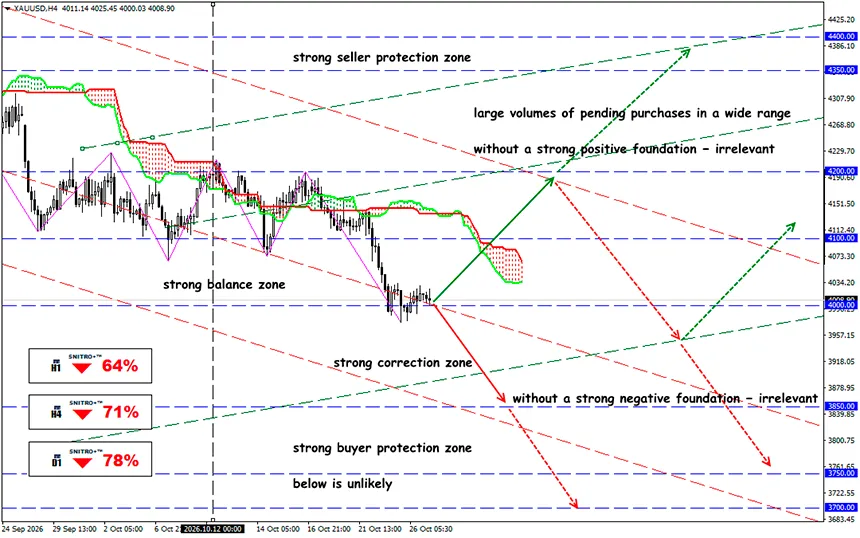
Gold ahead of the interest rate decision
XAU/USD
Key zone: 3,950.00 - 4,080.00
Buy: 4,100.00 (on strong positive fundamentals); target 4,350.00; StopLoss 4,030.00
Sell: 3,900.00 (on a pullback after retesting 4,000); target 3,650.00; StopLoss 3,970.00
The probability that the Fed will keep interest rates unchanged is extremely high, but the October 28 decision and the double impact of GDP/PCE data on October 29 could change expectations of an unfavorable FOMC decision in December. Institutional capital is positioning for a future tightening scenario.
Investors are trading not the absolute level of interest rates, but changes in the expected path of U.S. monetary policy.
A quick recap:
The Fed will make its decision before the release of two major macroeconomic reports that could change expectations for December. According to CME FedWatch, the market estimates an approximately 88% probability that the Fed will keep rates unchanged at 3.75–4.00% on October 28, versus a 12% probability of a 25-basis-point hike. In other words, leaving rates unchanged in October will not be a bullish signal.
The Fed will make its decision before the release of two major macroeconomic reports that could change expectations for December. According to CME FedWatch, the market estimates an approximately 88% probability that the Fed will keep rates unchanged at 3.75–4.00% on October 28, versus a 12% probability of a 25-basis-point hike. In other words, leaving rates unchanged in October will not be a bullish signal.
Further increases in yields will require a catalyst: a more hawkish signal from the Fed or unexpectedly strong inflation.
The correction following the historic rally is increasing pressure on gold.
Gold's decline has been accompanied by relatively stable open interest and falling trading volumes, according to available CFTC data. This pattern does not provide clear confirmation of widespread liquidation of long-term positions, but neither does it prove that buyers are ready to immediately restore the uptrend.
What Matters Right Now?
- U.S. bond real yields. If the Fed maintains a hawkish stance and real interest rates continue to rise, the recovery in XAU/USD could remain limited even amid heightened geopolitical uncertainty.
- Dollar performance. A stronger DXY makes gold more expensive for buyers using other currencies. However, during a systemic crisis, the dollar and gold can rise simultaneously.
- The structure of inflationary pressure. An acceleration in PCE inflation will not necessarily be positive for gold. If high inflation prompts investors to price in additional rate hikes, the initial reaction in XAU/USD could be negative.
For professional traders, the sequence of signals matters more than trying to predict the direction of every instrument in advance.
- Before the Fed decision: record the baseline probabilities for the December rate decision, UST 2Y/10Y yields, DXY, and TIPS real yields.
- After the Fed statement: compare the actual change in December rate expectations with the market reaction. If the dollar rises without a comparable move in short-term yields, the momentum requires additional confirmation.
- During the press conference: assess comments on inflation risks, the labor market, and the conditions for future rate hikes. Pay particular attention to divergences between the initial reaction and the price movement following answers to questions.
- Account for correlation: buying the dollar, selling gold, and, if you also trade crypto, selling Bitcoin at the same time may represent a single macroeconomic bet rather than three independent trades.
So What Is the Outcome?
The short-term outlook for gold is neutral to negative, with the risk of a sharp rebound if expectations for the December rate decision become more dovish. In the medium term, the bearish technical structure remains intact as long as gold trades below $4,120–4,260. In the long term, the potential for recovery has not been exhausted, but realizing that potential requires confirmation of a reversal.
The main battleground is $4,000. Holding this area and reclaiming $4,030 would allow buyers to test $4,075 and $4,120–4,135. A break below $3,975 would create conditions for the correction to extend toward $3,950–3,930 and potentially $3,900.
Even unexpectedly high PCE inflation does not guarantee a decline in XAU/USD if economic growth prospects deteriorate at the same time and real interest rates begin to fall.
Therefore, the strongest trading signal after October 29 will emerge when three factors align: a shift in expectations for the Fed's December decision, a directional move in real yields, and a technical breakout in XAU/USD.
So we act wisely and avoid unnecessary risks.
Profits to y’all!


