



The fate of BTC or why money is not the main factor

The CLARITY Act will determine the future of the crypto market
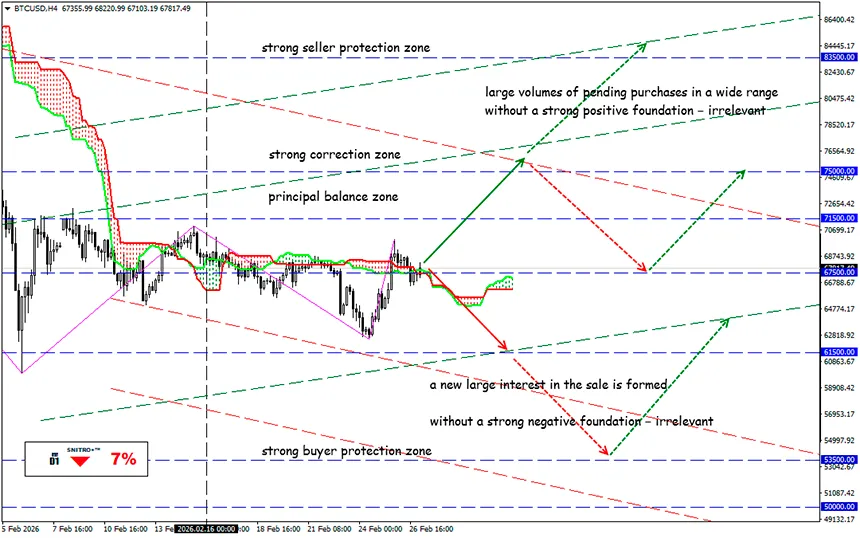
BTC/USD
Key zone: 63,500 - 71,500
Buy: 68,500 (on a confident breakout of the 67,500 level) ; target 73,500; StopLoss 67,500
Sell: 62,500 (on strong negative fundamentals) ; target 57,500-55,500; StopLoss 63,500
Investments enter the market only when there are guarantees of their protection. The current dynamics of digital assets depend not on market speculation, but on the strictness and transparency of legal regulation, particularly on decisions made in Washington.
Over the past year, the adoption of crypto assets by institutional banks, public companies, and governments as payment instruments and stores of value has accelerated. However, the lack of strong regulatory mechanisms scares both retail investors and fundamental capital.
Capital flows indicate that stocks and cryptocurrencies are gradually becoming interchangeable assets in investors’ perception, helping reduce risks.
For example, until the end of 2024, both sectors moved in sync: positive sentiment among traditional investors meant buying digital assets. However, in 2025 the trend broke — retail investors are now allocating funds into stocks at a record pace while staying away from cryptocurrencies.
The unstable correlation between retail activity and altcoin market capitalization confirms this shift. Investors now allocate funds between segments instead of investing in both simultaneously. The reason is that the lack of trust in crypto outweighs the risk of a stock market decline.
At present, national and regional regulators (and not only in the U.S.) continue to rely on lawsuits and other enforcement-based regulatory methods. As a result, exchanges, token issuers, and custodial services operate under critical uncertainty. For institutional investors, the problem has been not only volatility, but also the risk of falling outside regulatory protection.
It is U.S. crypto regulation that may become the catalyst for strong growth and capital inflows.
- The adoption of the comprehensive Genius Act package could change investor attitudes toward digital assets as early as the second half of the year. The issue is not short-term price impulses or macroeconomic conditions, but the elimination of legal uncertainty.
- Once the U.S. Congress approves the bill, the crypto industry will receive clear rules of the game. The law will ensure transparency of oversight, end regulation through enforcement, promote tokenization, and facilitate broader participation of traditional capital.
The Genius Act has already passed the House of Representatives, but its progress in the Senate has slowed. Lawmakers disagree on several issues that remained unresolved after the adoption of the CLARITY Act, signed by Trump back in July.
The conflict intensified in January when Coinbase CEO Brian Armstrong withdrew support for one version of the bill. This decision triggered a new round of negotiations, including closed-door meetings involving White House representatives. Armstrong later reported progress in discussions, but final agreements have not yet been reached.
The example of spot Bitcoin ETFs approved in January 2024 demonstrated how quickly demand can grow after infrastructure and regulatory barriers are removed. Within the first year alone, these funds attracted tens of billions of dollars in net inflows. The adoption of a full regulatory framework could extend this effect far beyond ETFs — including asset tokenization, custodial solutions, and modernization of trading infrastructure.
What is the result?
The extreme volatility that defined the 2021–2022 cycle and attracted an entire generation of new participants has largely disappeared. Although cryptocurrencies still play an important role in portfolios, digital assets have now become just one of many instruments rather than the primary speculative vehicle. Large capital remains neutral, and only the most aggressive speculators are capable of significantly moving prices.
So we act wisely and avoid unnecessary risks.
Profits to y’all!


