



The End of the carry trade era
The Bank of Japan is breaking the market
GBP/JPY
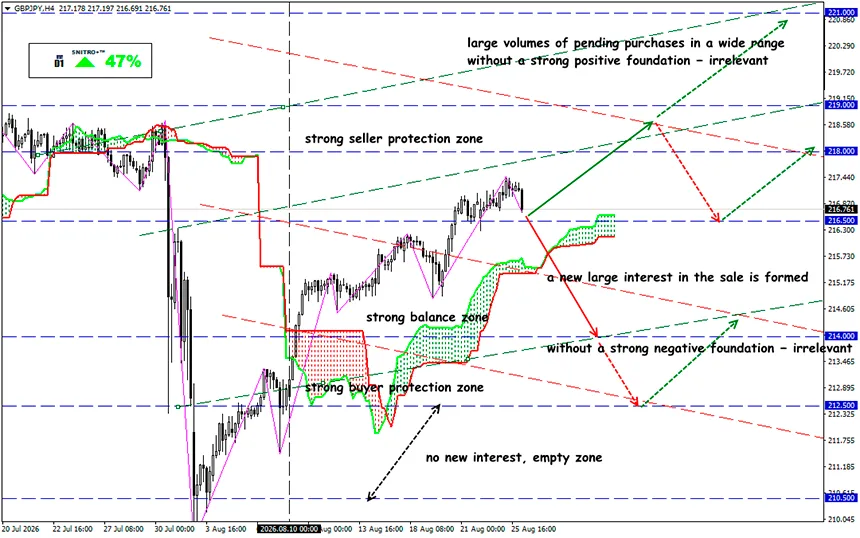
Key zone: 216.50 - 217.50
Buy: 218.00 (on a confident break above 217.50); target 219.50-220.50; StopLoss 217.30
Sell: 216.00 (on strong negative fundamentals) ; target 214.50-213.50; StopLoss 216.70
The threat of another rate hike and BOJ currency interventions are changing the rules of the game. Yen crosses are approaching a price zone where the long-standing logic of the carry trade is facing a serious fundamental opponent for the first time.
Japan is no longer a world of zero interest rates. Since June, the Bank of Japan’s policy rate has stood at 1.0%. The next BOJ meeting will take place on September 17–18, so a potentially crucial fundamental trigger is approaching for cross assets such as GBP/JPY.
A reminder:
Carry trade transactions are profitable when an investor funds a position in a cheap currency and buys assets denominated in a currency with a significantly higher yield. For many years, the JPY performed the role of a funding currency almost perfectly.
Now, the cost of borrowing in yen is rising.
Even if the BOE does not cut rates, successive BOJ hikes are gradually narrowing the spread between the UK and Japan. And this spread is one of the structural sources of demand for GBP against JPY.
On July 29, the Bank of England kept the Bank Rate unchanged at 3.75%. The decision was expected, but the vote split was more important: six MPC members voted to keep the rate unchanged, while three preferred an increase to 4.0%. The disagreement within the regulator is intensifying.
The reason is inflation risks. UK CPI inflation fell to 2.6%, but the BOE expects it to accelerate again to around 3.2% in Q4 2026. The energy shock is simultaneously increasing inflation and suppressing real demand. If the UK economy starts losing momentum rapidly, the market could shift from the “higher for longer” scenario toward expectations of policy easing. In that case, one of the key arguments for GBP/JPY buyers would disappear.
For GBP, this is important support. As long as inflation prevents the BOE from moving toward rapid rate cuts, UK assets retain comparatively high yields.
At the same time, Japanese inflation is giving its monetary authority arguments for further tightening.
In July, headline CPI accelerated from 1.6% to 1.9%, core CPI to 1.8%, while the core-core measure excluding fresh food and energy rose to 1.9%. Market expectations have strengthened for a possible additional 25 bp BOJ rate hike — to 1.25%.
- On July 31, the US and Japan conducted a joint intervention to support the JPY — the first such coordinated operation since 1998. Afterward, USD/JPY quickly fell from around 164 to 156.
- Yen intervention creates asymmetric risk for speculators. GBP/JPY can rise gradually thanks to positive carry, while sudden intervention by the authorities can trigger a very rapid unwinding of long positions.
Therefore, the strategy of unconditionally buying GBP/JPY on every decline is becoming significantly more dangerous than it was several years ago.
Another variable is the Middle East. The UK and Japan are energy importers, so expensive oil is a problem for both economies. The same oil shock can initially weaken the JPY through the trade balance and then strengthen it through a more hawkish BOJ.
That is why GBP/JPY traders now need to monitor not only Brent, but also the reaction of Japanese inflation expectations and JGB yields.
So, what does this mean?
Of course, the carry trade is not dead yet, but its fundamental attractiveness is already declining.
GBP/JPY remains one of the most interesting currency pairs for the carry trade. The technical structure looks bullish again, and short-term indicators predominantly point to further gains.
The 220 level is a kind of market referendum on the viability of the GBP/JPY carry trade.
A breakout and consolidation above 220.50 would confirm that sterling’s interest-rate advantage remains stronger than Japan’s monetary normalization. But a reversal from 219–220 followed by a drop below 216 would become the first serious argument in favor of a bearish scenario.
However, the fundamental picture is no longer so clear-cut. The key question is what happens first: will GBP/JPY break above 220, or will the narrowing BOE–BOJ rate differential trigger a reversal of the carry trade?
So we act wisely and avoid unnecessary risks.
Profits to y’all!


