



The dollar is flying on false optimism

The risk of a global meltdown is rising
EUR/USD
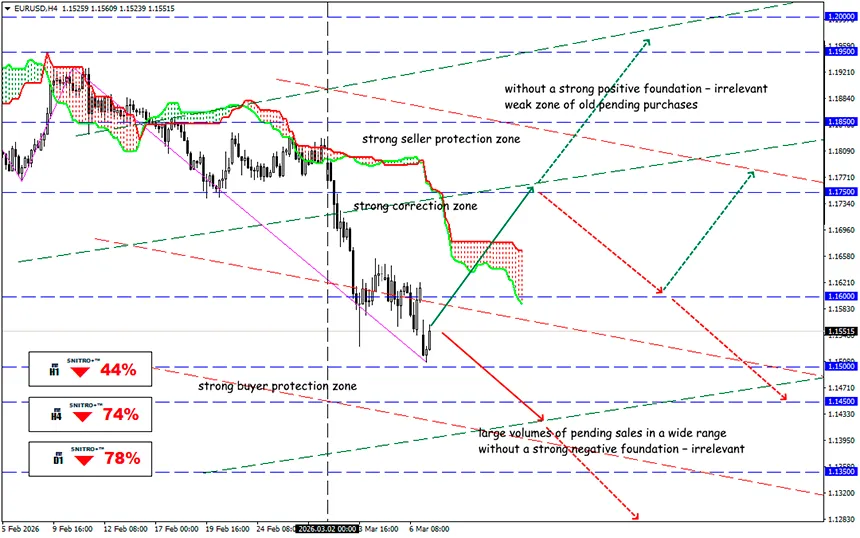
Key zone: 1.1500 - 1.1600
Buy: 1.1620 (on a confident breakout of 1.1550) ; target 1.1750-1.1800; StopLoss 1.1550
Sell: 1.1500 (on strong negative fundamentals) ; target 1.1350-1.1300; StopLoss 1.1570
At the start of the week, oil prices tested $120 for the first time in four years, although they later pulled back as panic sentiment eased. But this correction will not fool anyone anymore, since there are no grounds for normalization in the energy market.
The dollar still feels confident for now, but this momentum is also driven purely by geopolitics.
The war in the Persian Gulf is moving into a prolonged phase, as a regime change in Iran that would be convenient for the United States is currently impossible.
Bombardments are intensifying on both sides, while producers have begun suspending production amid the halt of traffic through the Strait of Hormuz. This is the main reason for the external resilience of the dollar, since the major industrial economies — Japan, South Korea, China, India, and the entire European Union — are critically dependent on external supplies.
The sharp rise in oil prices has already triggered capital flight into safer assets, which for now still include the dollar. But there are no economic factors in the market that justify a strong dollar.
Nevertheless, the CFTC report showed a sharp increase in demand for the dollar after the bombing of Iran began: the aggregate short position on USD against major world currencies shrank by an impressive $6.7 billion to -$12.3 billion.
As for the U.S. economy, the picture there is purely negative, and there are no reasons for strong demand for the dollar except one — a sharp increase in inflation risk. This factor is being amplified by rising import costs following the introduction of higher tariffs, and even the cancellation of Trump’s initiatives by the U.S. Supreme Court will change nothing in the short term.
The rise in oil prices adds another obvious threat to these risks. Trump was even forced to comment on this fact in his usual manner, calling himself the savior of the world and everyone else the aggressors.
Donny stated that short-term oil prices would quickly fall after the Iranian nuclear threat is eliminated, but it remains unclear what exactly he considers “short-term” growth and how the United States plans to “win” without a ground military operation. The yield on 5-year inflation-protected TIPS bonds surged sharply by Friday’s close, reaching yearly highs — one of the most reliable indicators of rising inflation expectations.
The NFP report released on Friday clearly showed the economy moving toward recession.
Not only were 92 thousand jobs lost in February instead of the expected increase of 59 thousand, but the two previous months were also revised downward by 69 thousand.
The Federal Reserve will hold its next meeting on March 18, and one can only speculate how those monetary clowns will assess the current situation. The destruction of the labor market clearly points toward recession, which is aggravated by the sharp rise in inflation expectations.
This is the worst possible scenario for the Fed.
And what is the result?
In the short term the dollar still retains its strength, since it remains a safe-haven asset, but the longer the war lasts — especially without clear signs of ending in favor of the United States and Israel — the greater the chaos that will emerge in financial markets.
So we act wisely and avoid unnecessary risks.
Profits to y’all!


