



The Dollar has earned the right to be strong
Kevin Warsh brought high rates back to the market
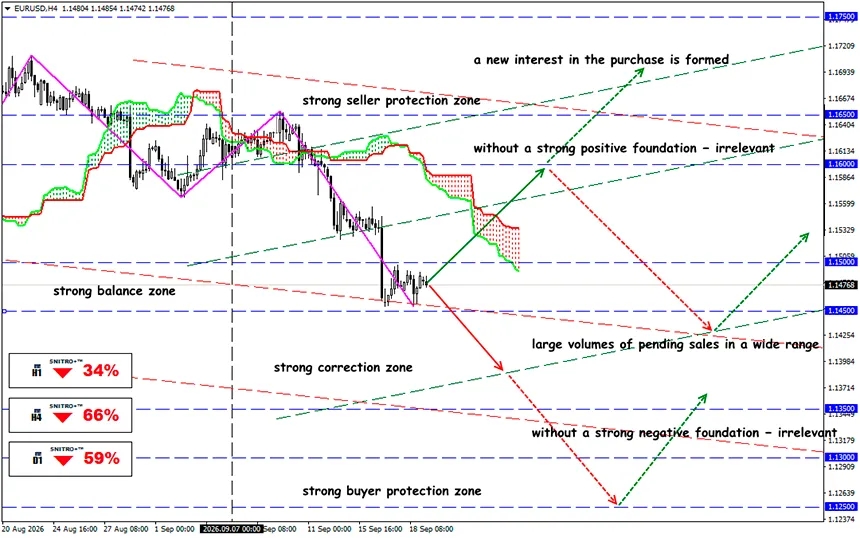
EUR/USD
Key zone: 1.1450 - 1.1500
Buy: 1.1550 (on strong positive fundamentals) ; target 1.1750; StopLoss 1.1480
Sell: 1.1400 (on a pullback following a retest of 1.1450) ; target 1.1250-1.1150; StopLoss 1.1470
The Fed raised the rate to 3.75–4.00% and reminded the market that the tightening cycle is not over yet. Strong demand, inflation at 3.4%, and the 10-year Treasury yield near 5% are supporting the dollar, but the ECB and BoJ are also raising rates, limiting the upside potential of the DXY.
After seven weeks of pressure on the U.S. currency, the September FOMC meeting forced the market to sharply reassess its positions: on September 16, the Fed unanimously raised the federal funds rate target range by 25 bps.
A reminder:
The Fed is no longer promising the market cheap money. The most important outcome of the meeting was not even the rate hike itself, but the change in the monetary policy trajectory. The reason is a combination of a resilient economy and inflationary pressure. The market reaction confirms that the rate hike removes one of the main arguments against the dollar.
The Fed has found itself in an extremely uncomfortable position:
- August CPI rose 0.4% m/m and 3.4% y/y, while core inflation stood at 2.4% y/y. The energy component was particularly unpleasant for the Fed: gasoline prices rose 3.9% over the month, while energy overall increased by 2.1%
- At the same time, consumers are showing no signs of capitulation. Retail sales increased by as much as 1.2% m/m and 6.0% y/y in August, reaching $773.9 billion.
In other words, the U.S. economy is strong enough to withstand high interest rates, but inflation remains too high to allow the regulator to quickly pivot toward easing.
On September 10, the ECB also raised its key interest rates by 25 bps. The reason was the same — the energy shock. Consequently, the previous setup of a “hawkish Fed versus a dovish ECB” no longer exists.
Europe has proved more resilient than the market expected:
- Eurozone GDP grew by 0.6% q/q and 1.2% y/y in Q2 after zero growth in Q1. The ECB raised its economic growth forecast for 2026 to 0.9% and for 2027 to 1.4%.
- The Eurozone Manufacturing PMI reached 52.7 in August, firmly establishing itself above the 50-point threshold separating expansion from contraction.
Therefore, the U.S. exceptionalism thesis now requires confirmation from fresh leading indicators.
And the market will receive that confirmation — or its absence — as early as September 23, when preliminary PMI readings for the U.S., Eurozone, and UK are released.
If the U.S. Composite PMI significantly exceeds the European reading, the dollar will receive a new fundamental boost. If the gap is small or Eurozone indicators surprise to the upside, part of the USD’s post-FOMC strengthening could be reversed.
The Dollar’s Main Ally Right Now Is Not the Fed, but Treasuries
The U.S. debt market is becoming a more significant advantage for the USD.
The 10-year Treasury yield reached 5.01% on September 16 and again ended the day near 5.01% on September 18. For global capital, this is an exceptionally high nominal risk-free return.
- High Treasury yields support capital inflows into dollar-denominated assets.
- If the U.S. economy continues to demonstrate resilience and inflation remains elevated, investors will be forced to keep the higher for longer scenario priced in for longer.
This is precisely why the relationship “Treasury yields → dollar” may now prove more important than a simple comparison between Fed and ECB rates.
And What Is the Result?
The September FOMC meeting changed the FX market more profoundly than it may appear at first glance.
The Fed did not simply raise rates. It shattered the assumption that the next major cycle in U.S. monetary policy would necessarily be a rate-cutting cycle.
That is why the dollar has gained a strategic advantage, but tactically, chasing it after the September rally is becoming dangerous. For EUR/USD to continue falling, the market now needs fresh evidence of U.S. exceptionalism — above all, stronger PMI readings, Treasury yields remaining near 5%, and no rapid decline in oil prices.
If these conditions are met, $1.14 may turn out to be not the final target, but merely the next step lower for EUR/USD. If not, the dollar’s September surge risks turning into another correction within a broader range.
So we act wisely and avoid unnecessary risks.
Profits to y’all!


