



The deal is delayed, but no one is to blame
Oil falls while politicians search for a compromise
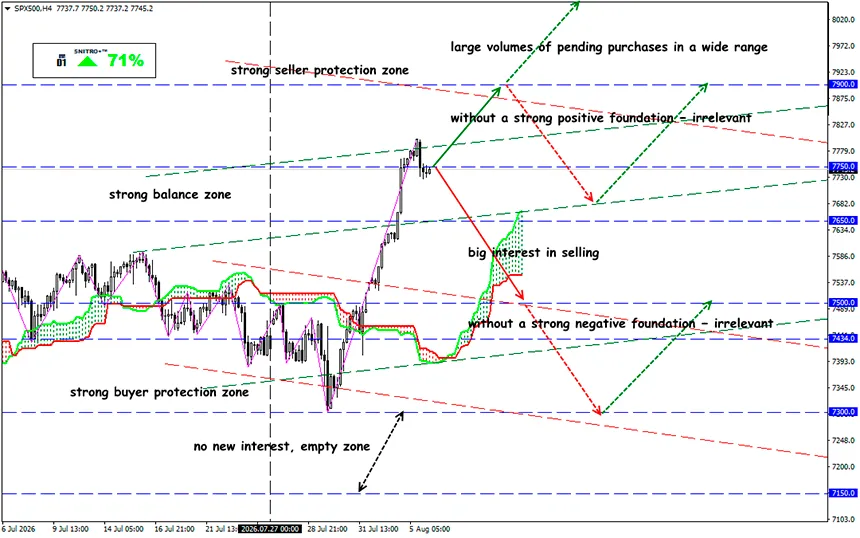
SP500
Key zone: 7,680 - 7,800
Buy: 7,830 (on a pullback following a correction to 7,700); target 7,950-8,000; StopLoss 7,760
Sell: 7,650 (on strong negative fundamentals); target 7,550; StopLoss 7,720
Iran and Oman were once again on the verge of reaching an agreement that could have increased oil flows, pushed crude prices lower, and reduced demand for the U.S. dollar as a safe-haven asset. At the same time, it would have lowered the odds of further Federal Reserve monetary tightening. Unfortunately, the celebration has been postponed.
Iran and Oman were once again on the verge of reaching an agreement that could have increased oil flows, pushed crude prices lower, and reduced demand for the U.S. dollar as a safe-haven asset. At the same time, it would have lowered the odds of further Federal Reserve monetary tightening. Unfortunately, the celebration has been postponed.
For his part, President Trump continues to alternate between promises and threats. This mixed messaging makes it more difficult for Tehran to move toward a compromise. Meanwhile, new explosions were reported near a passing oil tanker in the Strait of Hormuz. The exact cause remains unknown, but the incident once again highlights how fragile the situation remains.
Iran warned the Persian Gulf states that any new U.S. attack on its territory would trigger retaliatory strikes against critical regional energy infrastructure. According to five sources, Tehran is attempting to raise the cost of military action by threatening Washington's closest regional allies.
Let's recap.
Dollar bulls remain deeply concerned by the U.S. currency's inability to rally despite elevated Treasury yields and the hawkish rhetoric of Federal Reserve officials. Investors continue selling both the dollar and U.S. Treasuries. After reports emerged that Kevin Warsh had been holding regular private discussions with President Trump, market confidence in the Federal Reserve leadership deteriorated sharply.
And the deeper investors looked, the more concerning the overall market picture became. Still, the market has finally begun to move.
The market's primary filter—the U.S. Dollar Index (DXY)—remains trapped between two equally important levels at 99.68 and 99.82, unable to establish a clear direction without a powerful catalyst.
A rebound from 99.68 toward 99.82 could trigger a short-term correction lower in the major currency pairs, favoring tactical selling. A break below 99.68 would likely provide fresh momentum for buying the euro and the British pound. Selling the major currencies becomes the preferred strategy only if DXY secures a move above 99.82.
- Brent crude has fallen to $78.30 (down 11% over the past three days), as the market still hopes diplomacy will prevail. The primary resistance zone lies between $80 and $82. A break below $78 could accelerate the decline toward $75, while a recovery above $80 would signal the return of the geopolitical risk premium.
- Gold: A break below the $4,200 support level would open the way toward $4,000, while a breakout above the $4,280 resistance level would make the area above $4,350 the next upside target.
- Bitcoin continues to recover but remains technically fragile. Support is located at $64,000, while resistance stands at $65,000. A sustained move above $65,000 is likely only if DXY falls below 99.68 and the U.S. dollar weakens broadly.
- The S&P 500 is "taking a breather" after reaching fresh highs in the 7,730–7,750 area. At the moment, there are still no convincing reasons for a meaningful correction.
So, what does this mean?
The market remains frozen between hope for diplomacy and fear of another war. The delay of the agreement is neither a collapse nor a breakthrough—it simply punishes traders trying to get ahead of events under such conditions. Today, preserving capital and maintaining disciplined judgment matter far more than dramatic headlines. Trading before DXY breaks out of its current micro-range is not advisable.
Our job is not to guess which scenario will unfold, but to recognize in time which one the market is actually confirming. Only a clear technical breakout will ultimately determine whether hope or fear prevails.
So we act wisely and avoid unnecessary risks.
Profits to y’all!


