



The cartel is losing control of the market
Why Trump dismantled OPEC
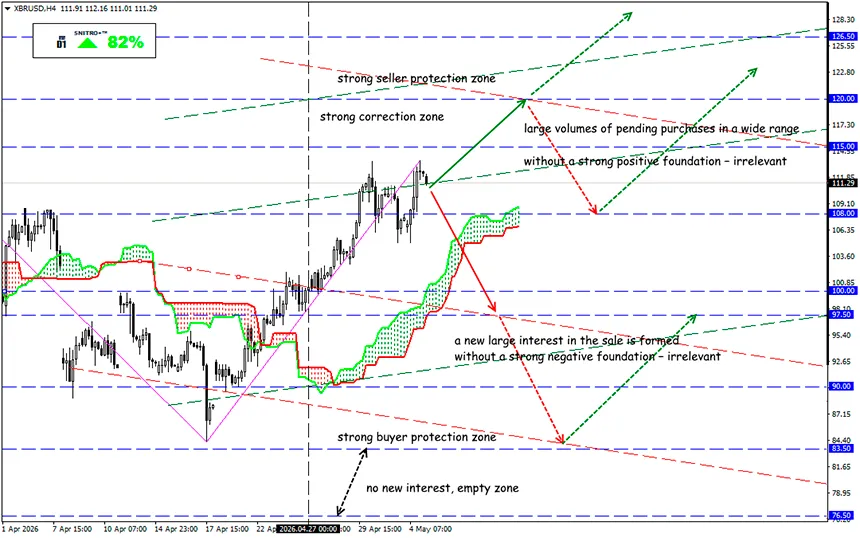
XBR/USD
Key zone: 110.00 - 115.00
Buy: 115.00 (on a pullback following a retest of 112.50); target 117.50-120.00; StopLoss 114.30
Sell: 109.50 (on strong negative fundamentals); target 106.50; StopLoss 110.20
U.S. military actions in Venezuela and the ongoing conflict in the Middle East have had a destructive impact on OPEC. Trump had unsuccessfully criticized the oil alliance’s policy for many years, and now has called the UAE’s exit from OPEC “magnificent,” claiming it will lead to lower oil prices.
Such statements are, at the very least, naïve.
Donny may consider this situation his political success, but in the long term the absence of an industry control center will negatively affect both the U.S. and global energy markets.
Recall:
For many years, OPEC, led by Saudi Arabia, exerted significant influence on oil markets by controlling production volumes and regulating global prices through spare capacity. Without effective regulation from OPEC, oil markets become more volatile and lose crisis-mitigation mechanisms, which will be needed more often as geopolitical tensions rise.
The cartel’s influence has been weakening for several years as the U.S. and non-OPEC countries strengthen their positions. The share of global oil production controlled by OPEC has declined from a peak of about 50% in the 1970s to around 35% last year. In March, after the closure of the Strait of Hormuz due to the war with Iran, this share fell to 26%.
- The UAE, the fourth-largest producer in OPEC, left the organization after 60 years of membership to pursue its own energy strategy without OPEC quotas. This decision challenges Saudi Arabia and other Persian Gulf countries.
- During 40 days of active conflict, dozens of energy sector facilities in the Persian Gulf came under attack, including tankers, oil and gas fields, refineries, pipelines, and storage terminals.
- Field shutdowns and military actions forced producers to halt about 10 million barrels per day, while Saudi Arabia and the UAE redirected part of their output to ports outside the Persian Gulf.
In January, following a rapid U.S. operation to overthrow Venezuelan President Nicolás Maduro, the Trump administration quickly took control of the country’s oil sector, redirecting a significant portion of exports to the U.S. and granting Western companies access to vast oil reserves.
The blockade of the Strait of Hormuz has led traditional OPEC leaders — Saudi Arabia, the UAE, Kuwait, and Iraq — to lose their primary export route. They found themselves helpless in the face of the largest oil crisis in history.
This gave the U.S. oil and gas sector an opportunity to rapidly increase exports to Asia and Europe, further undermining OPEC’s market share and influence.
Riyadh will likely attempt to stabilize the situation within the organization in the coming months and will more actively use its alliance with Russia to restore its authority.
However, the political context, including the conflict with Iran, has placed OPEC in a difficult position. The hardline U.S. policy in the Middle East could lead to the complete collapse of OPEC, but it will not bring fair competition. Trump’s goal is to create a new oil control center under U.S. leadership. And this is unlikely to be favorable for either consumers or producers.
So we act wisely and avoid unnecessary risks.
Profits to y’all!


