



The “Bessent Doctrine”: how to survive by American rules
A New threat to Global currency policy
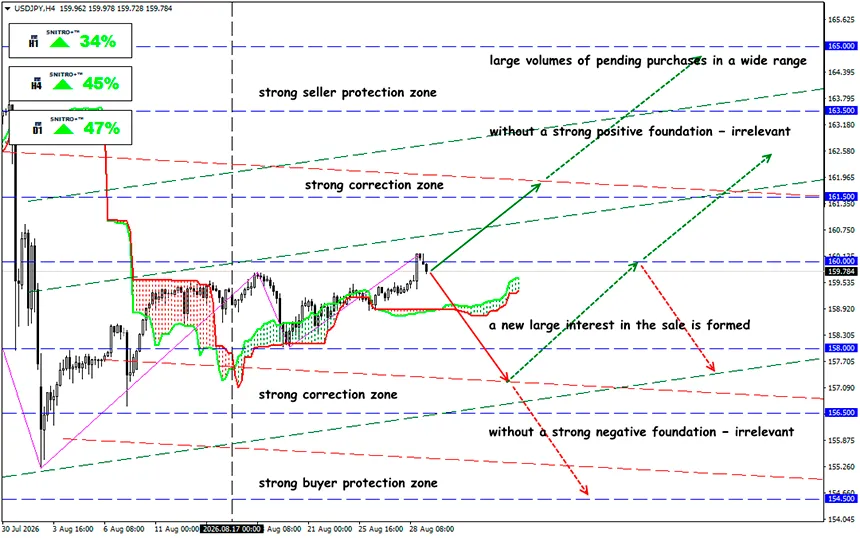
USD/JPY
Key zone: 159.00 - 160.50
Buy: 160.80 (on strong positive fundamentals) ; target 162.50-1.63.50; StopLoss 160.20
Sell: 159.00 (on a confident break of 159.00) ; target 157.50-156.50; StopLoss 159.70
Global currency policy is undergoing a major shift, and U.S. Treasury Secretary Scott Bessent is trying to address these imbalances with measures that many consider controversial.
The U.S. is moving from monitoring currencies to actively managing them. Washington is changing the rules of the currency game: intervention in the yen, pressure on Asian currencies, and increased scrutiny of China show that the U.S. Treasury is prepared to use the dollar and currency policy as tools for reshaping global trade.
A reminder:
Just a year ago, the idea that the U.S. Treasury could deliberately intervene in the currency imbalances of its largest trading partners was seen as a return to the era of the Plaza Accord. By the summer of 2026, this concept had ceased to be purely theoretical.
The key event occurred in late July. When USD/JPY approached 164 — its highest level in roughly four decades — the U.S. joined Japan in an intervention to support the yen. The Treasury used foreign currency assets from the Exchange Stabilization Fund to purchase JPY. Bessent later said that the U.S. was prepared to do “whatever is necessary” to support Japan’s efforts to stabilize its currency.
Following the joint U.S.-Japan intervention in the foreign exchange market, analysts began discussing the possible emergence of a new “Bessent Doctrine.” Its essence is not simply about weakening or strengthening the dollar. Washington is pursuing a more fundamental objective: pushing trading partners away from chronically undervalued currencies and using U.S. financial influence to reduce global trade imbalances.
Actions against a weak yen are fully compatible with the official U.S. “strong dollar” policy. Bessent himself previously emphasized that a strong dollar should be the result of strong U.S. fundamentals, while short-term bilateral currency movements do not contradict this concept.
What Traders Should Consider:
- USD/JPY rallies can be sold, but only with policy confirmation. The zone of an extremely weak yen now carries additional intervention risk. The faster USD/JPY returns to extreme levels, the worse the risk/reward ratio becomes for new long positions without a protective stop.
- EUR/USD above its fundamental valuation requires caution. If the political premium for a weaker dollar disappears, a pullback in the pair from the 1.17 area to 1.12 would represent a move of approximately 4%. Therefore, buying the euro at elevated levels should preferably be accompanied by strict risk management.
- CNY is the key strategic trade. A sustained decline in USD/CNY would be a much stronger confirmation of the emergence of a “Bessent Doctrine” than a one-off intervention in JPY.
- Traders should not bet exclusively on a decline in the DXY. The new policy does not imply automatically selling the dollar against every currency.
A fully developed “Bessent Doctrine” does not yet exist — at least not in the form of an officially announced new currency order. But its contours are already becoming visible. It combines trade policy, exchange rates, capital flows, reserve transparency, and financial diplomacy into a unified system of economic pressure. The joint intervention with Japan became the strongest evidence yet that the U.S. is prepared to move from words to actual market operations.
So, what does this mean?
The U.S. is not currently trying to engineer a global decline in the dollar. It is seeking a revaluation of the currencies of countries whose exchange-rate policies, in Washington’s view, contribute to chronic trade imbalances.
If this practice spreads from JPY to EUR, CAD, and especially CNY, the market will face a fundamentally new currency architecture. In that case, interest rate differentials will no longer be the only major factor driving Forex.
The decisions of the Fed, ECB, BOJ, and PBOC will have to be supplemented by another variable — what exchange rate the U.S. Treasury considers acceptable at any given moment.
The key marker for the coming months will be a shift from the isolated Japanese case to coordinated action involving CNY or other Asian currencies. That is what would transform Bessent’s still-emerging approach from a set of tactical decisions into a genuine currency doctrine.
So we act wisely and avoid unnecessary risks.
Profits to y’all!


