



Summit in the Fog of War
What to Expect from the Meeting in Paris
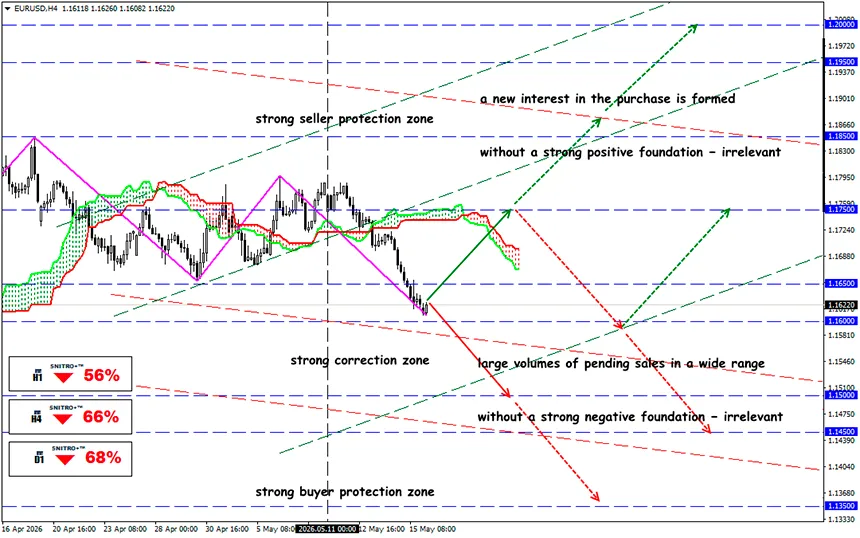
EUR/USD
Key zone: 1.1600 - 1.1650
Buy: 1.1720 (on strong positive fundamentals) ; target 1.1850; StopLoss 1.1650
Sell: 1.1550 (after retesting 1.1650) ; target 1.1400-1.1350; StopLoss 1.1600
While the U.S. dollar continues to lead in pairs against risk assets, G7 financial officials gathered today for a meeting that risks going down in history because of the scale of the problems it intends to discuss. But the chances of finding solutions to these problems are minimal.
For the first time since the founding of the G7, not only finance ministers and central bank governors gathered at one venue, but also energy ministers and representatives of the IEA. Formally, this is a working format. In essence, it is an attempt to prevent a new round of global economic instability.
The economic and energy crisis generated by the war of the U.S. and Israel against Iran has become so interconnected that addressing them separately through different agencies no longer makes sense.
Representatives of Brazil, India, South Korea, and Kenya have been invited — countries representing a significant share of global production, energy consumption, and critical minerals.
Particular attention is drawn to Syria’s participation in closed consultations: the country’s reconstruction and its return to the international financial system are beginning to be discussed seriously.
Washington arrived in Paris with a separate objective. U.S. Treasury Secretary Scott Bessent stated that he would seek to persuade allies to support a tougher regime of financial restrictions against Iran in order to limit financing for its military infrastructure.
The main goal of the meeting: avoiding a global economic crisis.
The agenda includes: trade imbalances, sovereign debt, market volatility, critical resources, energy security, support for developing economies, financing the reconstruction of Syria and Ukraine. The gap between Paris’ diplomatic tone and Washington’s militant rhetoric is becoming one of the meeting’s central storylines.
The situation in the oil market will be at the center of attention. The scale of destruction: 30–40% of refining capacity in the Persian Gulf has been damaged or destroyed, while 17% of gas production capacity has been taken offline — restoring it will take around three years. This is not a supply crisis — it is a structural breakdown, with recovery measured in years, not weeks.
The reopening of the Strait of Hormuz and the end of the conflict are of paramount importance for mitigating the consequences for the global economy.
A separate summit topic is the analysis of Trump’s Beijing visit, which ended without clear agreements. G7 ministers expect to hear from the American side a more detailed explanation of what exactly the leaders of the world’s two largest economies failed to agree upon.
Simply put, influential officials are trying to answer an uncomfortable question: how to avoid a scenario in which the world simultaneously faces expensive energy, high inflation, slowing economic growth, and financial instability.
Major breakthroughs should not be expected. Such meetings rarely end in sensations. However, several scenarios appear likely.
- The G7 may coordinate a joint strategy on critical resources to reduce dependence on China. This implies new investments, subsidies, and the creation of alternative logistics routes.
- Coordination of financial policy is likely — a signal to markets that the world’s largest economies are prepared to act jointly if turbulence intensifies. Even a political statement sometimes works more powerfully than actual measures: markets value the very fact of coordination.
- A tougher common stance on sanctions may emerge, albeit in softened diplomatic language. Especially if the U.S. succeeds in convincing partners that the risks of inaction are greater than the consequences of restrictions.
G7 meetings are often perceived as elite discussions on issues far removed from reality. But their decisions quickly turn into very practical matters: gasoline prices, mortgage rates, the cost of imported equipment, and inflation levels.
If market anxiety can be reduced, the world will have a chance to avoid another economic shock. But if participants once again diverge in their positions, investors may interpret this as a signal of Western weakness, and markets may respond with a new wave of instability.
So we act wisely and avoid unnecessary risks.
Profits to y’all!


