



Strategy Shares Are Falling Faster Than BTC
Why Michael Saylor Should Not Be Trusted
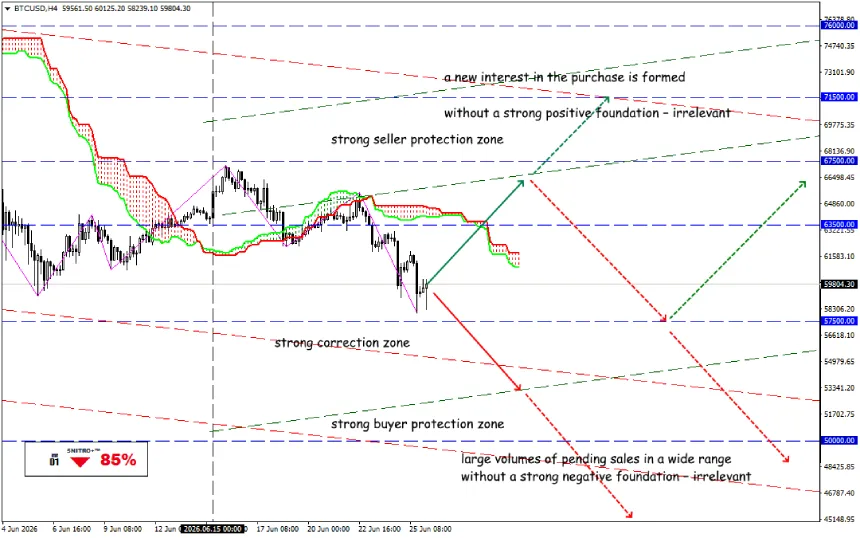
BTC/USD
Key zone: 55,000 - 60,000
Buy: 61,500 (on strong positive fundamentals); target 63,500-66,000; StopLoss 60,500
Sell: 53,500 (on a pullback after retesting 55,000); target 50,000-48,500; StopLoss 54,500
Strategy's documented, so-called "paper" losses on its BTC holdings, amounting to $13 billion, exceed the market capitalization of hundreds of tokens, highlighting the extreme concentration of risk currently present in the cryptocurrency market. Strategy (MSTR) is experiencing the largest unrealized losses in corporate history.
Reminder:
Since 2020, Strategy, under the leadership of Executive Chairman Michael Saylor, has been aggressively raising capital to expand its Bitcoin holdings, effectively turning the company into a leveraged bet on the asset.
The company, which shifted from software development to managing Bitcoin reserves, owns approximately 844,000 BTC, acquired at an average price of about $75,600. With the current BTC price near $60,000, the mark-to-market loss, more than $13 billion, calculated under fair value accounting rules, is reflected directly in the company's income statement.
Both Bitcoin and the broader crypto ecosystem were created around the ideals of decentralization, aiming to distribute financial power away from large institutions considered "too big to fail" and place it into the hands of individuals. Instead, a single publicly traded company has accumulated so much Bitcoin that it is now generating paper losses comparable to the market value of numerous cryptocurrency ecosystems.
Strategy's paper loss also exceeds the market capitalization of many DeFi, privacy, and oracle projects, including Monero, Cardano, Chainlink, Bitcoin Cash, Litecoin, BlackRock's BUIDL, Uniswap, Near Protocol, Aster, and others. This means that one company's leveraged bet on BTC has "consumed" more value than the combined practical utility of several blockchain projects.
Saylor's supporters view these losses as temporary volatility within the long-term "digital gold" thesis, believing today's paper losses will eventually become substantial gains once BTC finds its bottom and the next bull cycle begins.
Unfortunately, the situation is far more dangerous.
MSTR shares have already fallen by nearly 9%, while Bitcoin has declined by only 3%.
The continuous issuance of additional shares to raise money for dividend obligations on STRC and to purchase a new business jet has not gone unnoticed.
These preferred shares represent a hybrid between bonds and equities — their price is intended to remain around ≈$100, while the company pays an annual dividend yield of 11.5%.
This was exactly how Saylor presented the investment in his promotional videos, urging people to invest all of their capital, retire, and enjoy life living off the dividends. In reality, STRC fell today to $73.62.
And what is the result?
Michael's list of problems has now expanded beyond the market to include legal challenges. The law firm Rosen Law Firm has launched a form on its website allowing investors to join a potential class-action lawsuit against Strategy in just a few clicks. The core allegation is that investors were misled.
In other words, Michael is now facing accusations of building a new Ponzi-style scheme.
By itself, this private legal investigation does not pose an existential threat to Strategy, it is not an SEC investigation or one initiated by another regulator. However, it may worsen the overall situation, as Saylor will have to find additional funds to cover a new category of expenses. This could require another share issuance to compensate investors who are already dissatisfied with the company's repeated previous offerings.
Strategy simply promises to adjust the dividend yield in such a way that market supply and demand will keep STRC trading around the target price. For example, at today's intraday low ($73.62), the yield should have reached 15.6%. At the same time, the yield does not increase automatically; it changes only within the framework of monthly dividend periods. Moreover, the company has no binding obligation to raise the yield. Officially, it has spoken only about its "intention" to do so.
So we act wisely and avoid unnecessary risks.
Profits to y’all!


