



Stock market keeps rising against the rules

Why politics is more dangerous than war
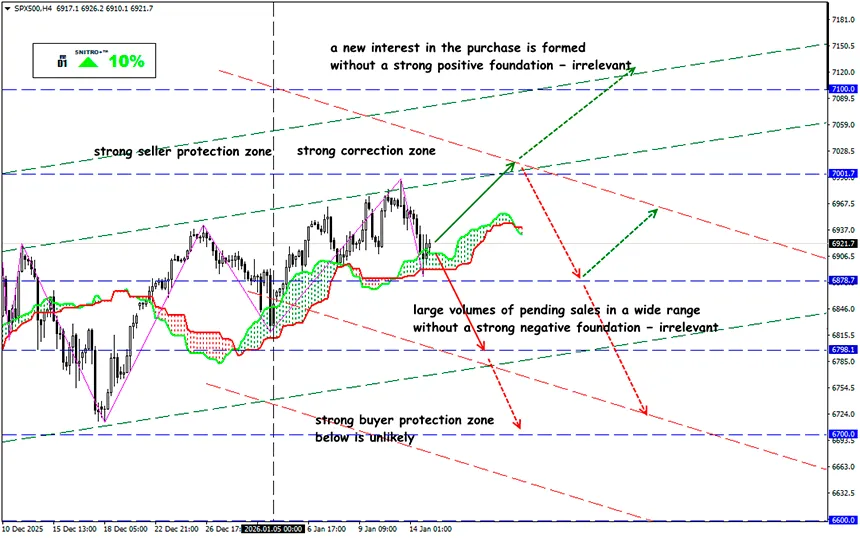
SP500
Key zone: 6,850 - 6,950
Buy: 7,000 (on strong positive fundamentals); target 7,100-7,150; StopLoss 6,950
Sell: 6,850(on a confident breakout of the 6,870 level); target 6,750-6,700; StopLoss 6,900
In recent years, a paradox has emerged: equity markets demonstrate resilience or rapid recovery after serious geopolitical shocks, even though, according to theory, even the threat of war creates uncertainty and risks.
Major stock indices virtually ignore military conflicts, and the lack of reaction, for example, to potential US strikes on Iran causes confusion among retail participants, bordering on panic.
Moreover:
- Trump’s inadequate economic policy is triggering capital outflows from the United States.
- Major players in the bond market are adjusting their strategies and reducing exposure to US assets.
- The discrediting of the idea of Federal Reserve independence leads to rising inflation expectations and higher interest rates.
However, the dynamics of the S&P 500, Nasdaq 100, and Russell 2000 show no hint of a technical correction. The situation looks like a classic capital rotation: when growth potential in large-cap companies is exhausted, money flows into mid- and small-cap stocks, continuing to push indices higher as a result.
For example:
- In response to the escalation of the Israel–Iran conflict, the S&P 500 barely moved, despite expectations of rising oil prices and increased tensions. The index remained close to pre-hostilities levels
- During Israeli strikes on Iran, markets initially declined (S&P 500 and Nasdaq futures fell by ~1.5–1.8%), but then almost fully recovered their losses.
- Analysts note that many market participants view the latest escalations as local and non-systemic, which reduces the risk of a large-scale sell-off.
The initial reaction may be negative, but prolonged and deep declines usually do not occur — markets quickly correct back or remain near previous levels.
Most likely, we are witnessing a classic market manipulation. A large share of traders do not correlate war risks with asset prices. Market makers “draw” an upward trend through manipulative spot buying, while retail participants rush to join a new growth cycle — a kind of pump, analogous to what is often seen in the crypto market.
In fact, there is a logical explanation for such behavior.
- Geopolitics is a risk factor, but for long-term investors, economic fundamentals and corporate earnings remain paramount.
- Equity markets do not “ignore” military conflicts; they assess their impact through the prism of the probability of a systemic shock to economic factors.
- As long as a conflict remains local, without the threat of a large-scale energy or economic crisis, markets tend to recover after the initial speculative sell-off.
- Investor behavior is driven not by isolated events, but by the overall picture of risks, monetary policy, corporate profits, and the probability of further escalation.
Market participants see that most modern conflicts remain local or isolated, without a fundamental shock to global supply chains or the financial system. For example, in Israel and Iran there is no direct threat to the global energy balance, while in Ukraine sanctions and logistics restructuring have already been priced in by markets.
Low risk premiums and a high share of institutional investors with algorithmic strategies lead to faster “digestion” of shock information by markets.
Trading models today are built not on headlines, but on probability assessments of scenarios and their economic impact. As long as the probability of more serious escalation is considered low, players remain in risk assets.
The probability of a major energy crisis is currently perceived as low, as oil producers are increasing output in other regions and strategic reserves help smooth shocks.
What can be considered during trading amid military threats:
- Do not close positions in risk assets based solely on geopolitical news if there is no confirmation of fundamental data deterioration.
- Use oil and gold options as insurance during periods of high volatility.
- Diversify investments across sectors toward defense companies, commodities, and consumer cyclical stocks.
So we act wisely and avoid unnecessary risks.
Profits to y’all!


