



Stock market can survive the War

How geopolitics supports the market
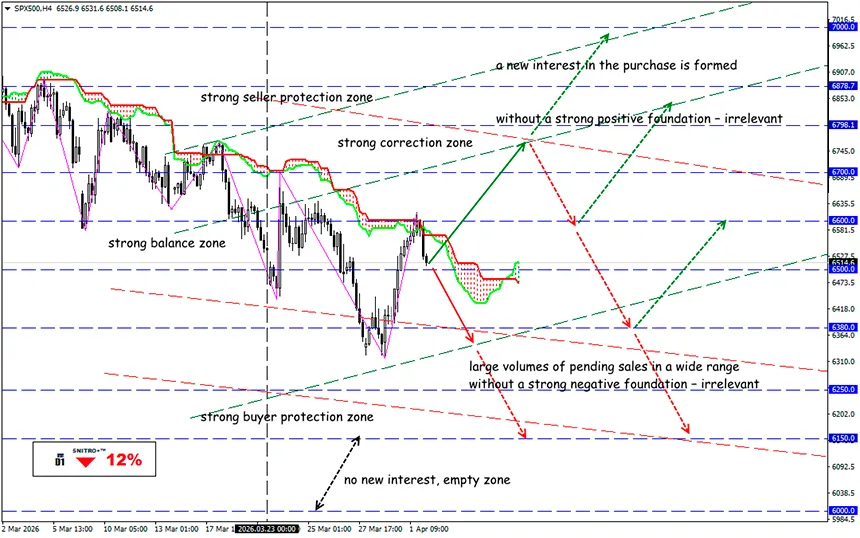
SP500
Key zone: 6,450 - 6,600
Buy: 6,650 (on strong positive fundamentals); target 6,850; StopLoss 6,580
Sell: 6,350 (after retesting the 6,500 level); target 6,200-6,100; StopLoss 6,420
Despite the conflict in the Middle East, the stock market has not fallen as much as one might expect. And there are solid arguments for this.
When the U.S. once again gets bogged down in a ground military operation, and oil prices storm above the $150 zone, active traders who sold their stocks will have every right to say — “we warned you.”
But for now, the decline in the most expensive stocks is not too catastrophic.
The S&P 500 index is holding within 6–7.4% of its pre-war maximum. Against the backdrop of a global energy crisis, which has already led to fuel rationing in some Asian countries, cautious observers see this as a factor of calm.
The stock market has three stability factors.
Price history
According to Deutsche Bank, the average decline during 30 major geopolitical events since 1939 was only 4%, and the recovery was fast.
Even the wars in Vietnam and Afghanistan did not disrupt the stability of the U.S. market, unlike the destroyed cities of the United Kingdom, Germany, and Japan during World War II.
Stock market disasters — the Great Depression, the 1973–74 oil embargo, the dot-com crash, and the 2007–09 financial crisis — were more damaging to global equities than wars.
Economic stability suffers from high oil prices, despite the fact that the U.S. is a net exporter of energy. American voters will not tolerate fuel prices even at current levels for long, and midterm elections are already approaching. So the war will at least have to be paused.
But it entered the war strong, so it can withstand a moderate удар. Only a few investors predict a recession.
Earnings forecasts of U.S. companies
Profit forecasts for companies in the S&P 500 index for the next 12 months have increased since the first attacks on Iran. Earnings per share expectations have risen by 3.6% — the most positive dynamic in the past 5 years.
The maximum expected growth is among oil companies; among the outsiders are oil consumers, in particular chemical companies, airlines, and cruise operators. Although revenue estimates have increased across all sectors, with the technology sector showing the largest monthly increase since 1995.
Only a few investors predict a recession, although concerns about inflation and slowing growth are fueling discussions of stagflation.
Potential profit from AI
Shares of Sandisk, Seagate Technology, Micron Technology, and Western Digital, which had surged on demand for the fast-memory chips they produce, declined in the short term. Despite this, hopes for AI continue to support the market: it is assumed that money will continue to flow into data centers.
And what is the result?
The optimism of the stock market is based on the idea that the war in the Middle East will end soon. But this may turn out to be a mistake:
- Iran or the U.S. may consider the terms mutually unacceptable;
- Israel may continue the fight;
- if Trump deploys troops, prolonged resistance may block the use of maritime transport routes for a long time — all of them, not just the Strait of Hormuz.
Instead of tactical fear, a structural reassessment is forming: expensive energy, broken correlations, a new cost of capital. Rising energy prices threaten corporate profits.
The problem is not when the war will end, but how long the physical stress in the supply system will persist and what systemic consequences to expect after the conflict stops.
The real consequences of the war have not yet been priced into forecasts. The third largest sell-off of the most liquid stocks is already underway, VIX is above 30, positive sentiment is minimal, and there is still no end to the conflict. This is a trap for those who want to buy the “bottom.”
So we act wisely and avoid unnecessary risks.
Profits to y’all!


