



SpaceX is taking money away from the crypto market
Bitcoin is losing the war for capital
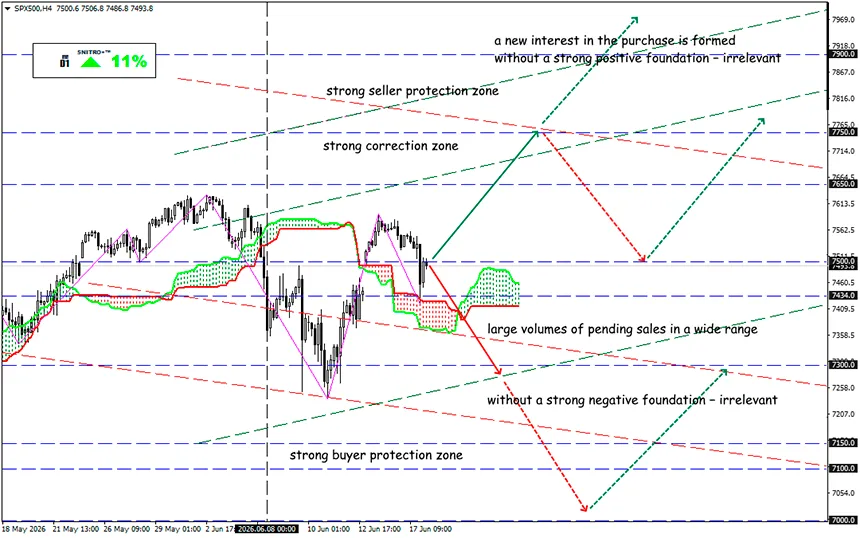
SP500
Key zone: 7,450 - 7,550
Buy: 7,600 (on a pullback following a correction to 7,500); target 7,850; StopLoss 7,530
Sell: 7,400 (on strong negative fundamentals); target 7,200-7,150; StopLoss 7,470
SpaceX shares have risen by more than 40% since their market debut. Eight days after its IPO, SpaceX exceeded a market capitalization of $2.5 trillion, which at one point was nearly twice Bitcoin’s market capitalization. Musk’s team is actively taking away the crypto market’s primary investment resource — venture capital.
Of course, part of this move is driven by supply-side dynamics. Only about 4.2% of SpaceX shares were available for trading on the first day, so competition for a limited number of shares is setting the price for the entire company.
Let us recall:
SpaceX is no longer just a rocket company. It has become a competitor to the entire crypto economy. The acquisition of xAI in February (Musk essentially bought it from himself!) brought Grok models and data centers into the company’s production ecosystem. This means direct competition with Anthropic and OpenAI, both of which have filed for public listings.
Any mature market develops through three resources:
- liquidity;
- human capital;
- venture investment.
Throughout the period from 2015 to 2024, cryptocurrencies dominated in two key areas.
- The best engineers moved into Web3.
- Investment funds created specialized crypto divisions.
- Hundreds of billions of dollars were directed into digital asset infrastructure.
In recent years, the crypto market has faced a fundamental problem: it has stopped generating unique investment stories. Most new projects are variations of already existing models. Against this backdrop, Bitcoin is beginning to look like a passive asset: it stores value but does not create new cash flows. For fund managers, this is a fundamental distinction.
A global-scale reallocation of venture capital is beginning. Not retail investors’ money. Not ETF liquidity. Rather, the very resource that has fueled the exponential growth of the crypto industry over the past fifteen years.
Today, SpaceX combines several megatrends at once:
- space logistics;
- global internet;
- artificial intelligence;
- defense technologies;
- next-generation data centers;
- robotics;
- energy infrastructure.
This is precisely the innovative “symbiosis” that cryptocurrencies claim to represent, and this growth is a sign of where risk capital and retail investor attention are currently flowing.
For venture investors, this looks like a far larger Total Addressable Market than most crypto projects.
And what is the result?
The risk of the current situation is that expectations have left very little room for error — a failure by SpaceX could affect a much broader market and enormous pools of private capital.
Current data reinforce these concerns: in 2025, SpaceX recorded a net loss of $4.94 billion on revenue of $18.67 billion, and with a market capitalization of $2.5 trillion, the company is trading at a price-to-sales ratio above 130, which some observers describe as meme-stock territory.
It is time to stop thinking in terms of “stocks versus cryptocurrencies.”
Today, SpaceX is not just another high-profile IPO. It is the beginning of the largest migration of capital since the emergence of cryptocurrency. If the market once tried to predict how much Bitcoin would be worth in ten years, investors are now asking which company will own the infrastructure of human civilization ten years from now.
The winner will not be the asset that talks most loudly about the future. It will be the one that succeeds in building that future. And today, more and more money is betting on Elon Musk.
So we act wisely and avoid unnecessary risks.
Profits to y’all!


