



Silver as a new stability factor
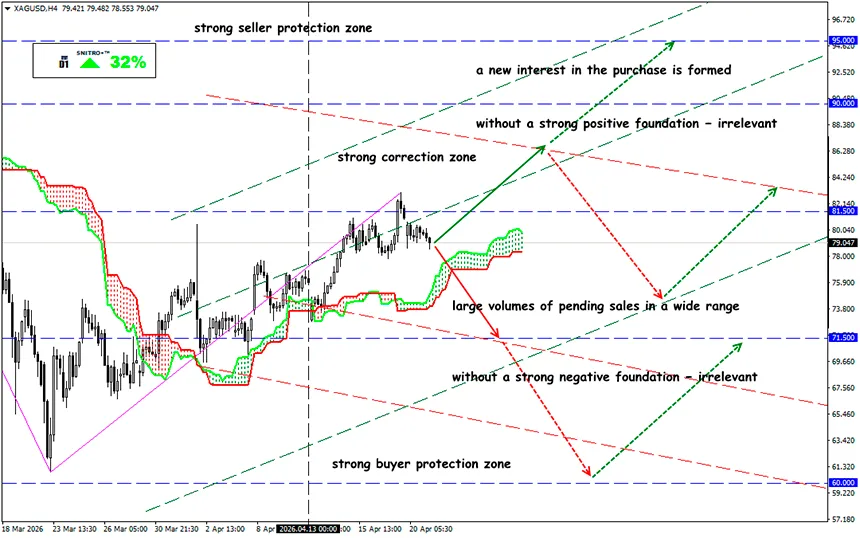
Where the precious metals market is looking
XAG/USD
Key zone: 78.00 -83.00
Buy: 84.50 (on a confident break of 83.50); target 86.50-87.50; StopLoss 83.80
Sell: 76.50 (on strong negative fundamentals); target 73.50; StopLoss 77.20
The war in the Persian Gulf has broken the trend in gold and silver, which have fallen out of investors’ focus amid energy commodities and fertilizers. However, this is still a typical correction.
Recall: gold is a “more market-driven” asset, with a strong speculative component in its price, as all gold-related assets are traditionally used for risk hedging.
Silver is considered a critically important raw material, and industrial demand is the main driver of its exchange price. It is commonly believed that under market conditions, silver always moves in the wake of gold.
At present, optimism in silver-related assets is supported by a new Asian factor.
At the beginning of the year, China sharply increased its silver purchases: according to data based on Chinese customs statistics, imports of silver metal in January–February exceeded 790 tons, of which nearly 470 tons were in February; in March, purchases exceeded 836 tons.
The most important fundamental signal here is not just “import growth,” but a shift in the market regime. In March 2025, Shanghai Metals Market (SMM) described imports of silver concentrate as mostly unprofitable in terms of impact on market prices, but now the flow of imported silver bullion has increased multiple times due to emerging arbitrage, shortages of physical metal, and redistribution of flows via Hong Kong/Shenzhen. This means that imports have ceased to be merely “raw material” and have become a tool for rapidly covering the deficit of finished metal within China.
Chinese demand is currently based on four main factors.
- Industry: silver is deeply embedded in the PV chain — Bloomberg as early as May 2024 indicated that the solar sector could drive Chinese silver imports, and SMM in 2025–2026 already recorded growth in production and expansion of capacities for silver raw materials.
- Investment and retail demand: at the end of 2025 and the beginning of 2026, Bloomberg and market publications described surging demand from Chinese buyers for silver bars and jewelry as a cheaper alternative to gold. In other words, silver in China has become a “mass-market” hedging trend as an alternative to overly expensive gold. This demand factor increases intraday volatility and makes imports sensitive to domestic market premiums.
- Jewelry production and small bars: in open official sources for China, this statistic is detailed worse than for gold, but Bloomberg directly noted high demand for silver bars and jewelry in China at the turn of 2025–2026. From a practical market perspective, this means that when gold prices surge, some consumers “switch” to silver.
- Policy, logistics, and trade sanctions: China maintains licensing for silver trade, and the market is sensitive to export control regimes. In 2025, China imposed retaliatory tariffs against the U.S., but SMM emphasized that the U.S. share in imports of silver concentrates in 2024 was only about 1.3%, so the direct impact on raw material flows was limited.
And what is the result
Trump’s Iranian venture negatively affects the precious metals market, but it is another argument in favor of moving away from dollar assets into something more reliable.
Fundamentally, silver remains one of the most interesting metals of 2026, but its medium-term dynamics look non-speculative. In other words, the market has already exited panic mode but has not yet returned to a confident upward trend. The safest strategy is not buying “at any price,” but disciplined trades from levels of $80–85 and constant monitoring of relevant information on China.
So we act wisely and avoid unnecessary risks.
Profits to y’all!


