



“Predatory Marketing” at Kalshi and Polymarket: new problems
U.S. Launches probe into major prediction markets
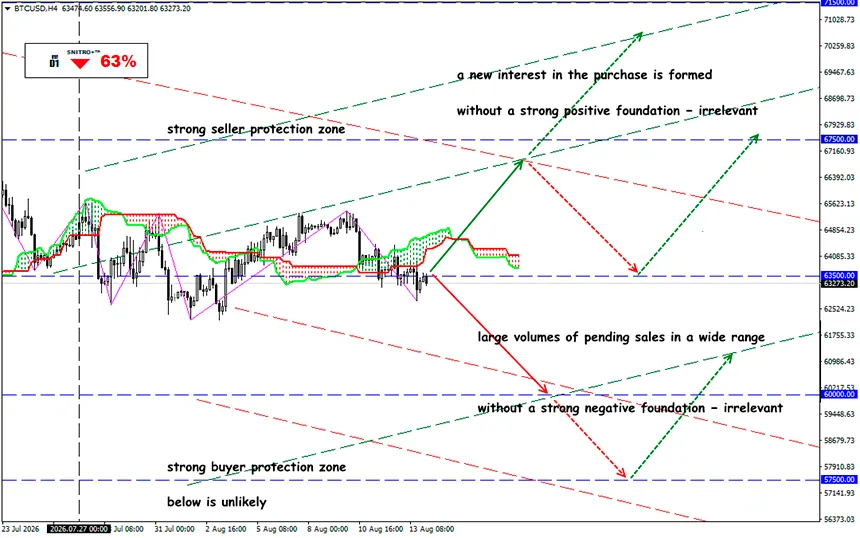
BTC/USD
Key zone: 62,500 - 64,500
Buy: 65,000 (on a decisive break above 64,500); target 68,500; StopLoss 64,000
Sell: 62,000 (on a pullback following a retest of 63,500) ; target 60,000-58,500; StopLoss 63,000
U.S. prediction markets are facing a new regulatory front. On August 12, 2026, the New York City Council announced an investigation into the marketing practices of four major industry players. The probe is focusing on potentially misleading advertising, undisclosed promotion through influencers, and the possible targeting of underage users.
A reminder:
This investigation matters far beyond the four companies involved. It is unfolding against the backdrop of a much more serious conflict: U.S. authorities have yet to reach a consensus on what prediction markets legally are — financial derivatives markets or a new form of online gambling.
The answer to this question will determine who controls this rapidly growing sector: the federal CFTC or individual state authorities.
The investigation was initiated by New York City Council Speaker Julie Menin. Official letters were sent to Kalshi, Polymarket, Coinbase, and Gemini Titan. The situation is unfolding against the backdrop of a much more serious conflict: U.S. authorities have yet to reach a consensus on what prediction markets legally are — financial derivatives markets or a new form of online gambling.
Incidentally, JPMorgan stopped providing banking services to the decentralized prediction market Polymarket in late 2025 amid regulatory concerns.
Lawmakers suspect the platforms of using misleading advertising, undisclosed payments to influencers, and promoting betting among underage users.
Virtually the entire U.S. prediction market model depends on which interpretation the courts ultimately support.
- The confrontation reached an unusual level on August 11. The CFTC invoked emergency powers after Kalshi notified it of a market emergency and ordered the exchange to continue operating in accordance with the Core Principles of the Commodity Exchange Act.
- At the federal level, on the same day, the CFTC issued guidance for regulated exchanges offering event contracts. The Commission said it was receiving a growing number of applications for incentive programs involving market making, liquidity provision, and product trading that contained procedural and substantive deficiencies.
- Another concern involves a promotional approach unusual for regulated financial markets — romanticizing the possibility of profiting from insider information.
- The New York City Council’s official statement explicitly mentions reports of promoting insider trading alongside fabricated winning bets, undisclosed influencer marketing, and the use of websites impersonating Polymarket.
For the traditional financial industry, such rhetoric looks particularly toxic. However, there is a fundamental line between having an analytical edge and using material nonpublic information.
The closer prediction markets come to functioning as full-fledged financial markets, the harder it becomes for regulators to ignore issues involving contract manipulation, conflicts of interest, and the use of nonpublic information.
So, what does this mean?
The central regulatory conflict surrounding prediction markets is gradually taking shape in the U.S.: is trading the probability of a future event a financial transaction or a bet?
The CFTC is trying to establish the first interpretation. New York and several other states are defending the second.
At the same time, the investigation into Polymarket’s marketing raises another question: if prediction markets want to gain the status of a full-fledged financial industry, can they simultaneously continue using aggressive audience-acquisition methods typical of the betting and social-media segments?
The answers to these questions will determine more than just the future of Polymarket and Kalshi. They will decide whether prediction markets evolve into a new global class of exchange-traded instruments or are gradually incorporated into the traditional gambling regulatory framework.
So we act wisely and avoid unnecessary risks.
Profits to y’all!


