



Powell: the last chance to be fair

The market is waiting for a strong Fed decision
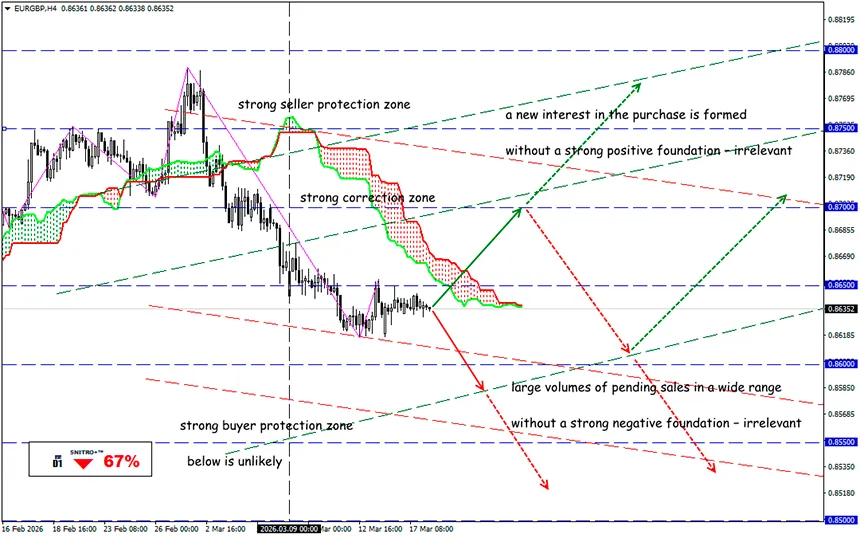
EUR/GBP
Key zone: 0.8600 - 0.8650
Buy: 0.8660 (on a strong positive foundation); target 0.8750; StopLoss 0.8610
Sell: 0.8580 (following a decisive break above 0.8600) ; target 0.8450; StopLoss 0.8630
The dollar is actively losing ground against a range of risk assets, including the euro and the British pound, as traders prepare to receive an honest assessment from the Fed of the risks facing the US economy. Uncertainty on this issue contributes to volatility in financial markets and reduces the attractiveness of the dollar as a safe haven.
In fact, the Fed will be forced to present a consolidated assessment of the consequences of the Middle East conflict. Moreover, this assessment will be reflected not only in the wording of the accompanying statement but also in the updated dot plot.
Formally, the Fed’s decision is predetermined: the regulator will almost certainly keep all monetary policy parameters unchanged. The probability of this scenario is 99%, according to the CME FedWatch tool. This scenario is already priced in.
However, updated forecasts, comments from Federal Reserve members, and (especially) Powell’s speech are capable of triggering volatility, including in European currencies.
- On the one hand, the current consumer price index has “stalled” (headline CPI remained at 2.4% y/y in February, core at 2.5%), while the core PCE index (the Fed’s most important inflation indicator) accelerated to 3.1% y/y, marking its third consecutive monthly increase.
- Against these arguments stands the weak February NFP report, with almost all components coming in “in the red.” The US unemployment rate unexpectedly rose to 4.4% after two months of consecutive decline.
- Nonfarm payrolls decreased by 92 thousand, contrary to expectations of a 58 thousand increase. This is the worst result since October 2025.
Naturally, the Fed will not be able to ignore both the distressed state of the labor market and inflation risks.
Especially since inflationary pressure has intensified not only due to external factors. As noted above, the upward dynamics of the core PCE index have been observed for three consecutive months, without the influence of the “Middle East factor.” The main problem for the Fed is inflation in services (excluding housing and energy), as it directly depends on wage growth.
By the way, US PPI inflation has increased, and this data was recorded even before Iran. Therefore, the risk of a rate hike remains high.
The war also increases the likelihood that inflation will become entrenched through secondary effects, especially amid already steady wage growth and services inflation. Most likely, these concerns will run as a common thread through the entire discussion at the Fed meeting. Inflation forecasts may be revised upward (to 2.2%–2.4%), while the GDP growth forecast may be adjusted to 1.8%.
Let us recall:
- Tomorrow, the ECB will publish updated data on monetary policy: investors are focused on possible comments regarding the future direction of interest rates.
- However, policymakers will certainly discuss how the war in the Middle East may put pressure on both sides of their mandate, and whether responding to the threat of slowing economic growth could fuel inflation.
- A reduction in geopolitical tensions, or at least expectations of stabilization based on Trump’s statements, may support European currencies.
Expectations of a more dovish Fed monetary policy may also make investments in these regions more attractive compared to dollar-denominated assets.
Risk appetite increased yesterday after European NATO countries refused to help Trump patrol the Strait of Hormuz until the formal end of the war with Iran. Trump took offense, especially at the United Kingdom, and promised new tariff troubles for partners.
So we act wisely and avoid unnecessary risks.
Profits to y’all!


