



Porsche is killing volkswagen
The Crisis in Germany’s auto industry is a problem for Europe
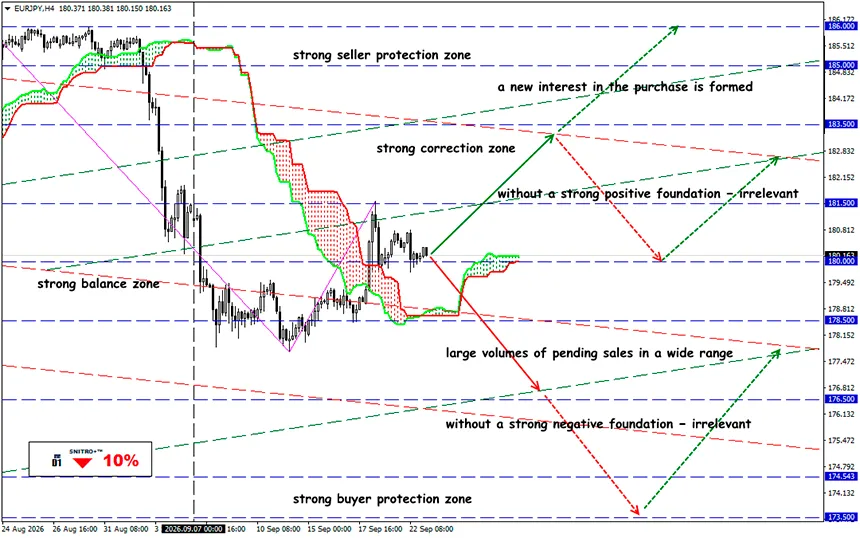
EUR/JPY
Key zone: 180.00 - 181.50
Buy: 182.00 (against a strong positive fundamental backdrop); target 183.50-185.00; StopLoss 181.30
Sell: 178.50 (on a decisive break above 180.00) ; target 176.50-175.00; StopLoss 179.20
Porsche’s crisis is no longer the problem of a single premium brand. Volkswagen’s former “perpetual profit machine” is losing margins, the Chinese market, and investor capital. The entire European automotive sector is suffering, and there are still no positive solutions.
Volkswagen’s €6 billion write-down, the collapse in Porsche’s margin from 18% to 1.1%, the loss of China, and pressure from U.S. tariffs demonstrate the structural weakness of the European auto industry. The risks are already being reflected in sector stocks and are increasing fundamental pressure on the euro.
A reminder:
Volkswagen Group decided to write down €6 billion of goodwill related to Porsche. Together with restructuring costs and problems in the Chinese business, special items are expected to reduce Volkswagen’s operating profit in 2026 by approximately €10 billion. As a result, the group’s operating margin forecast has been lowered from the previous 4–5.5% to no more than 1%. Excluding special effects, the figure would have been around 4%.
This fundamentally changes Porsche’s role within VW. Until recently, the premium brand offset the low profitability of mass-market vehicles. In 2025, Porsche generated only €413 million in operating profit, compared with €5.64 billion a year earlier, while return on sales collapsed from 14.1% to 1.1%. For comparison, in 2022–2023 Porsche delivered around 18%.
It is still too early to say that Porsche has definitively become a loss-making asset. In the first half of 2026, its operating margin recovered to 7.8% from 5.5% a year earlier, while operating profit rose 33.9% to €1.35 billion. Management is maintaining its 2026 forecast: revenue of €35–36 billion and a margin of 5.5–7.5%. The medium-term target remains significantly higher at 10–15%.
The main problem is China.
Porsche sales in China fell 26% in 2025 to 41,938 vehicles. Global deliveries declined to 279,449 vehicles from 310,718 a year earlier. The company explicitly cites intense competition, particularly in the electric vehicle segment, among the reasons.
And this is no longer simply a Porsche-specific issue. European manufacturers are losing under the new dynamics of the Chinese market: local companies are no longer merely cheaper — they are becoming full-fledged technology competitors in EVs, software, and hybrid powertrains.
Volkswagen has found itself caught between two problems: in China, it is losing its competitive advantages, while in one of its key export markets — the U.S. — it faces additional trade costs.
The stock market is already repricing the European industry. The STOXX Europe 600 Automobiles & Parts has lost around 17.6% since the beginning of 2026 and almost 14% over the past 52 weeks. Germany accounts for almost 49% of the sector index, which means the problems facing Volkswagen, Porsche, Mercedes-Benz, and BMW carry disproportionately large weight.
This means that, in the past, weak auto sales could be bought as a bet on an economic-cycle recovery. Now, evidence is required that European OEMs are capable of competing with Chinese companies on EV costs, software, and the speed of model-lineup updates.
And What Is the Result?
Porsche by itself is too small to determine EUR/USD. But Germany’s entire automotive complex already has macroeconomic significance. For Germany, the problem is even more serious: the economy grew by only 0.2% in 2025, with Destatis specifically noting a decline in exports of automobiles and industrial products.
The transmission channel to the euro looks like this:
weak auto industry → weaker exports and investment → lower industrial production and employment → weaker growth in Germany and the Eurozone → more room for dovish ECB policy → fundamental pressure on EUR.
But this is a secondary factor. For EUR/USD, ECB and Fed decisions, inflation, bond yields, energy prices, and geopolitical risks remain significantly more important than Porsche’s results.
German automotive statistics should be used as an additional filter for EUR/USD. A renewed deterioration in exports, industrial production, and employment in Germany strengthens the bearish scenario for the euro, especially if the gap between expected Fed and ECB rates widens at the same time. Conversely, stabilization in German industry and Chinese demand would reduce the structural risk premium attached to the European economy.
So we act wisely and avoid unnecessary risks.
Profits to y’all!


