



Oil rises again amid iranian risks
The Oil market remains a hostage to political ambitions
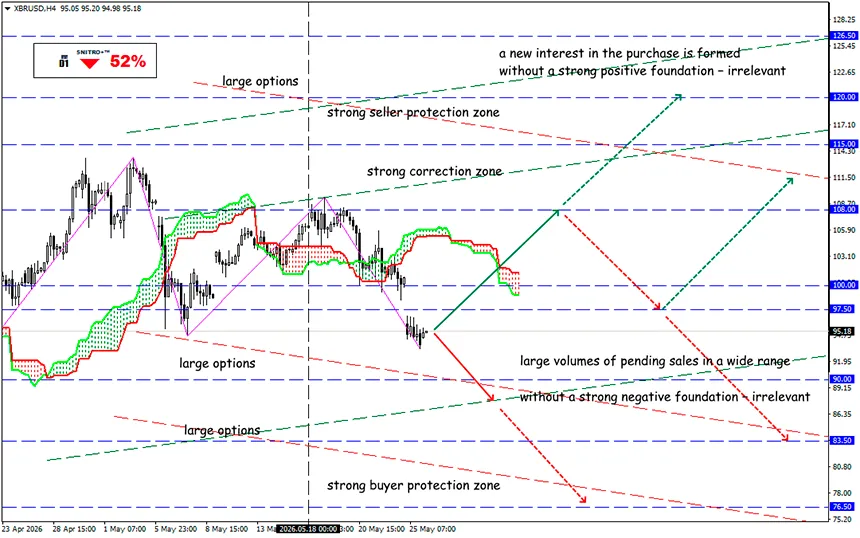
XBR/USD
Key zone: 97.50 - 100.00
Buy: 102.00 (after closing the gap); target 105.50-107.50; StopLoss 101.30
Sell: 97.00 (on strong negative fundamentals); target 93.50; StopLoss 97.70
Brent futures rose by more than 2% after U.S. military forces struck targets in southern Iran. Oil is no longer just a commodity. It is an instrument of power. And the price of a barrel is increasingly determined not by the market, but by the interests of major players.
The global oil market is reacting less and less solely to the fundamental factors of supply and demand. Tehran has urged markets to prepare for oil at $200 per barrel.
Reminder:
This warning came after U.S. military forces launched strikes on facilities in southern Iran. American forces attacked Iranian targets near Bandar Abbas “in self-defense.” Two mine-laying boats and an anti-aircraft missile system position were destroyed.
The targets of the attack included missile launch systems and vessels allegedly involved in laying mines in the Strait of Hormuz — one of the world’s most important oil transportation routes.
Yesterday’s enthusiasm in financial markets over the prospect of the war in Iran nearing an end had somewhat faded by this morning. Markets moved in mixed directions following the U.S. strikes, which Washington described as defensive, as investors assessed both the risks of escalation and the possibility of diplomatic progress.
U.S. Secretary of State Marco Rubio stated that the United States would give diplomacy a chance, while Tehran emphasized that it is still too early to speak of a quick agreement. Trump stated that the blockade of Hormuz would remain in place until an agreement is finalized, and that final approval could take several days.
Unfortunately, the chances of a quick deal are minimal.
- The Strait of Hormuz remains the key risk point: around one-fifth of global oil and liquefied natural gas flows pass through it.
- Brent had previously fallen below $100 amid hopes for a deal, but key issues, including transit rules through the strait, remained unresolved.
- Price dynamics indicate that the market is not yet ready to fully remove the geopolitical premium.
- Brent’s 7% decline the previous day reflected hopes for a diplomatic breakthrough, but the subsequent rise of more than 2% demonstrated how quickly military developments return risks into pricing.
- Any delay or breakdown in negotiations will likely once again lead to volatility in oil prices, the U.S. dollar exchange rate, and safe-haven assets.
So what is the outcome?
Fundamental indicators no longer function in their pure form. Inventories, industrial growth rates, or consumption dynamics still matter, but are increasingly becoming secondary to the political agenda.
Today, investors, businesses, and governments must take into account not only economic indicators but also political signals. And as long as energy remains an instrument of global influence, the oil market will continue to experience high volatility.
Even the U.S. Energy Information Administration (EIA) warns that a prolonged disruption in the Strait of Hormuz could add roughly another $20 to the price of a barrel in the short term.
Until an agreement with Iran is signed, oil will react not only to negotiations, but also to every new strike, statement, or signal regarding shipping in the Persian Gulf.
So we act wisely and avoid unnecessary risks.
Profits to y’all!


