



Oil is the financial fuel for a stable yen

Interventions in the commodity market are saving the Japanese currency
USD/JPY
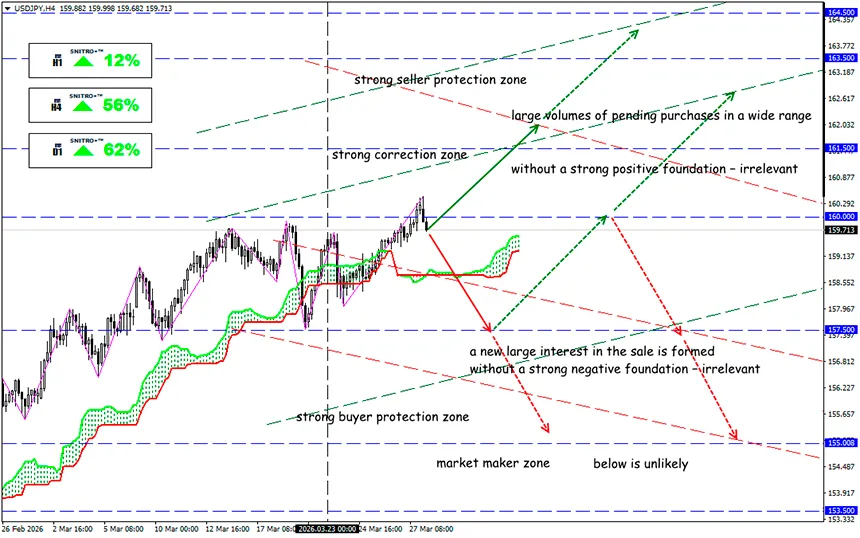
Key zone: 158.50 - 161.00
Buy: 161.50 (on a decisive break of 160.50) ; target 163.50-164.50; StopLoss 160.80
Sell: 158.00 (on strong negative fundamentals) ; target 155.50; StopLoss 158.70
The yen rose after statements from BOJ officials — the regulator continues to maintain a tight monetary policy. This is a response to the escalation of the conflict in the Middle East. Despite short-term negative consequences for exporters, the rate hike is seen as a necessary tool to fight inflation and maintain financial stability.
Let us recall:
Japan’s strong dependence on oil imports means that price fluctuations are quickly reflected in the value of the currency and the trade balance. Energy prices have risen because of the war in the Middle East, and the government is preparing to enter the oil market to indirectly support the weakening yen.
The Japanese government rarely intervenes in energy derivatives markets, but speculative trading in oil futures is now affecting the foreign exchange market.
Trading oil futures to strengthen the currency is an unusual method of investment diversification for Japan and could hit speculators hard.
- Almost all of Japan’s oil needs are covered by imports, and more than 90% of supply comes from the Middle East. Logistics problems and rising global oil prices since late February have led to higher fuel, electricity, and food prices. The risk to the economy has already forced the government to begin releasing 80 million barrels of oil from national reserves.
- Energy prices are rising, the country needs dollar liquidity to pay for imports — this puts pressure on the yen and increases inflation. If oil prices can be cooled, the pressure on the currency will decrease and most speculators will leave the market.
- Supporters of interventions believe that the huge size of the so-called “paper” oil market — the trading of futures and derivatives whose volume far exceeds physical supply — could make such actions effective, even if their impact is indirect.
Interventions can be carried out in different ways.
One option is to sell oil futures contracts to push prices lower and then gradually close these positions in small volumes.
Of course, such transactions will be carried out through financial institutions, just like standard currency interventions. It is still difficult to estimate the potential volume of such deals, but their scale will be significantly smaller than currency interventions, given the current size of the dollar-yen market.
For example, in April 2024 Japan spent ¥5.9 trillion ($37 billion) on a single currency intervention, which helped correct the exchange rate by more than 5 big figures. At the moment, no one will risk such an amount.
So what is the result?
Speculators are a very nervous group. Sometimes, to create government-controlled panic, all it takes is market rumors about a possible intervention — and that alone can support the yen.
Oil market interventions are only possible during periods of extremely high volatility — and such conditions are not being observed right now. Shorting oil futures carries the risk of large losses if prices rise sharply. And if such an intervention fails to produce the expected effect, it will significantly reduce confidence in the government, while the losses will only worsen the damage the economy is already suffering from rising import costs.
It is also unclear at what price level the government would risk starting such an experiment. If oil prices do not rise significantly above current levels and the yen does not move far away from the 160-per-dollar area, the domestic market will be able to deal with speculators in the traditional way.
So we act wisely and avoid unnecessary risks.
Profits to y’all!


